
I was recently interviewed by Shiao Chong (he goes by Chong), Associate Director of Global Scholars Canada (GSC). I came on board as a scholar with GSC at the end of 2025, with a mandate to help Christian academics in public universities in Canada and beyond reflect more deeply on their calling as Christians, in relationship to their teaching, scholarship, and institutional participation.
Since the idea of a Christian (or “biblical”) worldview, which I have been promoting over the years, is at odds with the way this term has come to be used among many Evangelical Christians, Chong focused the interview on why I want to retain this terminology.
What follows is Chong’s introduction, followed by the interview, which is published on the Global Scholars Canada website.
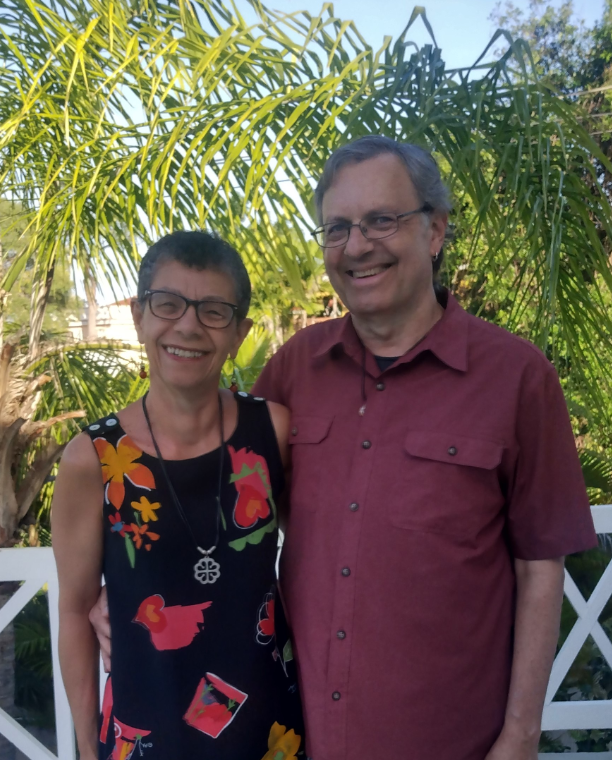
Marcia & J. Richard Middleton
Dr. J. Richard Middleton, a Jamaican American Canadian who joined Global Scholars Canada in 2025, is an eminent scholar on Christian worldview. Together with Brian Walsh, he co-wrote the bestselling The Transforming Vision (1984) that practically popularized the concept of a biblical worldview to Christian circles. Currently, Richard is rewriting that seminal work, on his own, with the tentative title of Dancing in the Dragon’s Jaws: The Bible’s Liberating Worldview.
Recently, I had the privilege and pleasure of conversing over video and subsequent emails with Richard about this book project. Below is a co-edited version (by Richard and me) of the main questions of our communications.
SC: Currently, the concept of a biblical worldview is very common among Christians. Do you think Christian faculty and graduate students still need to learn about a biblical worldview?
Yes, for two reasons. First, the concept of a biblical worldview has often been distorted in Christian circles, especially among Evangelicals. It has been reduced to a package of ideas, which Christians are supposed to link somehow to their field of study or research. It becomes almost an entirely cerebral affair that does not seem to affect the whole person. Christian philosopher Jamie Smith, for example, often avoids worldview terminology for this reason as it is often reduced to a rationalistic concept.
Beyond that, the actual content of what is often portrayed as a biblical worldview isn’t really what is taught in Scripture; the term “biblical” is used by many Christians as shorthand for what we think is right, which is often a set of so-called “absolutes.” I want to help educate the Christian community about the genuine biblical vision of life, which is empowering for our life and has implications for the vocation of Christian scholars.
I envision the biblical worldview as a river in which we are invited to swim. We get carried along by the current, which is the biblical story as told in Scripture, taught by the church, embodied in Christian worship, and in which we participate as a Christian community. All of this shapes us to be a certain kind of people; it is formative spirituality, a mode of Christian discipleship.
I like to use the quote from The Karate Kid (1984) movie to illustrate how learning a Christian worldview is an immersive experience. There is one scene where Mr. Miyagi asks the boy, Daniel, “You learn Karate from book?” That’s what Daniel was trying to do, whereas Mr. Miyagi learned karate by doing it experientially, in real life. Likewise, I tell my students that they can’t learn a Christian worldview from a course.
Don’t get me wrong: serious immersion in Scripture and intellectual grappling with ideas are important (they have been crucial for me) and I hope that my courses on a Christian worldview were helpful in guiding my students towards a deeper understanding of biblical faith. But a worldview is not a set of ideas. It is a lived vision, a whole-person orientation to the world.
When we indwell the biblical worldview and allow ourselves to be shaped by its values, we are able to engage the world and our specific fields of study as whole persons. We begin to ask questions of our discipline and to see things that others may not see. For example, during my MA studies at the U of Guelph, I was asking all sorts of questions in my philosophy classes, which got my professors’ attention. The kind of questions I asked were born out of my whole orientation to life (not just ideas), which was shaped by the biblical worldview.
SC: Why do you still wish to keep using the term “worldview” when it has been so distorted and when so many other Christian thinkers have tried to use different terms?
I don’t want those who have distorted the term to “win,” so to speak. They should not get to own the term they have distorted. The concept of worldview did not originate with Evangelicalism or even in theology. It was in circulation in other fields before Christians took hold of it. In fact, it is still being used in sociology and psychology in its original sense, as a preconceptual framework of meaning that orients people to the world. Just because Evangelicals have distorted and abused the concept does not mean that everyone else must abandon it. I want to reclaim its original sense.
SC: In your upcoming Dancing in the Dragon’s Jaws book, you plan to include an analysis of our current “postmodern” tribalism. Can you elaborate a little on that?
Sure. Almost all premodern cultures have affirmed that there is some standard of truth or reality outside of us to which we should conform in order to live a good life. In the modern period people continued to affirm this but introduced the idea of human autonomy into the mix.
As a Christian, I certainly affirm that there are universal truths – non-negotiable truths as theologian John Stott calls them – and these truths are external to us human beings, which we can, in our fallible and limited ways, understand to some degree. I also believe that Scripture affirms the reality of human agency. In the Bible, we see that God takes us seriously as human subjects, empowering us to represent him as his image in the world and responding to our prayers, both on behalf of ourselves and others.
But modernity has distorted human agency into autonomy, thinking that we decide, ultimately, what the non-negotiable truths are. But this is untenable. It is obvious that human autonomy has not led to any agreement about what is universally true. I have come to think of modernity as an unstable hybrid of the claim to universal truths with the belief that these truths are in some sense grounded in (or discoverable through) autonomous human reason.
This instability has led to the postmodern crisis, where people have given up on the belief in universal truth, though they have continued to affirm (even emphasize) human autonomy. If we no longer share truths in common, but each of us autonomously decides our own truths, then we devolve into a “post-truth” culture.
But people aren’t isolated individuals. We end up banding together with those who share our views into a “tribe”. Postmodern tribalism is almost reverting back to paganism – the sort we find in pre-Jewish and pre-Christian times – when tribes clash with other tribes for ideological and political dominance.
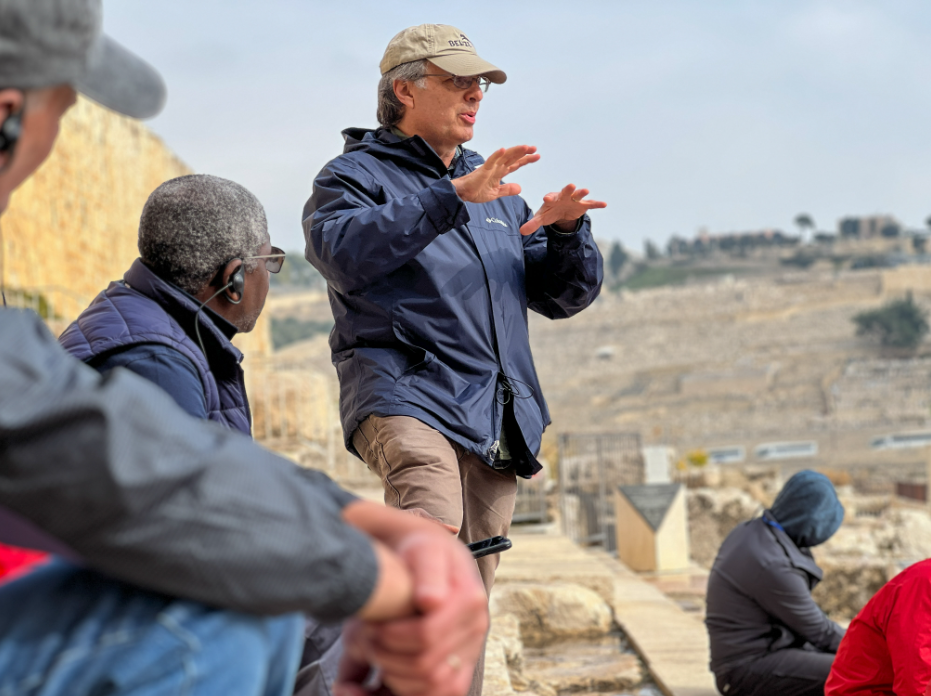
Richard, teaching on the Temple Mount steps
When Christians distort their worldview into a re-packaged set of absolute truths they only feed into this postmodern tribalism. They become another tribe, who believe that a certain set of ideas are absolute truths from God, which often results in seeing anyone who disagrees with the tribe as evil and demonic. It closes off dialogue. Instead of the biblical worldview opening you up to others, to share God’s love, you end up using a supposedly “biblical” worldview to shut others down and defend yourself against the other tribes.
SC: You also plan to add two chapters in the rewrite that addresses a Christian approach to suffering and the biblical pattern of discipleship respectively. Why focus on suffering and discipleship?
The theology I learned growing up in the church had a low view of humanity and did not value God’s creation. It was, therefore, transformative for my spiritual life when I discovered the biblical vision of God’s desire to redeem creation, instead of destroying it. God’s intent to bring shalom with peace and justice to this world gives Christians a much more positive and hopeful view of the ultimate end, the value of creation and of our human lives.
However, this begs the question: if it is God’s plan to redeem creation, why hasn’t God done it yet? Why are we still facing all sorts of injustice and challenges? Why is the redemption of all things seem so far off? Why are we still suffering as we live “between the times”?
That is why I think it is important to look at the concept of suffering in Scripture. And when you do that, you will find that God cares about the suffering of his creatures, so much that he became one of us in the incarnation to suffer on our behalf. And God listens to our laments that come from our experience of suffering.
Suffering is also part of the pattern of discipleship in the New Testament. Jesus said, “Whoever wants to be my disciple must deny themselves and take up their cross daily and follow me.” (Luke 9:23 NIV) Taking up the cross involves suffering for the sake of Christ. Similarly, the apostle Paul talks about sharing in Christ’s sufferings: “Now if we are children, then we are heirs—heirs of God and co-heirs with Christ, if indeed we share in his sufferings in order that we may also share in his glory.” (Rom. 8:17 NIV) And again: “For just as we share abundantly in the sufferings of Christ, so also our comfort abounds through Christ.” (2 Cor. 1:5 NIV)
This is why I think we need to have a Christian approach to suffering and to understand the biblical pattern of discipleship. This honest recognition of suffering in Scripture shows that the authentic biblical worldview isn’t just a rationalistic package of ideas but is grounded in the reality of the world as we know it.
SC: What do you plan to do with your fresh teaching on Christian worldview, especially with regards to your work with Global Scholars Canada?
The first thing I’m doing, as already mentioned, is writing an updated version of The Transforming Vision, my very first book, which was an attempt to introduce a Christian worldview to a wider public. At the time, I was a graduate student and campus minister at the University of Guelph. Since then, I’ve expanded (and deepened) my understanding of the Bible’s theology, so the new book will reflect that.
Another change will be in what you might call contextualization; I want to continue breaking down our unbiblical dualism, our separation of faith and the sacred from the rest of life (including our academic work), but I’m also writing the new book with an eye to the relevance of the Bible’s vision for our contemporary culture of postmodern tribalism.
Beyond writing, I hope to work closely with Global Scholars Canada to discern how best to use my gifts of teaching and mentoring. I particularly want to help Christian academics discern their calling to participate in God’s purposes for the redemption of earthly life. Given my primary expertise as a biblical scholar, my mission with GSC is to raise the level of biblical literacy among Christian academics through immersion in serious study of the Scriptures. I would love to see Christian academics inspired by the relevance of the Bible’s worldview for all they do, both on the job and in the rest of their life.
If you want to hear more about what I mean by a Christian “worldview,” check out “Reclaiming the Christian Worldview | J. Richard Middleton,” an interview from September 2025 on the UpWords podcast of Upper House (a Christian study center at the University of Wisconsin-Madison).
For those interested, I have posted my own reflections on joining Global Scholars Canada.
This is a short piece introducing me to the GSC community, written by Peter Schuurman, the director of Global Scholars Canada.


