Portrait of a Disgruntled Prophet

I have just submitted the completed manuscript of my book on the story of Samuel (the prophet) and Saul (Israel’s first king) to the publisher (Eerdmans). It covers 1 Samuel 1–15, with a coda on the anointing of David at the start of chapter 16 (which is Samuel’s last significant act).

When I signed the contract, my original title was Portrait of the Prophet as a Crotchety Old Man (a take-off on A Portrait of the Artist as a Young Man by James Joyce). But as I’ve reflected on this, and tested that title with others, I’ve come to realize that it’s a bit off-putting. Almost everyone I spoke to preferred (and actually liked) the newer title I proposed: Portrait of a Disgruntled Prophet: Samuel’s Resistance to God and the Undoing of Saul.

The title the editorial team at Eerdmans came up with is close enough and communicates well the thrust of the book: The official title (as of September 8, 2026) is Samuel and the Undoing of Saul: How a Disgruntled Prophet Resisted God.

The Book Came from My Teaching

The book has a long history.

I started working on 1 and 2 Samuel soon after I began my full-time tenure-track faculty career. I initially taught graduate seminar courses on Samuel at Colgate Rochester Crozer Divinity School (1997–2001) and then advanced undergraduate seminars at Roberts Wesleyan University (2002–2011). These seminars were amazing learning experiences both for me and my students; my students were especially helpful in raising ethical questions about the characterization of God, Samuel, Saul, and David in the text.

In more recent years (since 2011) I taught a more focused exegesis course on 1 Samuel at Northeastern Seminary, where we were able to slow down even more to attend to the details of the text. I was thus able to further develop my understanding of Samuel’s role in the demise of Saul.

I wrote a couple of chapters on the Hannah story (1 Samuel 1–2) long ago (while I was teaching at Colgate Rochester); then I published some essays on 1 Samuel, which were expansions of paper presentations I gave at conferences. Some sections of these essays have found their way into the book.

A Long Time Coming

But I got more serious about the writing when I signed a contract with Eerdmans back in 2016. An Eerdmans acquisitions editor approached me at the 2015 Society of Biblical Literature annual meeting to ask if there was a book I would like to write for them. So I submitted the proposal and got the contract.

Initially, I thought (very optimistically) that I could finish the book in a few years (I suggested 2019). However, I had just signed a contract with Baker Academic (in 2015) to write the book that eventually became Abraham’s Silence (published in 2021). That, plus the busyness of teaching (and some health problems in 2023), significantly delayed the Samuel book.

When I retired from my faculty position at Northeastern Seminary in 2024, I really got down to writing. I completed the bulk of the book in the past two years.

Did I Write a Commentary?

I hadn’t planned on writing a commentary, but rather a thematic study of the Samuel-Saul struggle, which took the reader through the flow of the book. I guess I thought of it as a quasi-commentary.

They say that a good sculptor doesn’t impose his or her predetermined idea on the stone, but needs to follow the contours of the material as they work. That was my experience as I worked through 1 Samuel.

Once I got into the writing, I found many fascinating details of the text that cried out for interpretation, details that many commentaries jumped over or treated in a very cursory way. By following the text more carefully, I was able to deepen my initial intuitions about the power struggle between Samuel and Saul (and Samuel and God) in ways I had not anticipated.

The book ended up being longer than I had anticipated. My wrestling with the text of Samuel led me to double the length of what I had originally thought would be a short 60,000 word manuscript (though it’s still shorter than my book A New Heaven and a New Earth).

One of the last things I wrote before I submitted the manuscript to Eerdmans was a semi-humorous dialogue at the start of my Preface, which you can read here (let’s see if the publisher allows me to keep it).

That dialogue was inspired by the Prologue to Robert Farrar Capon, An Offering of Uncles: The Priesthood of Adam and the Shape of the World (New York: Sheed and Ward, 1967).

Table of Contents

The book has seventeen chapters, plus an Introduction (on my approach to interpreting 1 Samuel) and a Conclusion (on evaluating the character of Samuel). You can download the Table of Contents here.

Preface

Introduction: A Proposal for Reading Samuel

Part 1: Overture to Conflict: A Preview of Things to Come (1 Samuel 1–3)

  1. Hannah’s Resolve and the Birth of Samuel: A New Era in Israel’s History
  2. Hannah’s Vow and Victory Song: A Challenge to Israel’s Leaders
  3. From Promised Priest to Newly-Minted Prophet: Clues to God’s Role in the Story

Part 2: Interlude before Conflict: The Ark Narrative as Preemptive Warning (1 Samuel 4–6)

  1. “Why Has YHWH Defeated Us Today before the Philistines?”: The Ark in Israel’s Theology
  2. The Ark of the Covenant Is “Taken”: Philistine and Israelite Responses to the Ark
  3. “Who Can Stand before YHWH, This Holy God?”: The Return the Ark

Part 3: The Conflict Begins: Samuel Asserts His Priorities (1 Samuel 7–11)

  1. Samuel on the Cusp: The Prophet’s Finest Hour
  2. The People Request a King: A Rift Begins to Open between Samuel and God
  3. Saul Loses His Way and Finds Samuel: Prelude to Kingship
  4. The Secret Anointing: Saul is (Almost) King
  5. Saul is Publicly Acclaimed King—at Mizpah and Gilgal

Part 4: The Conflict Intensifies: Samuel Clashes with Saul (1 Samuel 12–14)

  1. Samuel’s “Farewell Speech”: The Sin of Monarchy
  2. The Beginning of Saul’s Undoing: Whose/Which Command Did He Disobey?
  3. The Fallout for Jonathan: Saul’s Oath as Overreaction

Part 5: The Climax of the Conflict: Samuel and God Part Ways (1 Samuel 15–16)

  1. Failure and Rejection at Gilgal: Saul’s Confrontation with Samuel
  2. The Question of God’s “Repentance”: Samuel’s Disagreement with YHWH
  3. Prophet on a Short Leash: Irony in Samuel’s Anointing of David

Conclusion: How Should We Judge Samuel?

Stay Tuned

I plan to post updates on the publication of the book, including various tidbits of interesting things I learned or noticed about the story as I worked on the writing. This will include things like:

Why does God shift from his promise to provide a new priest (1 Samuel 2:35) to provide a prophet instead (1 Samuel 3:19)?

Why is the title for the Ark in 1 Samuel 4:4 (“the Ark of the Covenant of YHWH of Hosts […] the Cherubim”) missing a Hebrew preposition where you would expect one (so translators have to insert what they think is appropriate)?

Why does Samuel consistently disobey God’s instructions after the people ask for a king in 1 Samuel 8?

Where is the first place in the narrative when Samuel actually obeys an instruction or command from God?

What is going on with the seemingly garbled chronological note about Saul’s reign in 1 Samuel 13:1?

How should we understand Samuel’s contradictory instructions to the newly anointed King Saul in 1 Samuel 10:7–8 (especially given the multitude of interpretations proposed)?

What sin was Saul actually condemned for in 1 Samuel 13:13–14?

And lots more to come . . .

Was Abraham a Good Example? (Scot McKnight’s Blog Post on Abraham’s Silence)

New Testament scholar Scot McKnight wrote a blog post on my book Abraham’s Silence: The Binding of Isaac, the Suffering of Job, and How to Talk Back to God (Baker Academic, 2021). The post doesn’t cover the entire argument of the book; it focuses on the concluding section that addresses the Aqedah or Binding of Isaac (Genesis 22). The blog was posted this morning.

Scot also interviewed me about Abraham’s Silence for his Kingdom Roots podcast; we covered a bit more of the book in the interview, including my motivation for writing it and why lament or protest prayer is important in the Bible and the Christian life. I’ll post a notification when the podcast is available.

________________________________________________

“Was Abraham a Good Example?”

Scot McKnight — February 3, 2022

Gen. 22:1   After these things God tested Abraham. He said to him, “Abraham!” And he said, “Here I am.” 2 He said, “Take your son, your only son Isaac, whom you love, and go to the land of Moriah, and offer him there as a burnt offering on one of the mountains that I shall show you.” 3 So Abraham rose early in the morning, saddled his donkey, and took two of his young men with him, and his son Isaac; he cut the wood for the burnt offering, and set out and went to the place in the distance that God had shown him.

The challenge is for the reader and can be asked in a question:

Why the silence? (In those italicized words.)

 Why no protest?

 Protesting and lamenting sin and injustice are thoroughly biblical. Why the silence?

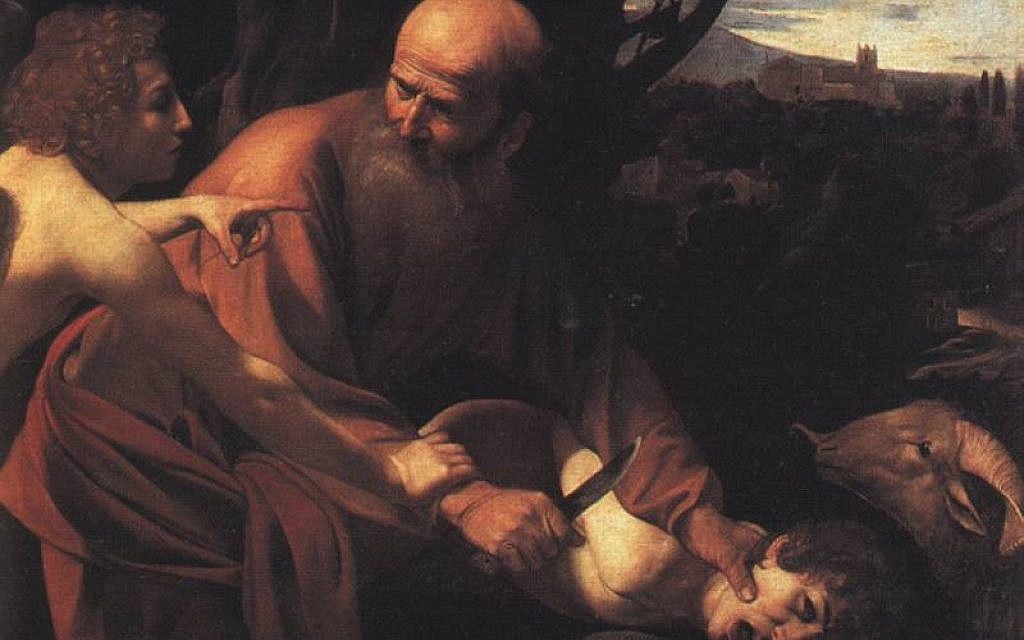
Picture Source: https://en.wikipedia.org/wiki/Binding_of_Isaac#/media/File:Sacrifice_of_Isaac-Caravaggio_(Uffizi).jpg

So many gaps in Genesis 22. So many questions. Our imaginations are stimulated to the highest levels in reading this chapter. Intentionally so.

Long ago I learned from reading Meir Sternberg and Robert Alter to ask about the textual gaps in such texts, and J. Richard Middleton explores all the gaps in Abraham’s Silence.

The details are so many that only a sketch can be given here. What I want to do is give you the big ideas of what Middleton thinks of the silence of Abraham.

In this text it is “God” (Elohim) not YHWH who tested Abraham. This is unusual, and could be a distancing expression. A messenger of YHWH, however, stops the sacrificial act (cf. Gen 22:1, 11). Why the change?

Isaac’s relationship to Abraham, or vice versa, is plumbed at length in this book: in essence, he thinks their relationship is dysfunctional as measured by the textual details. They do not talk on the way there; and Isaac all but disappears after this event; he does not come down the mountain and does not accompany Abraham back. Isaac’s not given a separable story in Genesis that we do find with Abraham, Jacob, and Joseph. Middleton suggests Abraham favored Ishmael over Isaac; he thinks Isaac picks up the idea that God is the One to be feared (all this comes from his careful reading of the text). And “whom you love” he thinks could be translated “You love him, don’t you?”

Perhaps most provocatively, Middleton thinks God is testing Abraham about whether he loves this special son Isaac.

Is Abraham’s silence exemplary?

Abraham’s narrative arc in Genesis: What view of God did Abraham have? In Genesis 18 Abraham whittles it down to 10 survivors but Middleton thinks he does this in a way that does not plumb the depth of God’s mercy, love, and grace.

Middleton sees problems in the traditional reading: (1) How is this a model for commitment? (2) Why did Abraham need to happen? There is no clear evidence of a special relationship of Abraham and Isaac.

Middleton thinks Abraham is being given an opportunity to prove his love for his son. He could have spoken up but he is silent. Then Isaac all but disappears. Even more, Abraham is being tested about his perception of God’s own character. Isaac ups the ante from Lot to Abraham’s own son. Abraham is silent.

Isaac learns not that God is a God of grace and mercy but one to be feared. Notice “the God of Abraham and the Fear of Isaac” (31:42).  Isaac is distanced from his father from this point on; Sarah, too, is never close to Abraham – perhaps not even living with him – from this point on.  It is a “broken family.” It was not Abraham who stopped the knife but an angel sent by the covenant God.

A big challenge to Middleton’s view are the words of the angel that seem to confirm Abraham as exemplary (not to ignore the positive view of Abraham’s Aqedah in much of Judaism and the NT). He probes how to see these words.

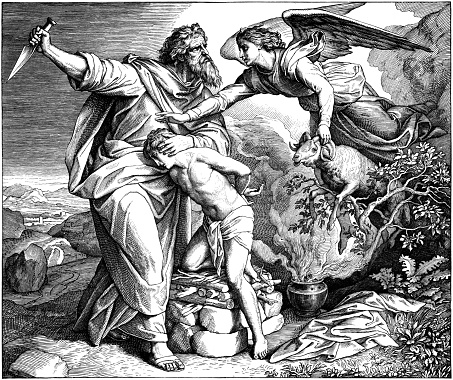
“By myself I have sworn”: God steps in because Abraham’s response was not as complete as it could have been. He thinks the ram was behind Abraham and, quite provocatively, he is not convinced Abraham had embraced the idea of God providing a ram instead of his son.

A sketch, for sure, without all the details, but you can get the big ideas from the above.

Middleton thinks Abraham did not in fact pass the test of Genesis 22. He could have protested for his son and his love for his son; he could have interceded; he could have had a more robust faith in God’s provision; he thinks he “just barely passed the test” of God’s character.

https://scotmcknight.substack.com/p/was-abraham-a-good-example

Reconfiguring Abraham’s Test—What Is the Aqedah (Genesis 22) Really About?

In four previous blog posts, I summed up various aspects of the argument of my new book Abraham’s Silence: The Binding of Isaac, the Suffering of Job, and How to Talk Back to God.

My Blog Posts on the Argument of Abraham’s Silence

1.  Abraham’s Silence—Why Genesis 22 Has Been a Puzzle to Me

2. The Importance of Lament for Understanding Genesis 22

3. The Contrast between Job and Abraham—From Vigorous Protest to Unquestioning Silence

4. Abraham’s Shift from Protest (Genesis 18) to Silence (Genesis 22)—What’s Going on?

This post is the fifth in that series.

Here I want to address—head on—the question of what the test in Genesis 22 is all about.

Does Abraham Love God More than His Son?

It is traditional to think that Abraham is being tested to see if he loves God more than Isaac, his son.

However, a careful reading of Genesis reveals that while Abraham loves Ishmael (his first son, born of Hagar), it is doubtful that he cares at all about Isaac (the covenant heir that God promises will be born to Sarah).

Evidence for this is that he passes Sarah off as his sister after God announced the coming birth of Isaac (while Sarah is likely pregnant with him). The result is that the Philistine king of Gerar takes Sarah into his harem (Genesis 20), so that God has to rescue her.

Abraham Is Being Tested for His Discernment of God’s Character

A better interpretation of what is going on in Genesis 22 is that God is testing Abraham for his discernment of God’s character. Is this the sort of deity who demands child sacrifice on the part of his faithful followers? Or is this a God of mercy? After all, Abraham is a man from a pagan culture (Mesopotamia) with no prior knowledge of this God.

This question of merciful character was also the point of the episode in Genesis 18, where God revealed his plans to Abraham about Sodom. The point was so that Abraham could learn about YHWH’s “way” of righteousness and justice, in order to be able to pass this on to his household and descendants (Genesis 18:17–19).

And God revelation to Abraham about the cry of Sodom did lead to Abraham’s passionate intercession on behalf of the city, because Lot (his nephew) was living there.

But (as I discussed in the previous blog post) Abraham stops his request for God to save Sodom too early. And so he never fully plumbs the depths of God’s mercy.

So God gives him another chance in Genesis 22. But this time it won’t be his nephew Lot (who lives in Sodom) who is in danger; it will be Isaac, his own son. And it won’t be God who will do the act; Abraham himself will do it.

If anything would cause Abraham to speak out, this would be it.

God’s command for Abraham to sacrifice his own son ought to generate protest on Abraham’s part and intercession behalf of Isaac.

But he doesn’t speak out. Instead, he goes silently to obey.

God sends him on a three day journey to a distant place (Moriah) to perform the sacrifice, intentionally giving Abraham time to think about it and gather the courage to speak out. But Abraham never gets to that point.

God Might Also Be Testing Abraham’s Love for Isaac

It is possible that there is a second dimension to the test.

Perhaps God wants Abraham to positively develop a love for Isaac. After all,  when God describes Isaac as the one “whom you love” (Genesis 22:2), this isn’t necessarily a statement of fact. It could be an encouragement, as in, “you love him, don’t you?” Then show it, by your response. Testing can bring out what is only potential, if we rise to the occasion.

Three Chapters on the Aqedah

So far I have just given the barest outline of the position I develop through three chapters in Abraham’s Silence. There is a great deal in those chapters that I haven’t even touched on in the above sketch.

For example, I have one chapter specifically devoted to the question of whether it is right to question the traditional interpretation of the Aqedah and whether it is appropriate to question God (since my alternative reading of the Aqedah is that Abraham should have questioned God’s command to sacrifice his son). This is the burden of chapter 5: “Is It Permissible to Criticize Abraham or God?”

Then I have an entire chapter examining clues in the text of Genesis 22 that all is not right with Abraham or with Isaac in the story. And then I examine connections between the Aqedah and the book of Job, which suggest that Job leads to a critique of Abraham’s response to God in Genesis 22. This is chapter 6: “Reading Rhetorical Signals in the Aqedah and Job.” 

Chapter 7 is the climax of the argument, where I explicitly address the question: “Did Abraham Pass the Test?” Beyond looking at the earlier Abraham story as context for Genesis 22, I examine the effect of the test on Isaac (including evidence in Genesis of trauma he suffered).

In this chapter I also take a look at what most readers think is God’s affirmation of Abraham through the speeches of the angel from heaven (Genesis 22:11–18). By careful attention to what the angel says, I show that it is entirely possible that God is actually showing his displeasure with Abraham.

I’m aware that this claim will seem incredible to most readers of this blog post. But I won’t defend it here.

For that, you will need to read the book.