Redeeming the Biblical Worldview: Q & A with J. Richard Middleton

I was recently interviewed by Shiao Chong (he goes by Chong), Associate Director of Global Scholars Canada (GSC). I came on board as a scholar with GSC at the end of 2025, with a mandate to help Christian academics in public universities in Canada and beyond reflect more deeply on their calling as Christians, in relationship to their teaching, scholarship, and institutional participation.

Since the idea of a Christian (or “biblical”) worldview, which I have been promoting over the years, is at odds with the way this term has come to be used among many Evangelical Christians, Chong focused the interview on why I want to retain this terminology.

What follows is Chong’s introduction, followed by the interview, which is published on the Global Scholars Canada website.
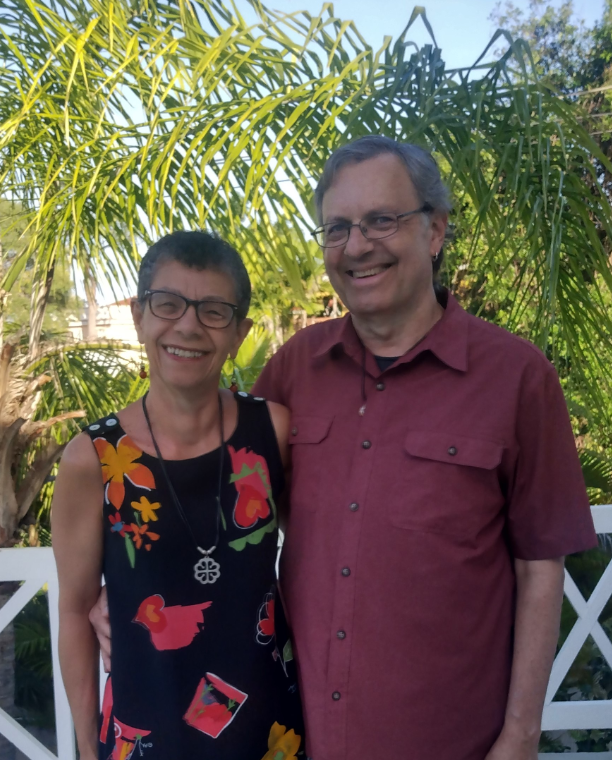

Marcia & J. Richard Middleton

Dr. J. Richard Middleton, a Jamaican American Canadian who joined Global Scholars Canada in 2025, is an eminent scholar on Christian worldview. Together with Brian Walsh, he co-wrote the bestselling The Transforming Vision (1984) that practically popularized the concept of a biblical worldview to Christian circles. Currently, Richard is rewriting that seminal work, on his own, with the tentative title of Dancing in the Dragon’s Jaws: The Bible’s Liberating Worldview.

Recently, I had the privilege and pleasure of conversing over video and subsequent emails with Richard about this book project. Below is a co-edited version (by Richard and me) of the main questions of our communications.

SC: Currently, the concept of a biblical worldview is very common among Christians. Do you think Christian faculty and graduate students still need to learn about a biblical worldview?

Yes, for two reasons. First, the concept of a biblical worldview has often been distorted in Christian circles, especially among Evangelicals. It has been reduced to a package of ideas, which Christians are supposed to link somehow to their field of study or research. It becomes almost an entirely cerebral affair that does not seem to affect the whole person. Christian philosopher Jamie Smith, for example, often avoids worldview terminology for this reason as it is often reduced to a rationalistic concept.

Beyond that, the actual content of what is often portrayed as a biblical worldview isn’t really what is taught in Scripture; the term “biblical” is used by many Christians as shorthand for what we think is right, which is often a set of so-called “absolutes.” I want to help educate the Christian community about the genuine biblical vision of life, which is empowering for our life and has implications for the vocation of Christian scholars.

I envision the biblical worldview as a river in which we are invited to swim. We get carried along by the current, which is the biblical story as told in Scripture, taught by the church, embodied in Christian worship, and in which we participate as a Christian community. All of this shapes us to be a certain kind of people; it is formative spirituality, a mode of Christian discipleship.

I like to use the quote from The Karate Kid (1984) movie to illustrate how learning a Christian worldview is an immersive experience. There is one scene where Mr. Miyagi asks the boy, Daniel, “You learn Karate from book?” That’s what Daniel was trying to do, whereas Mr. Miyagi learned karate by doing it experientially, in real life. Likewise, I tell my students that they can’t learn a Christian worldview from a course.

Don’t get me wrong: serious immersion in Scripture and intellectual grappling with ideas are important (they have been crucial for me) and I hope that my courses on a Christian worldview were helpful in guiding my students towards a deeper understanding of biblical faith. But a worldview is not a set of ideas. It is a lived vision, a whole-person orientation to the world.

When we indwell the biblical worldview and allow ourselves to be shaped by its values, we are able to engage the world and our specific fields of study as whole persons. We begin to ask questions of our discipline and to see things that others may not see. For example, during my MA studies at the U of Guelph, I was asking all sorts of questions in my philosophy classes, which got my professors’ attention. The kind of questions I asked were born out of my whole orientation to life (not just ideas), which was shaped by the biblical worldview.

SC: Why do you still wish to keep using the term “worldview” when it has been so distorted and when so many other Christian thinkers have tried to use different terms?

I don’t want those who have distorted the term to “win,” so to speak. They should not get to own the term they have distorted. The concept of worldview did not originate with Evangelicalism or even in theology. It was in circulation in other fields before Christians took hold of it. In fact, it is still being used in sociology and psychology in its original sense, as a preconceptual framework of meaning that orients people to the world. Just because Evangelicals have distorted and abused the concept does not mean that everyone else must abandon it. I want to reclaim its original sense.

SC: In your upcoming Dancing in the Dragon’s Jaws book, you plan to include an analysis of our current “postmodern” tribalism. Can you elaborate a little on that?

Sure. Almost all premodern cultures have affirmed that there is some standard of truth or reality outside of us to which we should conform in order to live a good life. In the modern period people continued to affirm this but introduced the idea of human autonomy into the mix.

As a Christian, I certainly affirm that there are universal truths – non-negotiable truths as theologian John Stott calls them – and these truths are external to us human beings, which we can, in our fallible and limited ways, understand to some degree. I also believe that Scripture affirms the reality of human agency. In the Bible, we see that God takes us seriously as human subjects, empowering us to represent him as his image in the world and responding to our prayers, both on behalf of ourselves and others.

But modernity has distorted human agency into autonomy, thinking that we decide, ultimately, what the non-negotiable truths are. But this is untenable. It is obvious that human autonomy has not led to any agreement about what is universally true. I have come to think of modernity as an unstable hybrid of the claim to universal truths with the belief that these truths are in some sense grounded in (or discoverable through) autonomous human reason.

This instability has led to the postmodern crisis, where people have given up on the belief in universal truth, though they have continued to affirm (even emphasize) human autonomy. If we no longer share truths in common, but each of us autonomously decides our own truths, then we devolve into a “post-truth” culture.

But people aren’t isolated individuals. We end up banding together with those who share our views into a “tribe”. Postmodern tribalism is almost reverting back to paganism – the sort we find in pre-Jewish and pre-Christian times – when tribes clash with other tribes for ideological and political dominance.
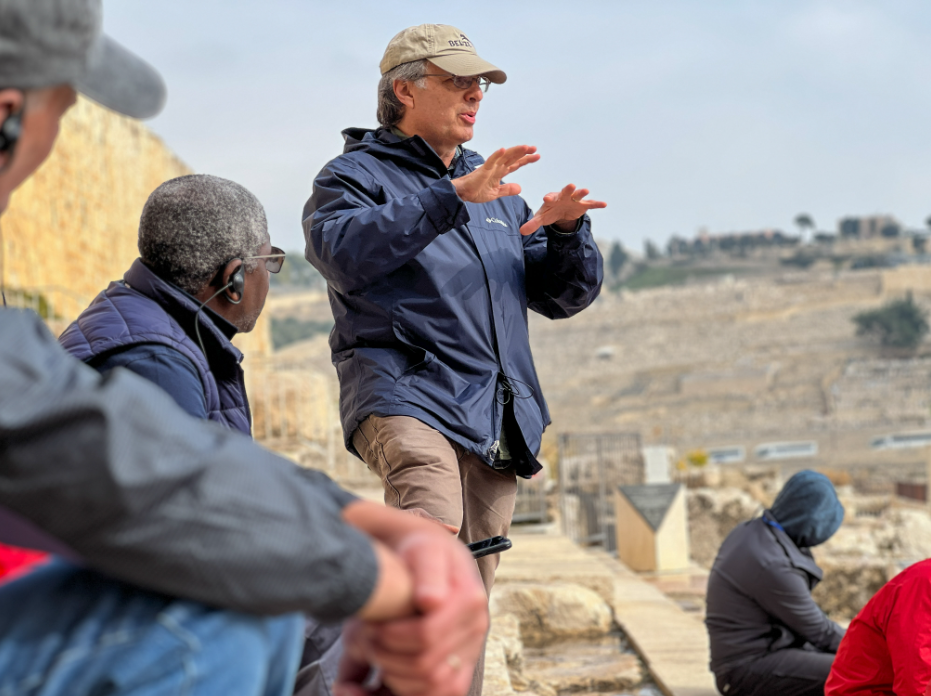
Richard, teaching on the Temple Mount steps

When Christians distort their worldview into a re-packaged set of absolute truths they only feed into this postmodern tribalism. They become another tribe, who believe that a certain set of ideas are absolute truths from God, which often results in seeing anyone who disagrees with the tribe as evil and demonic. It closes off dialogue. Instead of the biblical worldview opening you up to others, to share God’s love, you end up using a supposedly “biblical” worldview to shut others down and defend yourself against the other tribes.

SC: You also plan to add two chapters in the rewrite that addresses a Christian approach to suffering and the biblical pattern of discipleship respectively. Why focus on suffering and discipleship?

The theology I learned growing up in the church had a low view of humanity and did not value God’s creation. It was, therefore, transformative for my spiritual life when I discovered the biblical vision of God’s desire to redeem creation, instead of destroying it. God’s intent to bring shalom with peace and justice to this world gives Christians a much more positive and hopeful view of the ultimate end, the value of creation and of our human lives.

However, this begs the question: if it is God’s plan to redeem creation, why hasn’t God done it yet? Why are we still facing all sorts of injustice and challenges? Why is the redemption of all things seem so far off? Why are we still suffering as we live “between the times”?

That is why I think it is important to look at the concept of suffering in Scripture. And when you do that, you will find that God cares about the suffering of his creatures, so much that he became one of us in the incarnation to suffer on our behalf. And God listens to our laments that come from our experience of suffering.

Suffering is also part of the pattern of discipleship in the New Testament. Jesus said, “Whoever wants to be my disciple must deny themselves and take up their cross daily and follow me.” (Luke 9:23 NIV) Taking up the cross involves suffering for the sake of Christ. Similarly, the apostle Paul talks about sharing in Christ’s sufferings: “Now if we are children, then we are heirs—heirs of God and co-heirs with Christ, if indeed we share in his sufferings in order that we may also share in his glory.” (Rom. 8:17 NIV) And again: “For just as we share abundantly in the sufferings of Christ, so also our comfort abounds through Christ.” (2 Cor. 1:5 NIV)

This is why I think we need to have a Christian approach to suffering and to understand the biblical pattern of discipleship. This honest recognition of suffering in Scripture shows that the authentic biblical worldview isn’t just a rationalistic package of ideas but is grounded in the reality of the world as we know it.

SC: What do you plan to do with your fresh teaching on Christian worldview, especially with regards to your work with Global Scholars Canada?

The first thing I’m doing, as already mentioned, is writing an updated version of The Transforming Vision, my very first book, which was an attempt to introduce a Christian worldview to a wider public. At the time, I was a graduate student and campus minister at the University of Guelph. Since then, I’ve expanded (and deepened) my understanding of the Bible’s theology, so the new book will reflect that.

Another change will be in what you might call contextualization; I want to continue breaking down our unbiblical dualism, our separation of faith and the sacred from the rest of life (including our academic work), but I’m also writing the new book with an eye to the relevance of the Bible’s vision for our contemporary culture of postmodern tribalism.

Beyond writing, I hope to work closely with Global Scholars Canada to discern how best to use my gifts of teaching and mentoring. I particularly want to help Christian academics discern their calling to participate in God’s purposes for the redemption of earthly life. Given my primary expertise as a biblical scholar, my mission with GSC is to raise the level of biblical literacy among Christian academics through immersion in serious study of the Scriptures. I would love to see Christian academics inspired by the relevance of the Bible’s worldview for all they do, both on the job and in the rest of their life.


If you want to hear more about what I mean by a Christian “worldview,” check out “Reclaiming the Christian Worldview | J. Richard Middleton,” an interview from September 2025 on the UpWords podcast of Upper House (a Christian study center at the University of Wisconsin-Madison).

For those interested, I have posted my own reflections on joining Global Scholars Canada.

This is a short piece introducing me to the GSC community, written by Peter Schuurman, the director of Global Scholars Canada.

The Messianic Mission of Jesus (The Kingdom of God, part 5)

This is the fifth installment of an article on the Kingdom of God.

Part 1 began with Jesus’s proclamation at the start of his ministry about the kingdom of God. Part 2 looked at Jesus’s sermon at Nazareth, in which he explained the nature of the kingdom he was inaugurating.

Part 3 shifted to the biblical backstory of the kingdom, beginning with the royal calling of humanity created to image God, including how we squandered our calling through sin and violence, culminating in the tower of Babel. Part 4 traced the story of Israel from Abraham to the Babylonian exile, with a focus on the theme of “rule” (power and agency).

Against the backdrop of the kingdom of God in the Old Testament, the current installment picks up the story with the ministry and mission of Jesus, leading to his confrontation with the powers in Jerusalem at Passover.

The Rise of Messianic Expectation

Israelite prophets during and after the Babylonian exile began to articulate an expectation of renewal for God’s people, which intensified as the first century approached. God was going to bring about a new age of righteousness and justice for Israel and for the entire world.

As the Isaiah passage Jesus quoted at Nazareth made clear (see part 2 of this multi-part blog post), the prophetic vision of social and personal healing that arose in the exile remained unfulfilled even after Israel was back in the land. Isaiah 58 and 61 both addressed the moral state of the people, which had not changed; they continued to be embroiled in sin and disobedience to God. So beyond the bare fact of return to the land, the rest of the prophets’ vision of restoration had not yet come to pass.

It was this lack of fulfillment that generated messianic hope in the centuries leading up to the New Testament. The term Messiah (lit. anointed one) is derived from the fact that the kings of Israel were anointed for their leadership role (1 Samuel 9:26–10:1; 1 Samuel 16:12–13). The hope for a Messiah (a royal leader, in the lineage of David) arose out of the obvious failure of the Israelite monarchy in combination with God’s promise that the people would once again have righteous leaders.

The dominant messianic expectation was of a new Davidic king who would unify the nation and cast off Roman oppression, yet ideas about the coming Messiah were actually quite varied: would there be one or two leaders (one royal, the other priestly); would the agent of God’s coming rule be human, angelic, or divine?

Despite this variety there was a consistent expectation that one day God would establish his righteous rule both in Israel and throughout the world. The coming of this kingdom would eradicate evil and restore justice for God’s people and among all the nations. Indeed, the entire cosmos would be renewed, such that this coming age could rightly be called “a new heaven and a new earth” (Isaiah 65:17–25).

Jesus’s Confrontation with the Powers of Evil

It was this expectation for a radical reorientation of the world that set the stage for the ministry of Jesus, including his proclamation that the kingdom of God was at hand, his teaching about the kingdom (often in parables), and his embodying the kingdom in his healings, his exorcisms, and his forgiving of sins. Jesus both announced and demonstrated that the powers of evil were being overthrown, that God’s rule was coming.

But the powers of evil are never easily overthrown. Jesus encountered opposition throughout his ministry, which led to his crucifixion by a coalition of Roman and Jewish leaders, who considered him a threat to the status quo. Jesus was not, however, a passive victim of his opponents. His entire life and ministry were oriented towards this deathly confrontation.

The Messiah’s Destiny of Suffering

After three years of his public ministry, Jesus asked his disciples who they thought he was. When Peter confessed that he was “the Messiah of God” (Luke 9:20), Jesus explained that his destiny (in contrast to most messianic expectation of the time) was not immediate victory over the powers of evil. His destiny was suffering and rejection at the hands of “the elders, chief priests, and scribes,” resulting in his death—followed by resurrection (Luke 9:22; this episode is recounted in Matthew 16:21–23; Mark 8:31–33; Luke 9:21–23).

Jesus understood that the Messiah’s destiny of the ultimate triumph over evil was grounded in his suffering on behalf of his people—a theme found in what are known as the servant songs of Isaiah. These prophetic poems, in that section of the book written during the Babylonian exile (Isaiah 40–55), affirm that Israel is God’s servant (Isaiah 41:8; 49:3), whose mission is to bring light to the nations and to establish justice throughout the earth (Isaiah 42:1, 4, 6). This understanding of Israel as God’s servant draws on God’s promise that through Abraham and his descendants blessing would come to all the families of the earth (Genesis 12:1–3).

Yet in Isaiah’s servant songs, Israel is said to be a blind and deaf servant who does not understand or obey God’s purposes (Isaiah 42:19–20), This leads to a distinction between the servant and Israel in some texts; there the mission of the servant of YHWH is to bring light not only to the nations, but also to Israel (Isaiah 49:5–6).

While Isaiah 50 mentions briefly that the servant will suffer before his vindication by God (Isaiah 50:5–8), this theme is explored in depth in Isaiah 52:13–53:12, the so-called Suffering Servant song. The New Testament understands this vivid portrayal of the servant’s suffering to be fulfilled in Jesus, understood as the representative of Israel (Matthew 8:14-17; Luke 22:35–38; John 12:37–41; Acts 8:26–35; Romans 10:11–21; 1 Peter 2:19–25).

Jesus Sets Out for Jerusalem

Soon after Jesus predicted his suffering and death, he set out to meet his destiny. Perhaps alluding to Isaiah’s servant who “set [his] face like flint” to endure opposition (Isaiah 50:7), Jesus “set his face to go to Jerusalem” (Luke 9:51).

As he journeyed toward Jerusalem, stopping in other places on the way, he twice more reminded his disciples of his coming death (first in Matthew 17:22–23; Mark 9:30–32; Luke 9:43–45; then in Matthew 20:17–19; Mark 10:32–34; Luke 18:31–34); this was clearly on his mind.

In each case, his disciples found this difficult to comprehend; wouldn’t this mean the defeat of the Messiah? Even after Jesus reached Jerusalem, he again reminded them of his destiny (Matthew 26:1–2).

Jesus and the New Exodus

Not only did Jesus intentionally embrace his destiny, he chose the timing of it to coincide with the festival of Passover, when pilgrims were flocking to Jerusalem to celebrate the exodus from Egyptian bondage. But no-one in Jerusalem would have focused simply on that event in the past. Isaiah 40–55 had already viewed Babylon as a new Egypt and the return from Babylonian exile as a new exodus. The city would have been rife with expectation: would God act again to free his people from the latest incarnation of Egypt and Babylon?

Some centuries before Jesus, the Persians had conquered the Babylonian empire and allowed exiled Jews (inhabitants of Judah) to return to their homeland; so technically the exile was over. But after Babylon’s defeat, Judah (now known as Yehud) became a province of Persia, After that came the Greek empire, and finally the Romans—all of whom continued to subject the land and people of Israel to imperial domination. It would have been impossible for Jews in Jesus’s day to separate the message of the exodus of old from the need to be liberated from Roman oppression. A new exodus was called for.

Continuing Bondage and Exile

The idea that Israel was still in bondage—even after return to the land—is expressed in the anguished prayer of Ezra, the Jewish scribe and priest, during the early postexilic period:

“Here we are, slaves to this day, slaves in the land that you gave to our ancestors to enjoy its fruit and its good gifts. Its rich yield goes to the kings whom you have set over us because of our sins; they have power also over our bodies and over our livestock at their pleasure, and we are in great distress.” (Nehemiah 9:36–37; see also Ezra 9:8–9)

The Babylonian exile was over, but the bondage to foreign empires continued unabated.

The problem, however, was not simply the external oppression of empires. The internal problem of sin had to be dealt with. The prophets had declared that the Babylonian conquest and the ensuing exile was a consequence of Israel’s disobedience to God (Jeremiah 32:28–35; Isaiah 42:24–25; 43:27–28). This was a fundamental difference between Egyptian bondage (which was not attributed to Israel’s sin) and the Babylonian exile (which was).

Ezra himself combined recognition of continuing national bondage with the people’s ongoing sinfulness. “From the days of our ancestors to this day we have been deep in guilt, and for our iniquities we, our kings, and our priests have been handed over to the kings of the lands, to the sword, to captivity, to plundering, and to utter shame, as is now the case” (Ezra 9:7).

Now, even back in the land, the moral state of the people remained unchanged; their sin still had to be dealt with.

As we shall see in the next installment, the problem of Israel’s bondage was greater than either the external oppression by empires or the internal sinfulness of the people.

How My Rewrite of The Transforming Vision Will Vary from the Original

I am currently doing a total rewrite of the book on a Christian worldview that Brian Walsh and I coauthored, called The Transforming Vision: Shaping a Christian World View (Downers Grove, IL: InterVarsity Press, 1984).

The book has found a wide audience in both English and other languages (especially Korean, where it has just about outsold the English original). To date, it has been translated and published in Korean (1987), French (1988), Indonesian (2001), Spanish (2003), and Portuguese (2010); with new Korean (2013), French (2016), and Indonesian (2013, 2019) editions.

Over the years, many people who were using the book in teaching asked us for a second or revised edition, where we would update aspects of our analysis. Although the publisher did give the book a new cover, we were each too busy working on other projects to devote the time needed to a second edition.

Worldview Book and Worldview Courses

Brian and I wrote The Transforming Vision based on non-credit courses we were teaching through IVCF campus ministries at a number of Canadian universities. For a few years after the book was published, I continued teaching non-credit courses on a Christian worldview at universities in the USA and Canada as I moved around for graduate studies and university chaplaincy.

Since I began doctoral studies in 1990, and especially since I started a faculty position in the mid-nineties, I have been offering the course for credit to undergraduates and to graduate/ seminary students, while also giving papers and publishing as a biblical scholar—especially in the area of Old Testament.

Changes to the Course (and the Book)

The course has gradually changed over the years, in accordance with my expertise and context. The new version of the book will follow the content (and outline) of the course as I have been teaching it most recently (it’s a solo rewrite, since Brian hasn’t been teaching a comparable course).

Some changes have to do with Scripture, while others are aspects of what you might call contextualization, changes that reflect the cultural (and academic) contexts I have been living and teaching in.

An Expanded Exposition of the Biblical Story

First, I’ve expanded (and deepened) my understanding of biblical theology over the years, so the book will reflect that. Instead of three chapters on Scripture (in The Transforming Vision), I have eight chapters tracing the biblical story from creation to eschaton (the biblical worldview as a coherent story wasn’t explicitly addressed in the original book). Each chapter will be a theological dive into a biblical text (or set of texts) that advances the story (creation, imago Dei, fall, Israel, monarchy, prophets, Jesus, eschaton). I will draw out practical implications for Christian living from each of these “soundings” into Scripture.

An Analysis of “Postmodern” Tribalism

The second change is in my analysis of the history of western culture. I still find it helpful to begin with the otherworldly dualism that impacted the church (from the early middle ages onward) and trace the rise of the modern impulse to autonomy and conquest (over the last five hundred years). But my analysis of the crisis of modernity now includes our current “postmodern” tribalism—how modernity has devolved into the toxic “post-truth” culture we now experience.

The Contested Meaning of the “Christian/Biblical Worldview”

A third change is that I won’t start the book with much analysis of the nature of worldviews (which is how The Transforming Vision began). The new book will focus more on showing than telling. However, I plan to include an Appendix or Afterword on the problematic nature of worldview discourse among Christians. I’ll explain why I am reclaiming the terms “Christian worldview” and “biblical worldview” from those who use these terms to designate a pre-packaged absolutist system of so-called “truth,” which is often nothing more than an oppressive framework for control. In contrast, I think these terms are helpful markers for the Bible’s liberating vision, disclosed especially through its overarching narrative of God’s desire for creational flourishing and shalom.

Living between the Times

Also, I won’t have a section on the implications of Christian faith for academic disciplines. That section of The Transforming Vision came from the campus ministry context the course was developed in; that’s not been my present context. Instead, I’ll close with two chapters on “living between the times,” one addressing a Christian approach to suffering (drawing on the lament psalms) and one on the biblical pattern of discipleship (from the Gospels and Pauline epistles).

Dancing in the Dragon’s Jaws

My plan is for a fourteen-chapter book (plus Appendix/ Afterword), tentatively titled Dancing in the Dragon’s Jaws: The Bible’s Liberating Worldview. Those who know the music of Bruce Cockburn will recognize Dancing in the Dragon’s Jaws as the title of one of his albums; it is also a line in a song on the album, describing Jesus’s victory over evil: “just beyond the range of normal sight / this glittering joker was dancing in the dragon’s Jaws.”

The title is meant to capture the sense of freedom and joy that being grounded in Scripture can bring, while realistically acknowledging that our joy comes in the face of personal brokenness and systemic evil, both of which are ultimately overcome only by God’s saving action in Christ.

I decided to keep the term Worldview in the subtitle, as a gesture towards reclaiming that term as valuable and helpful; indeed, I believe that the Bible discloses a Liberating Worldview!

The word Liberating is also a nod to my book on humanity as the image of God, called The Liberating Image: The Imago Dei in Genesis 1 (Grand Rapids: Brazos, 2005). The human calling to image God is a key component in my exposition of the unfolding biblical story.

An Accessible Read

I plan to keep the reading level of the new book close to that of The Transforming Vision, so it is accessible to early undergraduates and Christian lay people (The Transforming Vision was even used in Christian high schools in Canada and the US).

If you have used The Transforming Vision in teaching or if the book has been important to you personally, please contact me. I am looking for a few key people to read portions of the draft of the new book and give me helpful feedback.