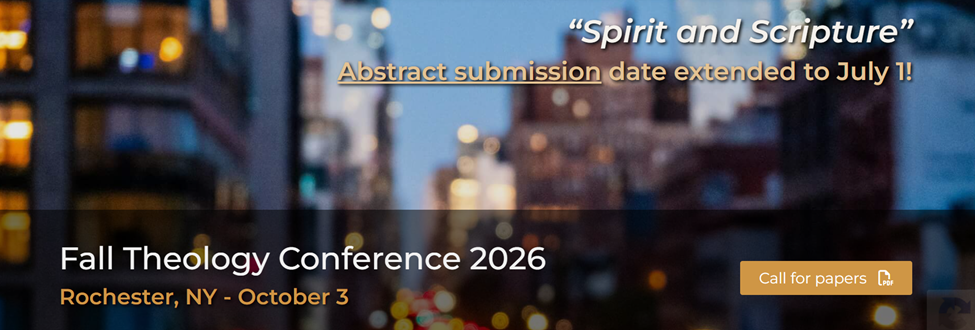
Northeastern Seminary has been hosting Fall Conferences of the Canadian-American Theological Association since October 2013 and we are looking forward to this year’s conference on the theme of “Spirit and Scripture.” This year’s theme is an invitation to theological reflection on the person and work of the Holy Spirit, the nature and interpretation of Scripture, and the relationship between the two.
The keynote speaker will be Dr. Ephraim Radner, Professor Emeritus of Historical Theology at Wycliffe College, Toronto School of Theology.
Paper proposals are invited on the theme of the conference, and are due by July 1 (see the Call for Papers for details).
Possible areas of focus within the theme include, but are not limited to:
• The person and work of the Holy Spirit in biblical and theological perspective
• Pneumatology in historical and contemporary theology
• The inspiration, authority, and canon processes of Scripture
• Hermeneutics and the role of the Spirit in biblical interpretation
• Spiritual formation, proclamation, and the Christian life
• Pneumatological approaches to theological method
I have had a wonderful and fulfilling full-time teaching career, which began some thirty years ago at Colgate Rochester Crozer Divinity School and continued through my move to Roberts Wesleyan University and Northeastern Seminary.
I formally retired from the Seminary in 2024 and have since focused on writing (though as Emeritus Professor I will still teach from time to time).
I am currently working on two books (both are partially complete). One is on the ethics of power in 1 Samuel 1–15 (contracted with Eerdmans). The other is on the liberating worldview of the Scriptures (for Baker Academic); this is a complete rewrite of The Transforming Vision, the book I coauthored with Brian Walsh when we were both graduate students.
Discernment Process
When I retired, I had a clear sense that writing was going to be my major focus (I have three other book contracts beyond the two mentioned above). But I have also been in a period of discernment for new ventures that God might be calling me to.
Here is a somewhat humorous poem I wrote the year before I retired, while on a retreat at the Gell Center in the Finger Lakes (a beautiful rural area south of Rochester, NY where I live). I broke up some of my sentences to mimic my breathing as I climbed uphill.
Uphill All the Way

J. Richard Middleton

Panting and huffing, he lugged
his sixty-eight-year-old frame
over rotting logs, snagging
his foot on a broken limb, stumbled, yet doggedly
kept ascending the steep climb. No
horizon in sight. Just trees, trees as far as vision. Yet
far easier to make out than his future
after retirement. After
twenty-seven years of pouring
his heart out
to indifferent students,
grading mediocre papers (and the odd
brilliant piece), correcting
bad grammar. It was time. Something
new beckoned. If only
he could see what it was.

October 2023
Gell Center, Finger Lakes
Contrary to the poem (which is only partly autobiographical), I’ve had excellent students throughout the years, who have gone on to do wonderful things for God’s kingdom. I’ve had the joy and privilege of keeping in touch with many of them.
Post-Retirement Opportunities
Since retirement, I have kept getting invitations to speak on topics close to my heart for various organizations, and I certainly could just take up such opportunities as they arise. But I have been wondering if there is a more strategic way to use my gifts and academic experience.
Being originally from the Caribbean, I have been especially interested in theological education for the global church. I’ve kept in touch with Jamaica Theological Seminary (where I earned my BTh) and the Caribbean Graduate School of Theology (where I taught while on sabbatical some years back). Both schools have recently contacted me about being involved in a variety of ways, including teaching, faculty development, and integrating a Christian worldview into the curriculum.
I am also a Canadian, having lived fifteen years in Ontario, where I worked as a campus minister and completed two graduate degrees, prior to my teaching career in the USA.
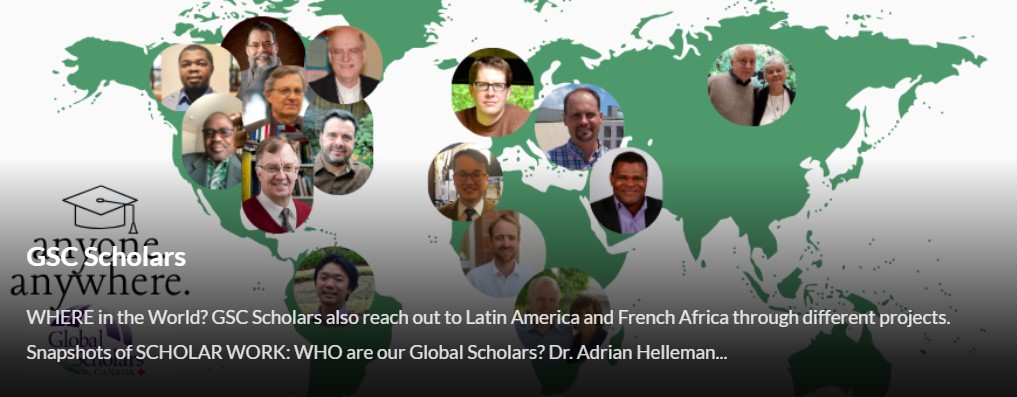
My period of discernment led me to join Global Scholars Canada (GSC), an organization that links Canadian scholars in a variety of fields with opportunities for teaching and mentoring in the Majority World.
I am hoping to leverage my Canadian and Jamaican experience and my expertise in biblical studies and the Christian worldview to help other scholars, whether in Canada or other countries, bring their faith to bear on their academic vocation in a way that witnesses to God’s kingdom purposes for the redemption of all of life.
I see my mission as raising the level of biblical literacy among Christian academics, but also among pastors and laypeople, by immersing them in serious, yet inspiring and practical, study of Scripture.
I am coming on board Global Scholars Canada as a part-time global scholar. Full-time scholars typically get placed in teaching positions overseas, negotiated between GSC and the hiring institution, with GSC helping to raise funds to supplement what the hiring institution is unable to cover.
Given that I have been ministering “overseas” since I left Jamaica as a young adult, and that I am part-time, my situation is somewhat different. I will be involved in specific short-term assignments that Global Scholars Canada will set up, such as speaking at conferences or mentoring young academics.
Two Specific Assignments
Global Scholars Canada is a partner with the Society of Christian Scholars, an international community of Christian academics that developed from a consultation (some sixteen years ago) of eleven scholars from six countries. The Society has numerous individual and organizational partners and affiliates throughout the world.
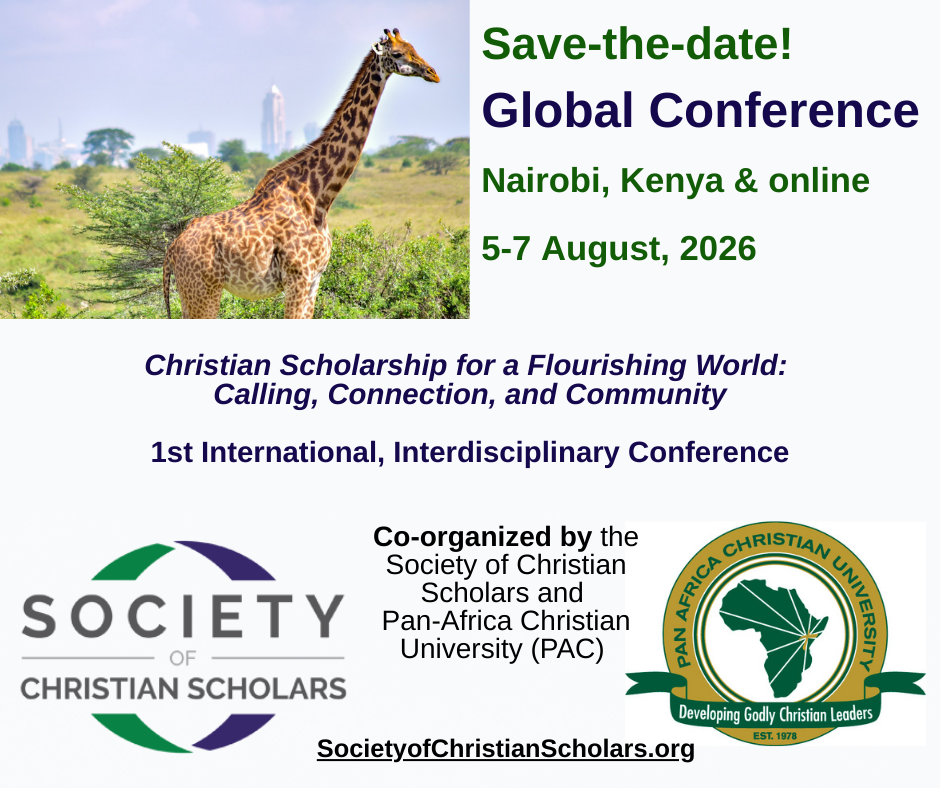
My next assignment will be to give a keynote talk called “The Vocation of the Christian Scholar: Called to Image God” at a Global Leadership Conference sponsored by the Society of Christian Scholars, which will be held in Nairobi, Kenya, in early August 2026.
The conference has changed a bit since the flyer below (the exact date and location have shifted). But the theme and focus will be similar. This will be a great time for networking with scholars from around the world who teach in a variety of disciplines at public universities.
At the urging of Global Scholars Canada, I will be taking along a younger scholar, Chris Landon (who is currently working on his PhD in Old Testament at McMaster Divinity College), as a mentee.
Although the conference is only a few days, it will be quite an undertaking, given the travel (and recovery) time and the cost of airfare and conference registration (which includes lodging and food).
Fundraising—Something I don’t Usually Do
Global Scholars Canada is committed to covering most of the expenses of myself and my mentee, for which I am very grateful. However, there will be other Global Scholars Canada events I will later participate in that will need funding.
Anyone interested in contributing towards my budget with Global Scholars Canada (as charitable giving in the US or Canada), can check out the relevant links below. It will be much appreciated. All the scholars with Global Scholars Canada are partially supported by charitable donations from interested persons.
The Global Scholars Canada website has a list of different ways to give(online or by cheque) in support of their scholars. The first four ways are for Canadian donations (you just designate the scholar you are supporting).
This Fall (beginning August 26, 2025), I will be teaching my signature course on the Biblical Worldview as a radical, liberating vision for the church and the world. The course has had a number of different names over the years, including “Exploring the Christian Worldview” (the undergraduate version at Roberts Wesleyan University) and “Biblical Worldview: Scripture, Theology, Ethics” (the graduate version at Northeastern Seminary).
I’ve taught non-credit versions of this course since I was a campus minister in Canada (at the University of Toronto, McMaster University, the University of Guelph, and Brock University) and in the US (at the University of Rochester, Cornell University, and Syracuse University).
My first book, The Transforming Vision: Shaping a Christian World View (IVP, 1984), which I co-authored with Brian Walsh, was based on this course.
When I began to teach the course for graduate and undergraduate credit at the Institute for Christian Studies, Colgate Rochester Crozer Divinity School, Roberts Wesleyan University, and Northeastern Seminary, I was able to develop the content further with a deeper dive into Scripture and further analysis of our changing cultural contexts.
This Fall the course will be offered as a dual modality course, which means that it may be accessed in person (in the classroom) or remotely (by Zoom link). It may also be taken for undergraduate or graduate credit.
Although the term “biblical worldview” has been used and abused by Christians with a rigid, absolutist stance, I want to reclaim the term for the Bible’s liberating vision of shalom and flourishing. That’s the orientation of this course.
I have been authorized by Northeastern Seminary to invite anyone interested to register for the course (in either modality—in person or online) for credit or for audit.
Auditors receive all the same resources as those taking the course for credit, without submitting any assignments. These resources include links to the professor’s weekly video lectures, along with links to PDFs of readings and handouts.
The course will meet for fourteen weeks on Tuesdays at 7:00–8:30 pm Eastern. The format will be a flipped classroom. Participants view the video lectures and do the readings in advance (auditors are encouraged to do as much or as little of the reading as they desire).
This weekly preparation gives participants a chance to formulate thoughtful questions that arise from the lectures and readings, which they are invited to bring to our hour-and-a-half synchronous meeting each week. These weekly meetings are a rich time of discussion and sharing, as we explore matters of biblical interpretation, worldview, theology, culture, and ethics, and their bearing on our lives.
“Biblical Worldview: Scripture, Theology, Ethics” (GBHT 5210) is a 3-credit course. The tuition is normally $575 per credit hour (thus $1,725 for the course). The fee for auditing is only $199.
If you are interested in taking the course (for audit or credit), you may use the NES Fast Application link (Fast App for short) to submit some preliminary information about yourself. Auditing students (and those desiring credit, yet not registering for a degree program) should select “Non-Degree Seeking” on the drop-down menu under “Application Type.” You don’t need to fill in all the information boxes in the app, just those with an asterisk.
When you have filled out the required information, you should email Jess Newcomb (Asst. Director of Recruiting and Admissions for Graduate, Professional Studies, & Seminary) at admissions@nes.edu to let her know you have completed the Fast App and that you want to audit the Biblical Worldview course; she will take you through the next steps for registering as an auditor. You can also call or text her at 585.565.6533.