A New Venture with Global Scholars Canada

I have had a wonderful and fulfilling full-time teaching career, which began some thirty years ago at Colgate Rochester Crozer Divinity School and continued through my move to Roberts Wesleyan University and Northeastern Seminary.

I formally retired from the Seminary in 2024 and have since focused on writing (though as Emeritus Professor I will still teach from time to time).

I am currently working on two books (both are partially complete). One is on the ethics of power in 1 Samuel 1–15 (contracted with Eerdmans). The other is on the liberating worldview of the Scriptures (for Baker Academic); this is a complete rewrite of The Transforming Vision, the book I coauthored with Brian Walsh when we were both graduate students.

Discernment Process

When I retired, I had a clear sense that writing was going to be my major focus (I have three other book contracts beyond the two mentioned above). But I have also been in a period of discernment for new ventures that God might be calling me to.

Here is a somewhat humorous poem I wrote the year before I retired, while on a retreat at the Gell Center in the Finger Lakes (a beautiful rural area south of Rochester, NY where I live). I broke up some of my sentences to mimic my breathing as I climbed uphill.

Uphill All the Way

J. Richard Middleton

Panting and huffing, he lugged
his sixty-eight-year-old frame
over rotting logs, snagging
his foot on a broken limb, stumbled, yet doggedly
kept ascending the steep climb. No
horizon in sight. Just trees, trees as far as vision. Yet
far easier to make out than his future
after retirement. After
twenty-seven years of pouring
his heart out
to indifferent students,
grading mediocre papers (and the odd
brilliant piece), correcting
bad grammar. It was time. Something
new beckoned. If only
he could see what it was.

October 2023
Gell Center, Finger Lakes

Contrary to the poem (which is only partly autobiographical), I’ve had excellent students throughout the years, who have gone on to do wonderful things for God’s kingdom. I’ve had the joy and privilege of keeping in touch with many of them.

Post-Retirement Opportunities

Since retirement, I have kept getting invitations to speak on topics close to my heart for various organizations, and I certainly could just take up such opportunities as they arise. But I have been wondering if there is a more strategic way to use my gifts and academic experience.

Being originally from the Caribbean, I have been especially interested in theological education for the global church. I’ve kept in touch with Jamaica Theological Seminary (where I earned my BTh) and the Caribbean Graduate School of Theology (where I taught while on sabbatical some years back). Both schools have recently contacted me about being involved in a variety of ways, including teaching, faculty development, and integrating a Christian worldview into the curriculum.

I am also a Canadian, having lived fifteen years in Ontario, where I worked as a campus minister and completed two graduate degrees, prior to my teaching career in the USA.

My period of discernment led me to join Global Scholars Canada (GSC), an organization that links Canadian scholars in a variety of fields with opportunities for teaching and mentoring in the Majority World.
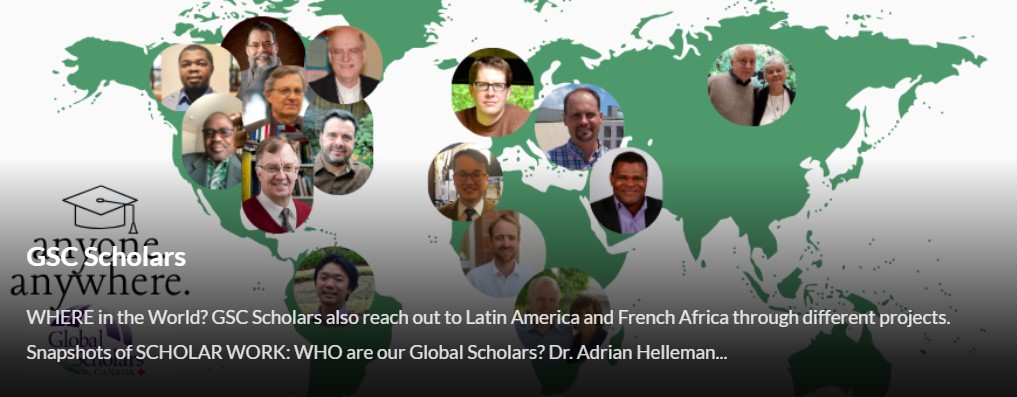
Peter Schuurman, the director of Global Scholars Canada (GSC), wrote a short piece introducing me to the GSC community.

My Vision and Mission

I am hoping to leverage my Canadian and Jamaican experience and my expertise in biblical studies and the Christian worldview to help other scholars, whether in Canada or other countries, bring their faith to bear on their academic vocation in a way that witnesses to God’s kingdom purposes for the redemption of all of life.

I see my mission as raising the level of biblical literacy among Christian academics, but also among pastors and laypeople, by immersing them in serious, yet inspiring and practical, study of Scripture.

My fuller vision and mission statement can be found on my Global Scholars Canada webpage.

I am coming on board Global Scholars Canada as a part-time global scholar. Full-time scholars typically get placed in teaching positions overseas, negotiated between GSC and the hiring institution, with GSC helping to raise funds to supplement what the hiring institution is unable to cover.

Given that I have been ministering “overseas” since I left Jamaica as a young adult, and that I am part-time, my situation is somewhat different. I will be involved in specific short-term assignments that Global Scholars Canada will set up, such as speaking at conferences or mentoring young academics.

Two Specific Assignments

Global Scholars Canada is a partner with the Society of Christian Scholars, an international community of Christian academics that developed from a consultation (some sixteen years ago) of eleven scholars from six countries. The Society has numerous individual and organizational partners and affiliates throughout the world.

One of the affiliates is the Caribbean Network of Christian Scholars.
My very first assignment as a global scholar was an invitation that came through a member of the Caribbean Network, who is the librarian for the Society of Christian Scholars. I will be doing an online presentation for the Society’s Library Reading Group meeting in June 2026. I’ve been asked to introduce the article I wrote for the book of Caribbean theology that I coedited with Garnett Roper some years ago (the article explores a creation theology for the Caribbean).

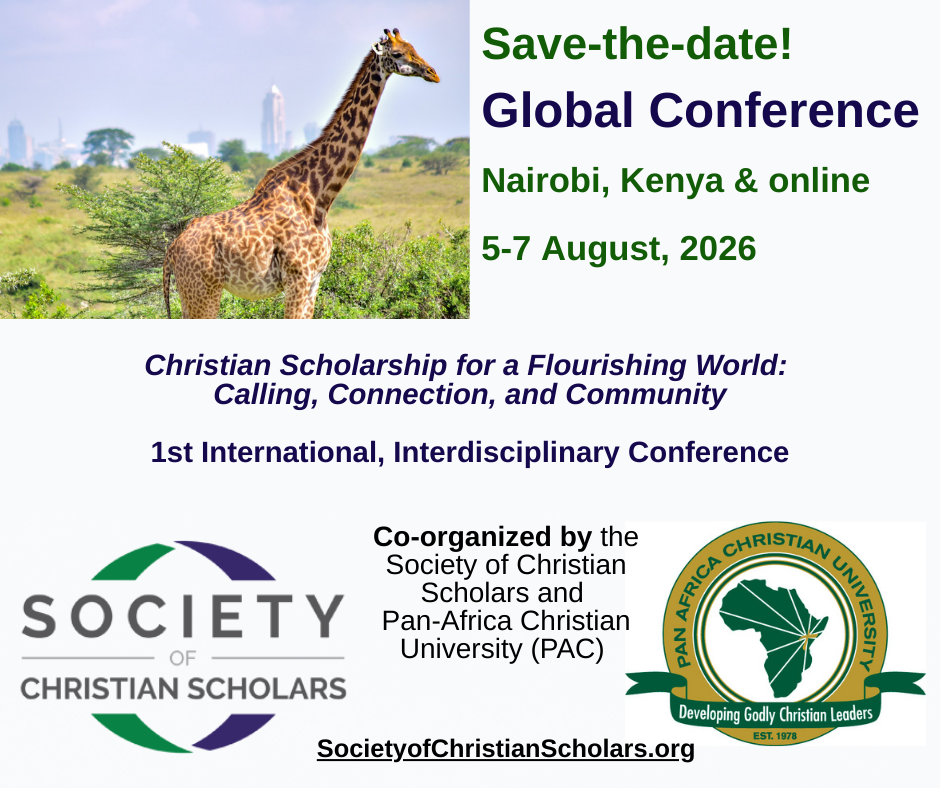
My next assignment will be to give a paper at the first international conference sponsored by the Society of Christian Scholars, which will be held at the Pan-African Christian University in Nairobi, Kenya, in early August 2026. My paper is entitled “The Vocation of the Christian Scholar: A Caribbean Biblical Studies Perspective.”

At the urging of Global Scholars Canada, I will be taking along a younger scholar, Chris Landon (who is currently working on his PhD at McMaster Divinity College), as a mentee. He may also be presenting a paper at the conference.

Although the conference is only a few days, it will be quite an undertaking, given the travel (and recovery) time and the cost of airfare and conference registration (which includes lodging and food).

Fundraising—Something I don’t Usually Do

Global Scholars Canada is committed to covering 90% of the cost of any mentees attending the conference (so they will cover this for Chris). They don’t cover quite as much for their scholars. But I am extremely grateful that their contribution will reimburse about half my expenses. I will need to raise the other half (which comes to about USD 1,100 = CAD 1,500).

Anyone interested in contributing towards these expenses (as charitable giving in the US or Canada), can check out the relevant links below. It will be much appreciated.

The Global Scholars Canada website has a list of different ways to give (online or by cheque) in support of their scholars. The first four ways are for Canadian donations (you just designate the scholar you are supporting).

The fifth way takes you to the website of the Society of Christian Scholars, where you can make a USD donation online or by a mailed check (with the scholar designated).

Newsletter

I will soon be starting a quarterly newsletter, reporting on some of my activities for Global Scholars Canada; if you are interested in receiving this, you can sign up on my GSC webpage (scroll down to the end for the sign-up form).

You’re invited to join me in this new adventure!


How My Rewrite of The Transforming Vision Will Vary from the Original

I am currently doing a total rewrite of the book on a Christian worldview that Brian Walsh and I coauthored, called The Transforming Vision: Shaping a Christian World View (Downers Grove, IL: InterVarsity Press, 1984).

The book has found a wide audience in both English and other languages (especially Korean, where it has just about outsold the English original). To date, it has been translated and published in Korean (1987), French (1988), Indonesian (2001), Spanish (2003), and Portuguese (2010); with new Korean (2013), French (2016), and Indonesian (2013, 2019) editions.

Over the years, many people who were using the book in teaching asked us for a second or revised edition, where we would update aspects of our analysis. Although the publisher did give the book a new cover, we were each too busy working on other projects to devote the time needed to a second edition.

Worldview Book and Worldview Courses

Brian and I wrote The Transforming Vision based on non-credit courses we were teaching through IVCF campus ministries at a number of Canadian universities. For a few years after the book was published, I continued teaching non-credit courses on a Christian worldview at universities in the USA and Canada as I moved around for graduate studies and university chaplaincy.

Since I began doctoral studies in 1990, and especially since I started a faculty position in the mid-nineties, I have been offering the course for credit to undergraduates and to graduate/ seminary students, while also giving papers and publishing as a biblical scholar—especially in the area of Old Testament.

Changes to the Course (and the Book)

The course has gradually changed over the years, in accordance with my expertise and context. The new version of the book will follow the content (and outline) of the course as I have been teaching it most recently (it’s a solo rewrite, since Brian hasn’t been teaching a comparable course).

Some changes have to do with Scripture, while others are aspects of what you might call contextualization, changes that reflect the cultural (and academic) contexts I have been living and teaching in.

An Expanded Exposition of the Biblical Story

First, I’ve expanded (and deepened) my understanding of biblical theology over the years, so the book will reflect that. Instead of three chapters on Scripture (in The Transforming Vision), I have eight chapters tracing the biblical story from creation to eschaton (the biblical worldview as a coherent story wasn’t explicitly addressed in the original book). Each chapter will be a theological dive into a biblical text (or set of texts) that advances the story (creation, imago Dei, fall, Israel, monarchy, prophets, Jesus, eschaton). I will draw out practical implications for Christian living from each of these “soundings” into Scripture.

An Analysis of “Postmodern” Tribalism

The second change is in my analysis of the history of western culture. I still find it helpful to begin with the otherworldly dualism that impacted the church (from the early middle ages onward) and trace the rise of the modern impulse to autonomy and conquest (over the last five hundred years). But my analysis of the crisis of modernity now includes our current “postmodern” tribalism—how modernity has devolved into the toxic “post-truth” culture we now experience.

The Contested Meaning of the “Christian/Biblical Worldview”

A third change is that I won’t start the book with much analysis of the nature of worldviews (which is how The Transforming Vision began). The new book will focus more on showing than telling. However, I plan to include an Appendix or Afterword on the problematic nature of worldview discourse among Christians. I’ll explain why I am reclaiming the terms “Christian worldview” and “biblical worldview” from those who use these terms to designate a pre-packaged absolutist system of so-called “truth,” which is often nothing more than an oppressive framework for control. In contrast, I think these terms are helpful markers for the Bible’s liberating vision, disclosed especially through its overarching narrative of God’s desire for creational flourishing and shalom.

Living between the Times

Also, I won’t have a section on the implications of Christian faith for academic disciplines. That section of The Transforming Vision came from the campus ministry context the course was developed in; that’s not been my present context. Instead, I’ll close with two chapters on “living between the times,” one addressing a Christian approach to suffering (drawing on the lament psalms) and one on the biblical pattern of discipleship (from the Gospels and Pauline epistles).

Dancing in the Dragon’s Jaws

My plan is for a fourteen-chapter book (plus Appendix/ Afterword), tentatively titled Dancing in the Dragon’s Jaws: The Bible’s Liberating Worldview. Those who know the music of Bruce Cockburn will recognize Dancing in the Dragon’s Jaws as the title of one of his albums; it is also a line in a song on the album, describing Jesus’s victory over evil: “just beyond the range of normal sight / this glittering joker was dancing in the dragon’s Jaws.”

The title is meant to capture the sense of freedom and joy that being grounded in Scripture can bring, while realistically acknowledging that our joy comes in the face of personal brokenness and systemic evil, both of which are ultimately overcome only by God’s saving action in Christ.

I decided to keep the term Worldview in the subtitle, as a gesture towards reclaiming that term as valuable and helpful; indeed, I believe that the Bible discloses a Liberating Worldview!

The word Liberating is also a nod to my book on humanity as the image of God, called The Liberating Image: The Imago Dei in Genesis 1 (Grand Rapids: Brazos, 2005). The human calling to image God is a key component in my exposition of the unfolding biblical story.

An Accessible Read

I plan to keep the reading level of the new book close to that of The Transforming Vision, so it is accessible to early undergraduates and Christian lay people (The Transforming Vision was even used in Christian high schools in Canada and the US).

If you have used The Transforming Vision in teaching or if the book has been important to you personally, please contact me. I am looking for a few key people to read portions of the draft of the new book and give me helpful feedback.

The Story of Israel from Abraham to the Exile (The Kingdom of God, part 4)

This is the fourth installment of an article on the Kingdom of God.

Part 1 began with Jesus’s proclamation at the start of his ministry about the kingdom of God. Part 2 looked at Jesus’s sermon at Nazareth, in which he explained the nature of the kingdom he was inaugurating. Part 3 shifted to the biblical backstory of the kingdom, beginning with the royal calling of humanity created to image God, including how we squandered our calling through sin and violence, culminating in the tower of Babel.

The current installment traces the story of Israel from Abraham to the Babylonian exile, with a focus on the theme of “rule” (power and agency). This backstory is essential for understanding the kingdom of God in the New Testament.

The Call of Israel—Election and Covenant

God’s response to this imperial violence was to call one couple, Abraham and Sarah, out of the nations of the world, so that they would become the progenitors of an alternative nation, who would function as a model or microcosm of God’s purposes for humanity on earth. God promises to bless this chosen nation so that they would flourish as a people, with the long-term purpose that through them blessing would come to the other nations of the world (Gen. 12:3; 18:18; 22:18; 26:4; 28:14); this would, in effect, restore the human race to its original purpose of imaging God.

But this long-term blessing is delayed as Abraham’s descendants (named Israel, after one of his grandsons) are enslaved by the Egyptian empire, whose Pharaohs typically styled themselves as the living image (indeed, the incarnation) of the gods on earth, which justified their absolute power. But Israel’s God (the Creator of all peoples) intervened to deliver Abraham’s descendants from Egyptian oppression by the hand of Moses, to whom he revealed his distinctive name, YHWH (Exod 3:14). The name, probably pronounced Yahweh, is typically written without vowels, since in later centuries Jews (including those responsible for the text of the Bible) viewed the divine name as too sacred to be pronounced.

The central event in the Old Testament is the exodus from Egypt, which climaxed at the Red Sea, when the people were pursued by Pharaoh’s army. Initially trapped between Pharaoh’s chariots and the Sea, God made a path through the waters for his people to escape. The final line of the victory song that Moses and the Israelites sang when they escaped the reach of Pharaoh’s power was: “YHWH will reign for ever and ever!” (Exod 15:18). Under their breath they may have whispered, “and not Pharaoh”; they had become part of an alternative kingdom.

After delivering the Israelites from Pharaoh’s army through the Sea, YHWH led them to Mt. Sinai (Exod 14–19), where the Torah (divine instruction, including the Ten Commandments) was given as part of the covenant God made with them (Exod 20–24). At Sinai, God clarified the calling of this newly redeemed people: “Now if you obey me fully and keep my covenant, then out of all nations you will be my treasured possession. Although the whole earth is mine, you will be for me a kingdom of priests and a holy nation.” (Exod 19:5–6a)

God’s elect people, chosen for a royal-priestly role, were intended to carry on the holy task, which had been distorted by human sin, of mediating God’s blessing and presence into the world by how they lived, including how they exercised power in the pursuit of justice. Since the human race was not fulfilling its created purpose, God calls Israel to be imago Dei—to reflect his purposes through their communal life. They are to model the sort of just and righteous life that God intended for all people, by embodying the values of the covenant God made with them at Sinai.

Monarchy and Exile

Although Israel originally came into being as a loose confederacy of twelve tribes, without a unifying monarchy, within a few centuries the people asked for a king so that they could be “like the other nations” (1 Sam 8:5). God graciously granted their request (1 Sam 8:7, 22), while providing normative standards for the king to follow (Deut 17:14–20). Given the typical practice of absolute power by ancient kings, these standards were intended to substantially limit the power of Israel’s rulers.

Most of Israel’s kings, however, ignored these standards and ended up no different from the kings of the other nations. Many tolerated, or even fostered, idolatry (compromising the worship of YHWH with allegiance to other gods) and this idolatry led to injustice, which was the consequence of ignoring the value system embedded in YHWH’s covenant.

Indeed, it was the idolatry of Solomon, Israel’s third king, combined with the oppressive practices of Rehoboam, his son and successor, that led to a split in the nation (1 Kgs 11:20–12:24). The ten northern tribes seceded from the unified kingdom in the tenth century BCE, forming their own nation (the Northern Kingdom of Israel or Ephraim), with Samaria as its capital, leaving the much smaller Southern Kingdom of Judah (the “house” or dynasty of David), with Jerusalem as its capital.

About two hundred years later (722 BCE), the Assyrian empire invaded and conquered the Northern Kingdom and deported much of the population. The inhabitants were resettled in a variety of nations that Assyria had conquered, while the Assyrians settled foreigners from conquered nations in Israel (this is the area that in New Testament times became Samaria and Galilee). Many refugees from the north also fled south and settled in Judah.

A little over a century after the Assyrian conquest of the North, the Babylonian empire (which had in the meantime conquered Assyria) invaded the Southern Kingdom of Judah and deported some of its inhabitants to Babylon (597 BCE); a second invasion followed ten years later (587/6 BCE), when Babylonian forces destroyed much of Jerusalem and demolished its temple, deporting even more inhabitants to Babylon.

At this point the line of Davidic kings (the only Israelite monarchy left) came to an end in massive failure. Although there are complex historical explanations for these imperial conquests of the Northern and Southern Kingdoms and the forcible exile of the people that followed, the Bible’s prophetic literature understands these events ultimately as consequences of the sins of God’s people, their disobedience to the covenant, especially through the leadership of unrighteous kings (2 Chr 36:20–21; with more detail in 2 Kgs 24–25).

Hope for the Future after the Exile

It was precisely in this time of national crisis—which included the ending of the monarchy, the destruction of the temple, and exile from the land—that hope for a new beginning arose, especially in Israel’s prophetic literature. Some of the prophets living on the edge of exile and others from within the exilic period began to articulate a vision of a hopeful future beyond exile.

The starting point of this vision was a return to the land, portrayed in Isaiah 40–55 as a new exodus; just as God liberated Israel from Egyptian bondage in ancient times, so God would release the Jews (the exiled Judeans) from their Babylonian captivity. Whereas at the exodus God’s people passed through the Sea to escape Pharaoh’s army, God was doing a “new thing”; this time the journey would be through the desert or wilderness, as the exiles traveled from Babylon back to their homeland (Isa 43:16–21).

But the return to the land was just the start; the prophets also envisioned the healing of the social order (such that justice and righteousness would prevail between people), the flourishing of the natural world (even the desert would bloom), a peaceful relationship with the nations (in place of war and oppression), the forgiveness of sins and a new heart (enabling obedience to God after a history of rebellion), the restoration of righteous leadership (in contrast to the corrupt kings of the past), and God’s intimate presence among the people in the renewed land.

In part 5 of this series, we will examine the rise of messianic expectation after the Babylonian exile and how this was fulfilled in Jesus’s mission.