A New Venture with Global Scholars Canada

I have had a wonderful and fulfilling full-time teaching career, which began some thirty years ago at Colgate Rochester Crozer Divinity School and continued through my move to Roberts Wesleyan University and Northeastern Seminary.

I formally retired from the Seminary in 2024 and have since focused on writing (though as Emeritus Professor I will still teach from time to time).

I am currently working on two books (both are partially complete). One is on the ethics of power in 1 Samuel 1–15 (contracted with Eerdmans). The other is on the liberating worldview of the Scriptures (for Baker Academic); this is a complete rewrite of The Transforming Vision, the book I coauthored with Brian Walsh when we were both graduate students.

Discernment Process

When I retired, I had a clear sense that writing was going to be my major focus (I have three other book contracts beyond the two mentioned above). But I have also been in a period of discernment for new ventures that God might be calling me to.

Here is a somewhat humorous poem I wrote the year before I retired, while on a retreat at the Gell Center in the Finger Lakes (a beautiful rural area south of Rochester, NY where I live). I broke up some of my sentences to mimic my breathing as I climbed uphill.

Uphill All the Way

J. Richard Middleton

Panting and huffing, he lugged
his sixty-eight-year-old frame
over rotting logs, snagging
his foot on a broken limb, stumbled, yet doggedly
kept ascending the steep climb. No
horizon in sight. Just trees, trees as far as vision. Yet
far easier to make out than his future
after retirement. After
twenty-seven years of pouring
his heart out
to indifferent students,
grading mediocre papers (and the odd
brilliant piece), correcting
bad grammar. It was time. Something
new beckoned. If only
he could see what it was.

October 2023
Gell Center, Finger Lakes

Contrary to the poem (which is only partly autobiographical), I’ve had excellent students throughout the years, who have gone on to do wonderful things for God’s kingdom. I’ve had the joy and privilege of keeping in touch with many of them.

Post-Retirement Opportunities

Since retirement, I have kept getting invitations to speak on topics close to my heart for various organizations, and I certainly could just take up such opportunities as they arise. But I have been wondering if there is a more strategic way to use my gifts and academic experience.

Being originally from the Caribbean, I have been especially interested in theological education for the global church. I’ve kept in touch with Jamaica Theological Seminary (where I earned my BTh) and the Caribbean Graduate School of Theology (where I taught while on sabbatical some years back). Both schools have recently contacted me about being involved in a variety of ways, including teaching, faculty development, and integrating a Christian worldview into the curriculum.

I am also a Canadian, having lived fifteen years in Ontario, where I worked as a campus minister and completed two graduate degrees, prior to my teaching career in the USA.

My period of discernment led me to join Global Scholars Canada (GSC), an organization that links Canadian scholars in a variety of fields with opportunities for teaching and mentoring in the Majority World.
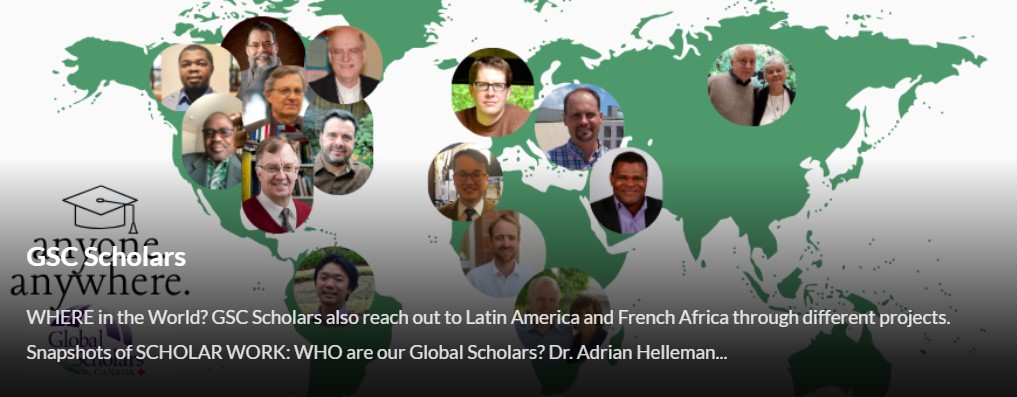
Peter Schuurman, the director of Global Scholars Canada (GSC), wrote a short piece introducing me to the GSC community.

My Vision and Mission

I am hoping to leverage my Canadian and Jamaican experience and my expertise in biblical studies and the Christian worldview to help other scholars, whether in Canada or other countries, bring their faith to bear on their academic vocation in a way that witnesses to God’s kingdom purposes for the redemption of all of life.

I see my mission as raising the level of biblical literacy among Christian academics, but also among pastors and laypeople, by immersing them in serious, yet inspiring and practical, study of Scripture.

My fuller vision and mission statement can be found on my Global Scholars Canada webpage.

I am coming on board Global Scholars Canada as a part-time global scholar. Full-time scholars typically get placed in teaching positions overseas, negotiated between GSC and the hiring institution, with GSC helping to raise funds to supplement what the hiring institution is unable to cover.

Given that I have been ministering “overseas” since I left Jamaica as a young adult, and that I am part-time, my situation is somewhat different. I will be involved in specific short-term assignments that Global Scholars Canada will set up, such as speaking at conferences or mentoring young academics.

Two Specific Assignments

Global Scholars Canada is a partner with the Society of Christian Scholars, an international community of Christian academics that developed from a consultation (some sixteen years ago) of eleven scholars from six countries. The Society has numerous individual and organizational partners and affiliates throughout the world.

One of the affiliates is the Caribbean Network of Christian Scholars.
My very first assignment as a global scholar was an invitation that came through a member of the Caribbean Network, who is the librarian for the Society of Christian Scholars. I will be doing an online presentation for the Society’s Library Reading Group meeting in June 2026. I’ve been asked to introduce the article I wrote for the book of Caribbean theology that I coedited with Garnett Roper some years ago (the article explores a creation theology for the Caribbean).

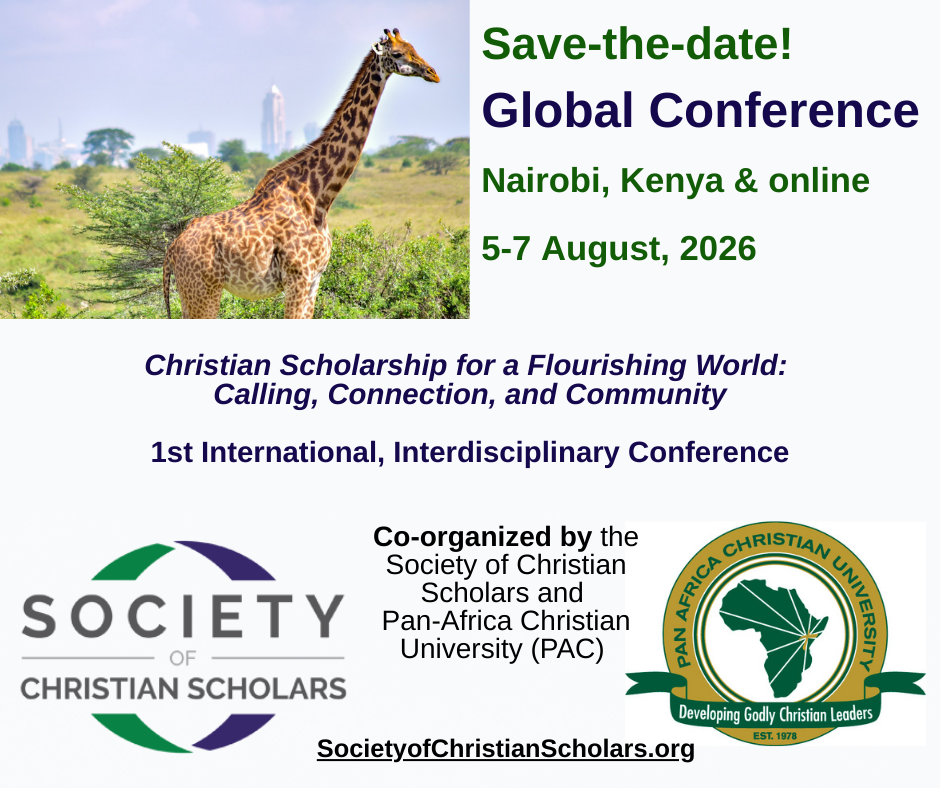
My next assignment will be to give a paper at the first international conference sponsored by the Society of Christian Scholars, which will be held at the Pan-African Christian University in Nairobi, Kenya, in early August 2026. My paper is entitled “The Vocation of the Christian Scholar: A Caribbean Biblical Studies Perspective.”
At the urging of Global Scholars Canada, I will be taking along a younger scholar, Chris Landon (who is currently working on his PhD at McMaster Divinity College), as a mentee. He may also be presenting a paper at the conference.

Although the conference is only a few days, it will be quite an undertaking, given the travel (and recovery) time and the cost of airfare and conference registration (which includes lodging and food).

Fundraising—Something I don’t Usually Do

Global Scholars Canada is committed to covering 90% of the cost of any mentees attending the conference (so they will cover this for Chris). They don’t cover quite as much for their scholars. But I am extremely grateful that their contribution will reimburse about half my expenses. I will need to raise the other half (which comes to about USD 1,100 = CAD 1,500).

Anyone interested in contributing towards these expenses (as charitable giving in the US or Canada), can check out the relevant links below. It will be much appreciated.

The Global Scholars Canada website has a list of different ways to give (online or by cheque) in support of their scholars. The first four ways are for Canadian donations (you just designate the scholar you are supporting).

The fifth way takes you to the website of the Society of Christian Scholars, where you can make a USD donation online or by a mailed check (with the scholar designated).

Newsletter

I will soon be starting a quarterly newsletter, reporting on some of my activities for Global Scholars Canada; if you are interested in receiving this, you can sign up on my GSC webpage (scroll down to the end for the sign-up form).

You’re invited to join me in this new adventure!


The Ultimate Victory of God’s Kingdom (The Kingdom of God, part 6)

This is the sixth (and final) installment of an article on the Kingdom of God.

Part 1 began with Jesus’s proclamation at the start of his ministry about the kingdom of God. Part 2 looked at Jesus’s sermon at Nazareth, in which he explained the nature of the kingdom he was inaugurating.

Part 3 shifted to the biblical backstory of the kingdom, beginning with the royal calling of humanity created to image God, including how we squandered our calling through sin and violence, culminating in the tower of Babel. Part 4 traced the story of Israel from Abraham to the Babylonian exile, with a focus on the theme of “rule” (power and agency).

Part 5 picked up the story with the messianic ministry and mission of Jesus, leading to his confrontation with the powers in Jerusalem at Passover.

The current installment examines the climax of the story of the kingdom of God, as God’s purposes for creation and history come to fruition through the Messiah.

After the Babylonian exile, when Israel had returned to the land, the prophetic expectations of restoration and blessing had not been fulfilled. Israel was still oppressed by various empires (the latest being Rome) and the people were still mired in sin and injustice.

There was a growing sense in the Old Testament, however, that the problem Israel faced was greater than either the external oppression by empires or the internal sinfulness of the people—though both were certainly real.

The Supra-Human Powers of Evil

Various biblical texts make this point by using the metaphor of the chaotic sea or dangerous sea beasts to represent the supra-human power of evil that lies behind human action.

Examples include Ezekiel’s description of the Egyptian Pharaoh as a great water-monster whom God will pull out of the Nile with hooks or haul up with a net (Ezekiel 29:2–7; 32:2–4) and Jeremiah’s picture of the king Nebuchadnezzar of Babylon as a sea serpent swallowing Israel, which will be forced to disgorge its prey (Jeremiah 51:34 and 51:44). It is as if there are destructive powers that lie behind human embodiments of evil.

The book of Daniel portrays a series of four oppressive empires as ravenous, devouring beasts arising from the sea (Dan 7:1–8), noting that they will be judged by God and their power taken away (Daniel 7:9–12).

Granted, neither the sea nor great sea beasts are always used as symbols of chaos or evil in the Bible; they are portrayed positively as aspects of God’s good, though wild, creation in some texts (Genesis 1:21; Psalm 95:5 and 104:26; and Job 41:1–34).

Yet elsewhere God is said to oppose and battle the sea, Leviathan, or some form of sea serpent (Job 26:12–13; Psalm 74:14 and 89:9–10). In Isaiah 27 this symbol is used for God’s final, eschatological judgment on evil: “On that day YHWH will punish with his fierce and great and strong sword Leviathan the fleeing serpent, Leviathan the twisting serpent, and he will slay the dragon that is in the sea” (Isaiah 27:1).

The sense that there were supra-human powers of evil, which had human individuals and even empires in their grip, developed in the period between the Old and New Testaments. This led to the explicit doctrine of personified evil, both in the form of demonic forces (also called unclean spirits or principalities and powers in the New Testament) and the devil or Satan, which the book of Revelation, drawing on Old Testament imagery, calls the “great dragon” and the “ancient serpent” (Revelation 12:9).

Although many of our popular ideas about the devil and the demonic come from post-biblical literature and not the Bible itself, the Bible clearly endorses the idea that there are systemic meta-human powers of evil that constrain human behavior.

Angels (lit. “messengers”) from God often appear in the Old Testament, though there is no systematic explanation of who they are. It is not until the book of Daniel that we find the first explicit reference to angelic opposition to God, in the form of a struggle between “the prince of the kingdom of Persia” and an angel (who seems to be Gabriel), who had to be aided by another angel, Michael, “one of the chief princes” (Daniel 10:13). By the time we get to the New Testament, the idea of supra-human powers that oppress human beings and have them in their grip is standard in Jewish thinking. This underlies the Gospel stories of Jesus’s confrontation with demonic powers throughout his ministry.

Jesus could counsel his followers to love their enemies (Matthew 5:43–44; Luke 6:27–28) because he did not regard even his human opponents (Jewish or Roman) as the ultimate enemy. As Ephesians 6 puts it: “We do not wrestle against flesh and blood, but against the rulers, against the authorities, against the cosmic powers over this present darkness, against the spiritual forces of evil in the heavenly places” (Ephesians 6:12).

The Clash of the Kingdoms

The clash between God’s kingdom and the powers of evil is clear from Jesus’s response to the accusation that he was casting out demons by the power of Satan, here called “Beelzebul, the ruler of the demons” (Luke 11:15). He responded that if this were true, it would mean that the kingdom of evil was divided against itself (Luke 11:18). However, “If it is by the finger of God that I cast out demons, then the kingdom of God has come to you” (Luke 11:20).

Jesus then used a vivid metaphor to describe his work of overcoming the dominion of the Evil One: “When a strong man, fully armed, guards his castle, his property is safe. But when one stronger than he attacks him and overpowers him, he takes away his armor in which he trusted and divides his plunder.” (Luke 11:21–22) This metaphor points to Jesus’s mission to liberate Israel and all people—indeed, the entire creation—from bondage to evil. Since Passover was the symbol of the expected liberation, Jesus chose that central Jewish festival as the time of his confrontation with the powers in all their raw opposition.

But how did Jesus overpower the “strong man”? In line with his teaching about an alternative form of rule—different from gentile overlords—Jesus did not come to overcome evil by the violent use of power. Rather, he came “to give himself a ransom for many” (Mark 10:45).

By submitting himself to Roman crucifixion, Jesus disarmed the powers of evil and absorbed into himself all the brokenness and corruption of human life, all the selfishness and the violence that mars this world—to suck it out of creation, to drain the mortal wound of sin, and give us back life and health and peace instead. Although any explanation of the sacrifice of Jesus on behalf of others always falters—it is ultimately a paradox—the New testament affirms that when the Messiah offered himself as the Passover lamb for a new exodus, he effectively “takes away the sin of the world” (John 1:29).

From Inauguration to Consummation—A Comprehensive Kingdom

Through his death on a cross and resurrection victory, Jesus inaugurated God’s kingdom as an alternative to the corrupt empires and dominions of this world. His resurrection is the “first fruits” of those who have died (1 Corinthians 15:20); the harvest of new creation has begun—the promised reversal of sin and death has been inaugurated.

But the reversal doesn’t happen all at once. The Bible is ruthlessly honest about the continuing struggle against evil; the clash of the kingdoms continues in our time. Yet the Scriptures envision a day when the kingdom will be consummated—bodies will be healed and human society will finally reflect God’s purposes for mercy and justice.

Throughout the Gospels, Jesus’s teaching about the kingdom of God anticipates God’s ultimate triumph over the powers of evil. In one of his parables, Jesus compares the kingdom of God to a woman who put some leaven (yeast) into a large amount of dough, in preparation for baking a loaf of bread. The yeast eventually permeated the entire loaf (Matthew 13:33; Luke 13:20–21). It may be a slow process, but the leavening of creation by the kingdom of God will be comprehensive, “far as the curse is found” (to quote the Christmas carol, “Joy to the World”).

The comprehensive nature of the kingdom of God is also portrayed in Daniel’s vision of a huge statue confronted by a small stone. The statue represents all the kingdoms of the world, whereas the stone is “not made by human hands” (representing God’s kingdom). Yet this seemingly insignificant stone strikes the statue and demolishes it; then the stone grows into a mountain that fills the entire earth (Dan 2:31–36, 44–45).

This transformation is envisioned in the book of Revelation when an angel announces, “The kingdom of the world has become the kingdom of our Lord and of his Messiah, and he will reign forever and ever” (Revelation 11:15).

The growth of the messianic kingdom is nothing less than God’s redemptive purposes becoming manifest in history, till the earth is filled with the knowledge of God (or of his glory) as the waters cover the sea (Isaiah 11:9; Habakkuk 2:14). On that day, the prophet Zephaniah proclaims, “YHWH will be king over all the earth” (Zechariah 14:9).

The Human Role in the Coming Kingdom

When God comes to bring justice to the earth, even the non-human created order will respond in praise to its maker (Psalm 96:11–13). Just as earthly life was subjected to corruption by the distortion of human rule, so in the kingdom of God the earth will be restored when redeemed humans take up their rule again—this time in accordance with the principles of God’s peaceable reign.

In the Beatitudes, Jesus affirmed that “the meek [not the powerful oppressors] will inherit the earth” (Matthew 5:5) and the book of Revelation pictures a great number from many nations formed into God’s royal priesthood (God’s redeemed people), who will “reign on the earth” (Revelation 5:10); this is the restoration of the original human calling as the image of God (Genesis 1:26–28). Indeed, the redeemed will “reign forever and ever” (Revelation 22:5).

When the kingdom of God is fully established in human life, and humans image their Creator by their loving and generous exercise of power, then creation itself, which has been groaning in its bondage to corruption (Romans 8:22), will be liberated from this bondage to share in the glorious freedom of the children of God (Romans 8:19–21).

The entire biblical story from creation to eschaton—from origin to climax—testifies to God’s unshakeable purpose for the flourishing of the world. “In the beginning God created the heavens and the earth” (Genesis 1:1); and in the end there will be “a new heavens and a new earth, in which righteousness dwells” (2 Peter 3:13).

That new creation is the fulfillment of the kingdom of God.

How My Rewrite of The Transforming Vision Will Vary from the Original

I am currently doing a total rewrite of the book on a Christian worldview that Brian Walsh and I coauthored, called The Transforming Vision: Shaping a Christian World View (Downers Grove, IL: InterVarsity Press, 1984).

The book has found a wide audience in both English and other languages (especially Korean, where it has just about outsold the English original). To date, it has been translated and published in Korean (1987), French (1988), Indonesian (2001), Spanish (2003), and Portuguese (2010); with new Korean (2013), French (2016), and Indonesian (2013, 2019) editions.

Over the years, many people who were using the book in teaching asked us for a second or revised edition, where we would update aspects of our analysis. Although the publisher did give the book a new cover, we were each too busy working on other projects to devote the time needed to a second edition.

Worldview Book and Worldview Courses

Brian and I wrote The Transforming Vision based on non-credit courses we were teaching through IVCF campus ministries at a number of Canadian universities. For a few years after the book was published, I continued teaching non-credit courses on a Christian worldview at universities in the USA and Canada as I moved around for graduate studies and university chaplaincy.

Since I began doctoral studies in 1990, and especially since I started a faculty position in the mid-nineties, I have been offering the course for credit to undergraduates and to graduate/ seminary students, while also giving papers and publishing as a biblical scholar—especially in the area of Old Testament.

Changes to the Course (and the Book)

The course has gradually changed over the years, in accordance with my expertise and context. The new version of the book will follow the content (and outline) of the course as I have been teaching it most recently (it’s a solo rewrite, since Brian hasn’t been teaching a comparable course).

Some changes have to do with Scripture, while others are aspects of what you might call contextualization, changes that reflect the cultural (and academic) contexts I have been living and teaching in.

An Expanded Exposition of the Biblical Story

First, I’ve expanded (and deepened) my understanding of biblical theology over the years, so the book will reflect that. Instead of three chapters on Scripture (in The Transforming Vision), I have eight chapters tracing the biblical story from creation to eschaton (the biblical worldview as a coherent story wasn’t explicitly addressed in the original book). Each chapter will be a theological dive into a biblical text (or set of texts) that advances the story (creation, imago Dei, fall, Israel, monarchy, prophets, Jesus, eschaton). I will draw out practical implications for Christian living from each of these “soundings” into Scripture.

An Analysis of “Postmodern” Tribalism

The second change is in my analysis of the history of western culture. I still find it helpful to begin with the otherworldly dualism that impacted the church (from the early middle ages onward) and trace the rise of the modern impulse to autonomy and conquest (over the last five hundred years). But my analysis of the crisis of modernity now includes our current “postmodern” tribalism—how modernity has devolved into the toxic “post-truth” culture we now experience.

The Contested Meaning of the “Christian/Biblical Worldview”

A third change is that I won’t start the book with much analysis of the nature of worldviews (which is how The Transforming Vision began). The new book will focus more on showing than telling. However, I plan to include an Appendix or Afterword on the problematic nature of worldview discourse among Christians. I’ll explain why I am reclaiming the terms “Christian worldview” and “biblical worldview” from those who use these terms to designate a pre-packaged absolutist system of so-called “truth,” which is often nothing more than an oppressive framework for control. In contrast, I think these terms are helpful markers for the Bible’s liberating vision, disclosed especially through its overarching narrative of God’s desire for creational flourishing and shalom.

Living between the Times

Also, I won’t have a section on the implications of Christian faith for academic disciplines. That section of The Transforming Vision came from the campus ministry context the course was developed in; that’s not been my present context. Instead, I’ll close with two chapters on “living between the times,” one addressing a Christian approach to suffering (drawing on the lament psalms) and one on the biblical pattern of discipleship (from the Gospels and Pauline epistles).

Dancing in the Dragon’s Jaws

My plan is for a fourteen-chapter book (plus Appendix/ Afterword), tentatively titled Dancing in the Dragon’s Jaws: The Bible’s Liberating Worldview. Those who know the music of Bruce Cockburn will recognize Dancing in the Dragon’s Jaws as the title of one of his albums; it is also a line in a song on the album, describing Jesus’s victory over evil: “just beyond the range of normal sight / this glittering joker was dancing in the dragon’s Jaws.”

The title is meant to capture the sense of freedom and joy that being grounded in Scripture can bring, while realistically acknowledging that our joy comes in the face of personal brokenness and systemic evil, both of which are ultimately overcome only by God’s saving action in Christ.

I decided to keep the term Worldview in the subtitle, as a gesture towards reclaiming that term as valuable and helpful; indeed, I believe that the Bible discloses a Liberating Worldview!

The word Liberating is also a nod to my book on humanity as the image of God, called The Liberating Image: The Imago Dei in Genesis 1 (Grand Rapids: Brazos, 2005). The human calling to image God is a key component in my exposition of the unfolding biblical story.

An Accessible Read

I plan to keep the reading level of the new book close to that of The Transforming Vision, so it is accessible to early undergraduates and Christian lay people (The Transforming Vision was even used in Christian high schools in Canada and the US).

If you have used The Transforming Vision in teaching or if the book has been important to you personally, please contact me. I am looking for a few key people to read portions of the draft of the new book and give me helpful feedback.