Power, Inequality, and Reconciliation in the Church

In about a week (June 16, 2015) Northeastern Seminary will be having their annual one-day summer Conference on Ministry. This year the topic is Power, Inequality, and Reconciliation in the Church, and the speaker is Dr. Christena Cleveland.

The conference is intended to explore how God’s people can respond to the forces of division, especially in a world that is saturated with inequality along social, economic, and political lines.

Christena Cleveland is a social psychologist, author, and speaker with a hopeful passion for overcoming cultural divisions in groups. She has just been appointed Associate Professor of the Practice of Reconciliation and Director of the Center for Reconciliation at Duke University’s Divinity School.

She is the author of Disunity in Christ: Uncovering the Hidden Forces that Keep Us Apart (IVP, 2013), which won a 2013 Leadership Journal Book Award.

The one-day conference is part of a Doctor of Ministry course that Dr. Cleveland will be teaching throughout the week at Northeastern Seminary. The conference is meant to allow a wider audience to gain the benefit of her expertise while she is on campus.

More details about the conference, including a schedule and registration details, can be found on the Northeastern Seminary website.

Click here to watch a video clip of Dr. Cleveland talking about the topic of her book.

Esau McCaulley was Dynamite! Report on the Rochester Preaching Conference

I just came from presenting with Rev. Esau McCaulley (doctoral candidate in New Testament at the University of St. Andrews) at the annual Preaching Conference of the Rochester Consortium of Theological Schools, held at St. Bernard’s School of Theology and Ministry (May 21, 2015). We had a great time, with lots of discussion, both in the Q&A after each talk and during lunch with the attendees.

My presentation on Matthew’s use of the Old Testament in the infancy narratives had considerable overlap with his presentation on Paul’s understanding of the Law in Galatians 3:10-14.

Just as I addressed Matthew’s use of four Old Testament quotations, Rev. McCaulley addressed Paul’s use of four OT passages in the Galatians text. In both presentations we argued that the New Testament writer in question (Matthew/ Paul) was reading the OT texts in context with significant discernment.

Further, we both focused on how the broader biblical narrative of Israel’s crisis/exile and coming Messianic resolution framed the argument of the New Testament text. And in both cases we addressed the communal and socio-political implications of the text relevant for preaching.

It looked like we had collaborated on our presentations, but we hadn’t. This just shows that when Rev. McCaulley begins as a new faculty member at Northeastern Seminary (part-time, at a distance this Fall, and full-time on campus in Fall 2016) there’s going to be great synergy in the biblical studies courses—and, indeed, with the entire core curriculum of NES, which emphasizes the relationship of Bible, theology, and praxis.

In fact, since Rev. McCaulley just signed his contract with Northeastern (the day before the conference), he is already technically on the faculty.

So I want to affirm the welcome to Professor Esau McCaulley that Doug Cullum, the Dean of NES, extended at the conference. Lots of students are eagerly looking forward to taking your courses and being mentored by you.

You can access Esau McCaulley’s blog here.

Online Interview on Creation and Violence in the Old Testament (and a Few Other Topics)

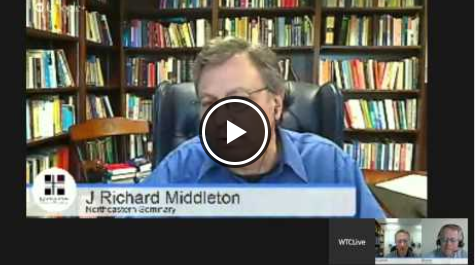
I’ve just completed (this afternoon) the online interview I mentioned in a previous post on the topic of creation and violence in the Old Testament. Bill Brown (of Columbia Theological Seminary) and I were interviewed by Matt Lynch of the Westminster Theological Centre in the UK.

Bill Brown is so eloquent (in both print and in person) that he sometimes makes me feel a bit tongue tied. But it was a lot of fun and we discussed topics such as Genesis 1 and the goodness of creation, violence as a perversion of the imago Dei, the Flood as a response to human violence, God’s role in prophetic judgment, etc.

In fact, we ranged quite a bit beyond the advertized topic of creation and violence in the Old Testament.

Brown was asked about the role of “wonder” as a key to the wisdom literature in connection his new book, Wisdom’s Wonder: Character, Creation, and Crisis in the Bible’s Wisdom Literature (Eerdmans, 2014). And I got to respond to questions about eschatology, in connection with my new book A New Heaven and A New Earth: Reclaiming Biblical Eschatology (Baker Academic, 2014).

The interview is available on online for those who missed it but still want to watch it.