My Next Book—On Abraham and Job

I just received my finalized contract from Baker Academic for my next book. I signed the contract and sent it in a couple of weeks ago, and the counter-signed contract arrived yesterday.

The book is tentatively entitled The Silence of Abraham, The Passion of Job: Explorations in the Theology of Lament.

A Comparison of Abraham and Job

The focus of the book would be a comparison of Abraham’s ominous and silent attempt to sacrifice his son in Genesis 22 (known in Jewish tradition as the Aqedah or “binding” of Isaac) with Job’s outspoken challenge to God in response to his sufferings (which God finally affirms as “right” speech, at the end of the book).

I’m planning to work on the book over my next sabbatical, which begins in the summer of 2016. During the sabbatical, I will be presenting my research as the Thiessen lectures at Canadian Mennonite University in Winnipeg, Manitoba, and also as Visiting Theologian-in-Residence at St. Barnabas’ College and St. Mark’s National Theological Centre, both in Australia (where I’ll be for four weeks).

The book would be framed by the important question of how Christians, who believe and trust in the God of heaven and earth, may respond to suffering. Given that the lament or protest psalms provide model modes of prayer in situations of suffering, the book would challenge traditional Christian interpretations of Genesis 22 and the book of Job. Whereas Abraham’s blind obedience in Genesis 22 to God’s command to sacrifice his son is typically seen as virtuous, God’s response to Job is usually thought to be a divine put-down for his audacity in challenging God’s running of the cosmos.

Some Exegetical Questions

Among the exegetical questions to be addressed in the book are:

  • Why does Abraham shift from bold protest prayer on behalf of Sodom in Genesis 18 to ominous silence about the death of his own son in Genesis 22?
  • What is the significance of the phrase “dust and ashes,” which occurs in the Bible only on the lips of Abraham (in Genesis 18) and Job (in Job 30 and 42)?
  • In what sense is the term “God-fearer” applied both to Abraham (in Genesis 22) and to Job (in the first two chapters of the book)?
  • Could the book of Job be thought of as a commentary on the Abraham story?
  • If so, what are we to understand by this inner-biblical interpretation?
  • And what are the implications of the differing responses to suffering of these two “patriarchs” (one Jewish, one gentile) for our understanding of faithful prayer in the face of suffering in the church today?

A Spirituality of Suffering

The book will draw on relevant teaching I have done on Genesis and Job and on academic papers I have presented on Genesis 22 and YHWH’s speeches in the book of Job.

But my engagement with Abraham and Job would not be geared to a purely academic outcome. This engagement is in the service of developing an honest, yet trustful, spirituality of suffering that could empower God’s people with hope in their daily lives, as they face a world full of chaos and pain.

Videos of my three Thiessen lectures on the lament psalms, Abraham, and Job are now available.

Esau McCaulley was Dynamite! Report on the Rochester Preaching Conference

I just came from presenting with Rev. Esau McCaulley (doctoral candidate in New Testament at the University of St. Andrews) at the annual Preaching Conference of the Rochester Consortium of Theological Schools, held at St. Bernard’s School of Theology and Ministry (May 21, 2015). We had a great time, with lots of discussion, both in the Q&A after each talk and during lunch with the attendees.

My presentation on Matthew’s use of the Old Testament in the infancy narratives had considerable overlap with his presentation on Paul’s understanding of the Law in Galatians 3:10-14.

Just as I addressed Matthew’s use of four Old Testament quotations, Rev. McCaulley addressed Paul’s use of four OT passages in the Galatians text. In both presentations we argued that the New Testament writer in question (Matthew/ Paul) was reading the OT texts in context with significant discernment.

Further, we both focused on how the broader biblical narrative of Israel’s crisis/exile and coming Messianic resolution framed the argument of the New Testament text. And in both cases we addressed the communal and socio-political implications of the text relevant for preaching.

It looked like we had collaborated on our presentations, but we hadn’t. This just shows that when Rev. McCaulley begins as a new faculty member at Northeastern Seminary (part-time, at a distance this Fall, and full-time on campus in Fall 2016) there’s going to be great synergy in the biblical studies courses—and, indeed, with the entire core curriculum of NES, which emphasizes the relationship of Bible, theology, and praxis.

In fact, since Rev. McCaulley just signed his contract with Northeastern (the day before the conference), he is already technically on the faculty.

So I want to affirm the welcome to Professor Esau McCaulley that Doug Cullum, the Dean of NES, extended at the conference. Lots of students are eagerly looking forward to taking your courses and being mentored by you.

You can access Esau McCaulley’s blog here.

Online Interview on Creation and Violence in the Old Testament (and a Few Other Topics)

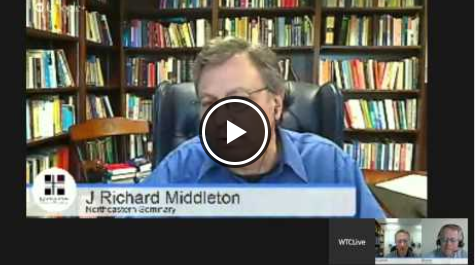
I’ve just completed (this afternoon) the online interview I mentioned in a previous post on the topic of creation and violence in the Old Testament. Bill Brown (of Columbia Theological Seminary) and I were interviewed by Matt Lynch of the Westminster Theological Centre in the UK.

Bill Brown is so eloquent (in both print and in person) that he sometimes makes me feel a bit tongue tied. But it was a lot of fun and we discussed topics such as Genesis 1 and the goodness of creation, violence as a perversion of the imago Dei, the Flood as a response to human violence, God’s role in prophetic judgment, etc.

In fact, we ranged quite a bit beyond the advertized topic of creation and violence in the Old Testament.

Brown was asked about the role of “wonder” as a key to the wisdom literature in connection his new book, Wisdom’s Wonder: Character, Creation, and Crisis in the Bible’s Wisdom Literature (Eerdmans, 2014). And I got to respond to questions about eschatology, in connection with my new book A New Heaven and A New Earth: Reclaiming Biblical Eschatology (Baker Academic, 2014).

The interview is available on online for those who missed it but still want to watch it.