What I Learned at the Evolution Conference

I promised a report on the the March 26-28, 2015 conference of the Colossian Forum entitled “Re-imagining the Intersection of Evolution and the Fall” held at Garrett-Evangelical Theological Seminary in Evanston, IL. I’ve been back for a week now, so it’s time to share some of my thoughts.

In general, I had a stimulating time of listening to thoughtful speakers and networking with a variety of scientists, theologians, philosophers, historians, and biblical scholars—a very worthwhile event.

My presentation on “Reading Genesis 3 Attentive to Human Evolution” was well received, and resulted in many great conversations afterwards.
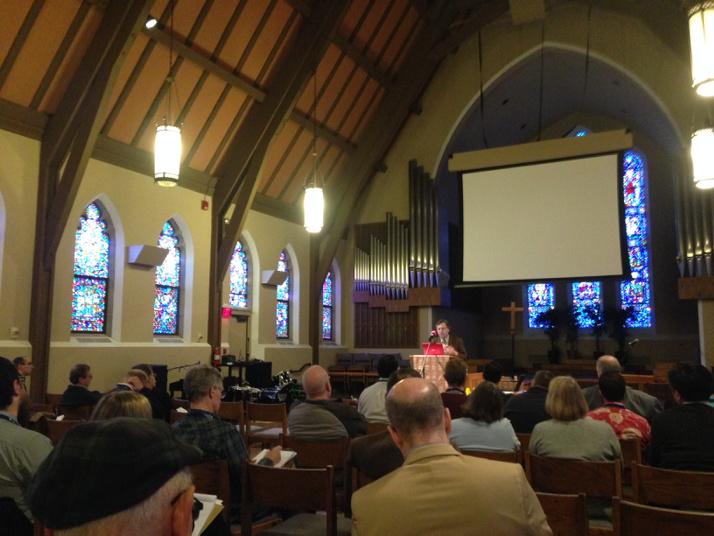
Photo of me giving my presentation on March 27, tweeted by Jamie Smith.

New Opportunities Arising from the Conference

While at the conference I was asked by BioLogos, the organization that funded the conference, to do a series of blog posts on the topic of my presentation (which I accepted). I was also invited to a BioLogos meeting of pastors, scholars, and others in San Francisco this Fall (all expenses paid) on the theme of the science/ faith intersection, called “Celebrating Creation.”

While at the conference I had a meeting with Jim Kinney and Steve Ayers, from Baker Academic (the publisher of my latest book, A New Heaven and a New Earth). Jim invited me to publish my next book with them, something I am happy to do. It is tentatively titled The Silence of Abraham, the Passion of Job (on lament prayer). I just sent Baker Academic a preliminary proposal.

What was my basic takeaway from the conference? There were two main points that struck me as important.

Taking Evolution Seriously

The first thing that struck me is that there are many orthodox Christian scholars, working in different fields, who fully embrace the evidence for the biological evolution of humanity over millions of years; they have no trouble being committed Trinitarian Christians while taking evolution seriously. This was a heartening realization, because it coheres with what I believe should be the outworking of a biblical doctrine of creation. Believing that the Creator made a world that is “very good” (Gen 1:31) suggests that we should trust that reliable knowledge of creation is possible, and this knowledge includes the findings of science, including evolutionary science.

Of course, science is an ever-changing field, as new data are uncovered, and not everything that scientists claim at a particular moment will still be claimed in the future. This is certainly true of the details of hominin evolution, including issues like precisely when Homo sapiens migrated from Africa or the precise dating of the male and female ancestors of all persons living today (which depends on understanding the rate of mutations of the Y chromosome and Mitochondrial DNA). Nevertheless, the general outlines are pretty clear and the fact of evolution is not really in dispute in the scientific community.

Taking the Christian Faith Seriously

If there was one significant difference of opinion that I picked up at the conference, it was over the issue of how we relate the Christian faith (including the doctrine of sin/the fall) to evolutionary science. While many scientists and some theologians at the conference clearly wanted to harmonize (in some way) the biblical accounts of origins and the fall with what we know (or think we know) about biological evolution, not all were convinced this was the best route to go.

The reasons were twofold.

The first has to do with the ever-changing field of scientific knowledge. Peter Harrison (a past Gifford lecturer, who has written extensively on the history of religion and science) gave a brilliant presentation on historical attempts to relate biblical teaching about the cosmos to contemporaneous science. He showed how quickly harmonizations of the Bible and science in the modern period had to be revised, as science grew and progressed, leaving some of the authors of new books on the subject looking quite foolish. So we shouldn’t be too quick to jump to an explanation of how biblical truth relates to the latest science.

But the second reason for resisting immediate harmonization is even more important. The biblical accounts of creation and fall have their own integrity, and these accounts make theological claims about origins in their own right. The danger in harmonization (laudable though it is to try and show connections between theology and science) is that we are in danger of changing what the text is actually claiming (for example, many attempts to connect the biblical accounts of origins to evolution end up denying the Bible’s affirmation of a good creation or the historical origin of human sin).

We need to attend to the fact that the Bible wasn’t written to satisfy our scientific curiosity about the cosmos, but rather has a salvific and ethical purpose. This was a point made especially by theologians and biblical scholars at the conference.

It was the judgment of many (though not all) at the conference that the church needs to attend to its own articulation of the significance of creation and fall, indwelling its own scriptural narratives in their full depth, without feeling pressured to make the Bible “fit” what science is currently telling us. This is not a matter of mistrusting science, but rather of respecting the integrity of the biblical witness to God’s purposes for the world articulated in texts like Genesis 1-3.

I was particularly struck this past weekend, as my church celebrated the paschal, mystery followed by Easter, in a series of services, of the amazing richness of the biblical story of Christ’s victory over death, which is meant to frame all of our lives, and guide us towards holy living. Far from us needing to explain away our faith to make it fit contemporary science, the existential truth and power of this deep mystery is a guide for living and thinking, including our thinking about and our practice of science.

My Own Approach to Evolution and the Fall

Not all the presentations at the conference explicitly addressed Genesis 3, the the classic “Fall” narrative. But, as an Old Testament scholar, that was the focus for my own paper.

When I began working on my paper, I initially framed it as an alternative to naive concordism and Non-Overlapping Magisteria (NOMA). The former approach is what I grew up with in the conservative evangelical church, where Scripture was understood as teaching scientific truth about the cosmos, including a young earth and a non-evolutionary history of biological organisms. The result is that much of modern science is rejected, and the rest is made to harmonize with Scripture.

NOMA is the approach advocated by Stephen Jay Gould, the famous agnostic scientist who wanted to respect what the various religious traditions said. He therefore affirmed that their truth was of a different order from that of the sciences, so that the various “magisteria” (science and religion) could never actually contradict each other.

I was dissatisfied with both approaches—the former since it doesn’t take science seriously and the latter since it seems to erect a concrete wall between science and faith that admits of no interaction.

I initially conceived of my paper as an attempt to get beyond both concordism and NOMA. To that end I set out to explore various theological motifs in Genesis 2-3, such as the creation of humans and animals from the earth, the meaning of the tree of life, the prohibition of the tree of the knowledge of good and evil, the significance of the snake and its dialogue with the woman, the subsequent narrative of transgression and judgment, and the spread of sin and violence in Genesis. Along the way, I made some tentative and speculative comments about how elements of this story might relate to a virtue ethics approach to the development of moral consciousness and also with the state of our current knowledge of evolutionary anthropology.

While some of my suggestions for possible connections with evolution were intriguing, in the end I came to the conclusion that our primary need is to understand the story of Genesis 2-3 in its own right before we try to relate it to evolutionary history. We need to take the time to understand (and indwell) this powerful narrative as the deepest truth of our origins as human beings and the origins of our falling out with God and one another. Only then will be in any position to think clearly about how this text might relate to human evolution.

Note: The conference proceedings are now published as essays in Evolution and the Fall (Eerdmans, 2017), ed. by William T. Cavanaugh and James K. A. Smith.

The Intersection of Evolution and the Fall

I am about to head off to a conference at Garrett-Evangelical Theological Seminary in Chicago called “Re-Imagining the Intersection of Evolution and the Fall,” to present a paper on Genesis 3 in light of evolution. This three-day conference (March 26-28, 2015) grows out of a research group I’ve been a part of for the past two years that has been tasked with addressing how orthodox Christians may think about the origin of human evil (the “Fall”) in the context of what we know about the evolution of humans on this planet.

The group has two biblical scholars (myself included), along with scholars specializing in theology, philosophy, biology, ethics, and history. Many of the scholars have expertise in more than one discipline, and many have previously written on this topic.

Here is the lineup of the research team, in alphabetical order, along with their disciplinary specializations:

  • William Cavanaugh (theology, political theory)
  • Celia Deane-Drummond (theology, biology)
  • Darrel Falk (biology)
  • Joel Green (New Testament, theology, neuroscience)
  • Peter Harrison (history of science)
  • J. Richard Middleton (Old Testament, theology)
  • Aaron Riches (theology)
  • James K.A. Smith (philosophy, theology)
  • Brent Waters (theology, social ethics)
  • Norman Wirzba (theology, environmental ethics)

Here is a list of the bios for each person on the team.

Each of us will be presenting our findings in plenary sessions at the conference. You can access the conference schedule here and you can read a brief summary of the content our our presentations here.

A more detailed summary of my own paper can be found here.

Beyond the plenary presentations, there will be multiple sessions of concurrent presentations by other scholars (twenty-two in all); some of these look very interesting. I even know some of these presenters; one of them is Matthew Hill, who has been an adjunct professor at Roberts Wesleyan College and now teaches philosophy at Ann Arbor University. A book based on his dissertation, called Evolution and Holiness, will be published by InterVarsity Press next year.

The papers from the conference (both the plenaries and possibly some of the concurrent papers) will be collected in a volume published by Eerdmans, scheduled to appear sometime in 2016. The volume will be edited by William Cavanaugh and James K. A. Smith, who are the co-chairs of the research team.

I’ll post some reflections about the conference when I get back.

The Problem of Animal Suffering in a Good Creation—Engaging Ronald Osborn’s Death Before the Fall (IVP, 2014), Part 2

In a previous post I explained my interest in the problem of suffering and summarized part 1 of Ronald Osborn’s book, in which he addressed various problems with a literalistic reading of the biblical creation accounts (that is, taking them to be a straightforward scientific or historical account of the world, as many modern Christians do).

In the present post I will address Osborn’s account of animal predation as part of the good world God made (since predation significantly contributes to animal suffering); I’m actually going to go a bit beyond Osborn, to strengthen his case.

In my final post I will interact with Osborn’s chapter on Christ’s redemption of animal suffering.

Osborn on Animal Suffering and Death

In the five chapters of part 2 of Death Before the Fall Osborn finally gets to his advertised topic—animal suffering. Osborn explains that the critique of literalism in part 1 “is to a large extent prolegomena” to part 2, which addresses “the theodicy dilemma of animal suffering and mortality” (p. 19).

Osborn correctly notes that this is a problem for both creationists and evolutionists. Although creationists often object to the implication of an evolutionary account of the world since it involves millions of years of the suffering and death of animals (through extinctions, disease, carnivores preying on herbivores), even creationists need to account for why God would allow animal suffering (especially through predation) to be so pervasive in a young earth.

If this is due to the Fall (human sin) as most creationists claim, doesn’t this seem like unjustified suffering? Since most creationists affirm that animals were vegetarian prior to the Fall, this means that carnivores are a post-Fall phenomenon. Does this mean that today’s carnivores were previously herbivores who suddenly grew (or evolved) canines? Or did pre-Fall carnivores use their canines for eating vegetation? And beyond all these crazy theories, creationists still need to answer the question of why animals have to suffer for human sin.

In part 1 of this review I noted that Osborn’s background in the Seventh Day Adventist church equipped him for addressing young earth creationism. In a similar manner, his approach to the problem of animal suffering is informed by having grown up in Zimbabwe of missionary parents, which included many visits to a game reserve. He mentions his awareness of the presence of predatory animals (crocodiles and jackals) and describes witnessing lions eviscerating a fresh kill with the smell of blood in the air.

The world of the game reserve was “deeply mysterious, untamed, dangerous, beautiful and good” and “the danger was part of its goodness and beauty. . . . Herein lies the central riddle of this book” (p. 13).

Although part 2 contains five chapters, the tension evident in the above quote is embodied in the contrast between chapters 12 and 13. These are the chapters that most interested me.

Animal Predation as Part of God’s Good Creation—The Witness of Job

Chap. 12 (“God of the Whirlwind”) explores the vision of the book of Job, where animal predation is part of the world God celebrates.

In response to Job’s complaint about his sufferings, God describes in his first speech an untamed non-human world that includes suffering and death (Job 38-42). Not only does God send rain on a land where no human lives (Job 38:26-28), but in his rhetorical questions to Job, God implies that he provides food for lions and ravens:

39  Can you hunt the prey for the lion,
or satisfy the appetite of the young lions,
40  when they crouch in their dens,
or lie in wait in their covert?
41  Who provides for the raven its prey,
when its young ones cry to God,
and wander about for lack of food? (Job 38:39-41)

Indeed, God commands the eagle to build her nest on high, from which she delivers prey to her young (Job 39:27-30), who “suck up blood;/ and where the slain are, there she is” (39:30). Those are the closing words of God’s first speech to Job, and I have often thought it is no wonder that Job was struck silent, at a loss for words at such a gruesome image.

But Osborn is right in emphasizing that throughout the first speech God is delighting in animal ferocity.

This delight continues in God’s second speech, where the creator boasts about Behemoth and Leviathan (given the mythic overlay of these beasts, I wouldn’t reduce them to known animal species, as Osborn seems to do here).

I initially thought that Osborn wrongly identified the second beast with Behemoth (pp. 153 and 157), but it turns out that he was using the New English Bible’s rendering of the first beast as a “crocodile,” which is what most interpreters take as a possible model for Leviathan, the second beast.

Part of the reason I misread Osborn here is that he quotes selections from the description of Behemoth (40:15-15, 19-20) along with selections from the description of Leviathan (41:12, 33-34), all in one block quotation, without distinguishing them from each other (p. 153).

He himself may have been confused by the NEB, which he was quoting, since it idiosyncratically translates 40:15 and 20 as if Behemoth (“crocodile”) was a carnivore (“who devours cattle as if they were grass” and “he takes the cattle of the hills for his prey and in his jaws he crunches all wild beasts”). In the NRSV these lines are correctly rendered: “it eats grass like an ox” and “the mountains yield food for it where all the wild animals play” (this is what the Hebrew actually says). In other words, while Leviathan is clearly a carnivore, Behemoth (seemingly modeled on a Hippopotamus) is a herbivore (though still a dangerous animal).

Despite this slip, Osborn’s point is well-taken that these dangerous beasts (like many animals in the first speech) are paraded before Job as part of a world God is proud of. Predation and danger therefore do not constitute “natural evil” in the book of Job.

Beyond Osborn—The Psalms on Animal Predation

A similar perspective may be found in the Psalms—although Osborn doesn’t explicitly address this. But his case could be strengthened by adding other relevant biblical references to God’s approval of animal predation as part of the natural order.

Just as Job mentions the feeding of ravens, so does Psalm 147. Verse 7 calls on the reader to sing praise to YHWH because “He gives to the animals their food,/ and to the young ravens when they cry” (verse 9). Ravens are omnivores, often scavenging on carrion.

And just as Job mentioned the feeding of lions (which are clearly carnivores), so Psalm 104 notes: “The young lions roar for their prey,/ seeking their food from God” (verse 21).

The psalm even claims that God feeds all animals:

27  These all look to you
to give them their food in due season;
28  when you give to them, they gather it up;
when you open your hand, they are filled with good things. (Psalm 104:27-28)

 This implies that at least some biblical texts (Job and Psalms) regard animal predation (thus animal death, even suffering) as simply part of the good world that God made; after all God feeds the animals. This is, therefore, not part of what we should regard as “evil.” If a human being is injured or killed by a wild animal, this is certainly “evil” to us; but to regard animal predation in general as “natural evil” is a highly anthropocentric judgment.

The Parallel between Animal Predation and Natural Disasters

Thinking of animal predation as “natural evil” is somewhat like viewing natural disasters (earthquakes, volcanic eruptions, hurricanes, tsunamis, tornadoes) as intrinsically evil. Yet such destructive phenomena have been part of the world long before humans; they are simply part of the natural geological forces and weather patterns on this planet. Like animal predation, when a natural disaster negatively impacts human life, this is certainly “evil” to us. But that has to do with the interaction of humans and nature, not nature considered independently.

Terence Fretheim’s book Creation Untamed: The Bible, God, and Natural Disasters (Baker Academic 2010) is a superb theological exploration of this theme.

Fretheim (who is one of the most careful readers of Scripture that I know) clarifies how we may think of natural disasters as part of the wildness of the cosmos that God has incorporated into the order of the world; this wildness is part of the good (but not “perfect”) creation that God made. Such natural phenomena may certainly be impacted negatively by human behavior (Fretheim suggests that Scripture itself supports this). And he boldly addresses how the Bible even portrays God as mediating judgment on humanity by the use of natural disasters—all the while affirming that such disasters are not intrinsically evil.

In my next post I will address Osborn’s chapter on Christ’s incarnation and atonement and how these relate to animal suffering. I will raise what I perceive as an internal tension between this chapter and the idea that animal predation/suffering is simply part of the good creation.