Herod as Pharaoh? My Talk for the Upcoming Rochester Preaching Conference (May 21, 2015)

On Thursday, May 21, I’ll be speaking at a conference called “From Interpretation to Preaching.”

My presentation will address Matthew’s use of Old Testament quotations/ citations in the infancy narratives (Matthew 1-2). There are four, five, or six citations, depending how you count them.

In chapter 1 Matthew quotes Isaiah 7:14 (the Immanuel prophecy), while chapter 2 contains quotes from Micah 5:2 (with an addition from 2 Samuel 5:2), Hosea 11:1, and Jeremiah 31:15 (plus a closing citation of “the prophets,” but there is no agreement what the OT reference is).

What Is Matthew Doing with the Old Testament?

As an Old Testament scholar, I’m interested in what Matthew is doing with these texts. Are they functioning simply as “proof texts,” or is there some exegetical strategy to their use?

Another, more theological, question is whether the infancy narratives in Matthew are simply a set of “feel-good” stories for the Christmas season; or do they have some intrinsic connection to the thrust of his Gospel? And if so, what might that be?

The title of my talk is “Herod as Pharaoh.”

Herod, Pharaoh, and Nebuchadnezzar

The connection to Pharaoh comes from Matthew’s use of Hosea 11:1 (which focuses on the exodus from Egypt). But I could just as easily have called the talk “Herod as Nebuchadnezzar” in connection with his use of Jeremiah 31:15 (which addresses the Babylonian exile).

Herod and David

There is also a link to David (as the shepherd of Israel) from the bit of 2 Samuel 5:2 that Matthew includes in the Micah 5 quote. But this is not an idealized David; the context indicates this is a David who is remarkably like Herod (and Pharaoh and Nebuchadnezzar).

The connection becomes clear from investigating each of the OT quotes in context. Not only do all the quotes address the crisis of ancient Israel in various sociopolitical contexts, but the context of the three prophetic quotes in Matthew 2 revolves around God bringing Israel back from exile and binding up their wounds.

Jesus as an Alternative “Son of David”

Matthew 1-2 is setting up Jesus, “the Messiah, the son of David” (Matthew 1:1) as a different kind of leader for Israel after their time of extended exile. Unlike Herod, and even David (both of whom have certain affinities to Pharaoh and Nebuchadnezzar), this Messiah doesn’t slaughter or oppress helpless Israelites, but rather tends them as a true shepherd (and ultimately suffers with them).

Matthew’s infancy narratives thus constitute a significant challenge to the leadership of first-century Israel.

So the subtitle of my talk is: “Matthew’s Subversive Use of Old Testament Quotations in the Infancy Narratives.”

Implications for Preaching

The introduction of Jesus in Matthew 1-2 has significant implications for us today, including for preaching that aims to get beyond pious platitudes. Indeed, Matthew’s vision of Jesus, the true “son of David,” generates a serious ethical challenge for the nature of leadership in the church and the wider society.

Esau McCaulley on Paul and the Law in Galatians

After my presentation, we will be hearing from Rev. Esau McCaulley (PhD candidate in New Testament at the University of St. Andrews), who will be joining the faculty of Northeastern Seminary in July 2015.

His talk is entitled “Preaching Paul and the Law in Galatians”; this is how he describes his focus:

“Everyone who preaches from Paul’s letters must eventually talk about the Law. This session will show how recovering the narrative of Israel’s history that informed Paul’s understanding of the Law can bring nuance and vigor to our preaching about the relationship between faith, Law, and the reign of the Messiah.”

For more information on Esau’s talk, see his expanded explanation here.

Second Annual Rochester Preaching Conference

Rev. McCaulley and I will be giving our presentations at the second annual preaching conference sponsored by the Rochester Consortium of Theological Schools.

The three Schools are Northeastern Seminary (where I currently teach), Colgate Rochester Crozer Divinity School (where I used to teach), and St. Bernard’s School of Theology and Ministry (where my church used to meet, until just recently). So I’ve got a connection to all three institutions.

Last year’s conference was held at Northeastern Seminary and the speaker was the president of Colgate Rochester, Dr. Marvin McMickle. In 2016 the conference will be held at Colgate Rochester and the speaker(s) will be come from St. Bernard’s.

This year’s preaching conference will take place at St. Bernard’s, with a focus on the value of serious biblical exegesis for good preaching (hence the title: “From Interpretation to Preaching”).

So this conference is not meant to be an introduction to preaching; rather, it is for those who want to dig deeper into Scripture, in order to reinvigorate their preaching. And you don’t even have to be a preacher to attend.

You can register for the 2015 Rochester preaching conference here.

This blog is also posted on the Northeastern Seminary website.

 

Current Issue of the Canadian Theological Review is the Best Yet

The current issue of the Canadian Theological Review, the journal of the Canadian Evangelical Theological Association (CETA), is now at press and should be ready shortly.

The issue consists of five papers that were presented at the Fall 2013 CETA theology conference held at Northeastern Seminary in Rochester, NY, plus another paper that wasn’t presented at the conference. In my opinion, this is the best issue of the journal yet. The papers, though diverse, are uniformly thought-provoking and insightful.

This is the lineup of articles:

  • J. Gerald Janzen, “Ecce Homo: The Servant of YHWH as Imago Dei in Second Isaiah”
  • Steven Bouma-Prediger, “Eschatology Shapes Ethics: New Creation and Christian Ecological Virtue Ethics”
  • C. Cord Sullivan, “Introducing the Incarnate Christ: How John’s Logos Theology Sets the Stage for the Narrative Development of Jesus’s Identity”
  • James Pedlar, “‘His Mercy is Over All His Works’: John Wesley’s Mature Vision of New Creation”
  • Andrew Van’t Land, “(Im)Peccability amid the Powers: Christ’s Sinlessness in a Culture of Sinful Systems”
  • Anthony G. Siegrist, “Moral Formation and Christian Doctrine: ‘The Conjunction against Which We Must Now Struggle’”

Old Testament scholar Gerry Janzen engages in a superb intertextual study of the Servant of YHWH in Deutero-Isaiah to illustrate the profound theology articulated in this figure; the Servant is both the human image of YHWH (even in his suffering) and the alternative to Babylonian idols (false images).

Theologian and ethicist Steve Bouma-Prediger asks what sort of virtues we need in order to manifest the Bible’s eschatological vision of a new creation; his unpacking of this biblical vision and his interaction with the field of ecological virtue ethics provides an excellent grounding for contemporary earthkeeping or creation care.

Cord Sullivan, graduate student at Northeastern Seminary, shares part of his thesis research, illuminating the background to the Logos theology of John’s Prologue by recourse to the distinctive use of memra (Aramaic for “word”) in Jewish Targums; this background then becomes the clue to the unity between the Prologue and the rest of the Fourth Gospel (an issue that has been contested in Johannine scholarship).

The paper by James Pedlar, who holds the chair of Wesley Studies at Tyndale in Toronto, is a detailed exposition of John Wesley’s mature understanding of the redemption of creation; by examining a series of relevant primary texts Pedlar clarifies Wesley’s vision of God’s love for all creatures.

The paper by Drew Van’t Land (student at the Institute for Christian Studies, Toronto) won the CETA theology award for best graduate student paper. Van’t Land addresses the knotty problem of how we can understand Jesus’s sinlessness given what we know of systemic evil; how did Jesus (if he was truly human) avoid being conformed to the pre-existing societal corruption he was born into? His concluding exegesis of Jesus’s two visits to the Jerusalem temple constitutes an enlightening exploration of the paper’s central theological claims.

Theologian Anthony Siegrist addresses how we get from the truth of doctrine to ethics, arguing these are not two separate categories (as often conceptualized), but that doctrine is meant to be morally formative; his analysis of the role of teachers in the process of communicating biblical truth for life-change is both insightful and encouraging to those who embrace this calling.

These articles are followed by a series of in-depth book reviews.

This issue of the Canadian Theological Review is currently at press and will be mailed out shortly. If you are not a CETA member, but would like to purchase a copy, please check out contact information for the journal on the CETA website.

Two other issues of the journal are currently being worked on, one incorporating papers from the Canadian Theological Society meeting given at the 2014 Congress at Brock University, the other showcasing papers from the Fall 2014 CETA conference at Wycliffe College on evangelical feminism.

The Canadian Theological Review is actively seeking submissions of both articles and book reviews for future issues.

No Dualisms! Byron Borger of Hearts and Minds Bookstore

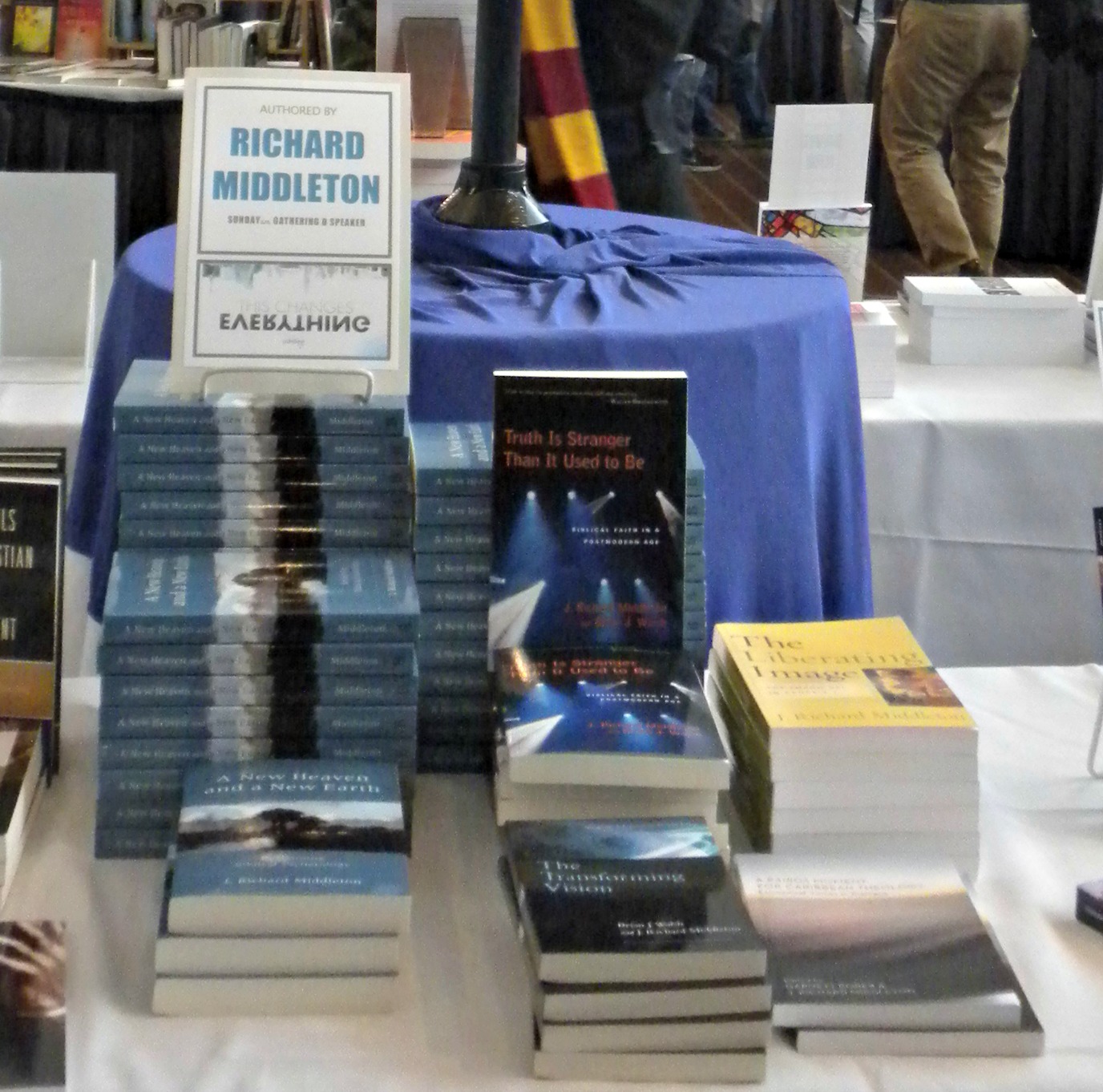
The book display at the Jubilee 2015 conference that I recently spoke at was organized and staffed (as it is every year) by bookseller extraordinaire, Byron Borger of Hearts and Minds Books.

When I say “book display” I should put that in the plural; there were multiple tables with an amazing array of works in theology, biblical studies, ethics, and topics on how faith relates to every aspect of culture and society.

Byron has an encyclopedic knowledge of good books, both classical and contemporary, and he has done a phenomenal job over the years introducing many Christians to a depth of life-transforming knowledge that they otherwise would not have known about.

The book displays also featured works written by speakers at this year’s Jubilee conference, including my own recent eschatology book, A New Heaven and a New Earth (plus all my other books!).

In fact, Byron has written two reviews of my eschatology book, one extended, the other briefer—to accompany his naming it as biblical studies “book of the year” (given the number of books Byron reads, that’s quite an honor).

Byron recently posted a comment on his Facebook page about one of my blogs (from about a year ago) that addressed the relationship of my own eschatological vision to that of New Testament scholar Tom Wright (via Brian Walsh).

Here is Byron’s post:

I have often noted how N.T. Wright dedicated his first big “Origins” book (“The New Testament and the People of God”) to Brian Walsh. Brian tells a bit about his studying Colossians with Wright in his and Sylvia Keesmaat’s “Colossians Remixed” and how he pressed Tom to more fully proclaim the full-orbed redemption the text insists upon. (And what a joy to have a back cover endorsement blurb right next to Tom on that extraordinary book!)

Here, the co-author of Brian’s “Transforming Vision” (one of my all time favorite books) J Richard Middleton shows the connection between TV, which they were writing even while Brian was engaging Tom Wright with a more comprehensive view of God redeeming all things. Now that Richard has written the definitive book on wholistic eschatology (“A New Heaven and a New Earth”) — and spoken about it at Jubilee last week — I thought I’d share his rumination on this little story.

Three cheers for their phrase “no dualisms” which CCO used to have printed up on staff tee-shirts! Three cheers for Tom, Brian, Sylvia, and Richard. I am thankful to know about such significant authors, and to praise God for these generative friendships.

Well, I couldn’t find a picture of the T-shirt that Byron mentions, but I did find this:

Byron, thanks for all your work for the kingdom!