The Problem of Animal Suffering in a Good Creation—Engaging Ronald Osborn’s Death Before the Fall (IVP, 2014), Part 1

I’ve been interested in the question of how the Bible addresses the problem of suffering for a long time. This is sometimes called the theodicy problem—from the Greek for God (theos) and justice (dikē). Many writers through history have tried to “justify” God in light of the reality of suffering.

My own interest in this question is based both on theology and personal experience.

First of all, I am drawn to the Bible’s theological vision of a good creation. Having written quite a bit about God’s creational intent for the world’s flourishing (in articles and books), I am keenly aware of the need to grapple with the reality that the world does not at present match up with that ideal.

But it isn’t just that the world (out there) doesn’t match up to this ideal. Around the time I was coming to fully embrace a positive biblical vision of a good creation (having just completed a book on the Christian worldview), my life began to experience serious dissonance from this vision. As a result, I found it difficult over a period of some months to trust in God’s goodness. (I’ve recounted some of this story in a previous blog post.)

During this time I was introduced to the psalms of lament as a powerful resource for renewing trust in God in the midst of suffering. One outcome of this experience was an essay I wrote on the problem of suffering and evil that contrasted the attempt of classical theodicy to “solve” the problem with the more experiential approach of the lament psalms (“Why the ‘Greater Good’ Isn’t a Defense”). Another was the book that Brian Walsh and I wrote on Christian faith in a postmodern world.

The Question of Evolution and Evil

I’m now being pressed to think further about suffering, given what I’ve come to understand about the evolutionary processes uncovered by various sciences (including paleontology and genetics). I am interested in how we might think about the Bible’s presentation of origins (origin of the world, of humans, of evil) in light of cosmic, biological, and human evolution.

I will be presenting a paper that explores the origins of human evil in Genesis 3 in light of human evolution at a conference called “The Intersection of Evolution and the Fall” next March in Chicago.

One facet of this issue is the reality of death and suffering prior to the origin of human beings. It seems undeniable to me that that biological death, animal predation, and natural disasters all predate humanity. We are latecomers on the scene, and plants and animals (from bacteria to dinosaurs) were subject to death by extinction, predation, accident, disease, or simply old age (if they were lucky) long before us.

This means that we can’t reasonably attribute these factors to the results of human sin (a “curse” on nature). Indeed, my own re-reading of Genesis 3 and other biblical texts has helped me realize that the common Christian assumption that nature was systemically affected by of human sin isn’t clearly supported in Scripture. (I’ll get to the origin of this idea later.)

Even with this realization, questions remain. This is where Ronald Osborn’s thoughtful new book comes in.

Ronald E. Osborn. Death Before the Fall: Biblical Literalism and the Problem of Animal Suffering. Downers Grove, IL: IVP Academic, 2014.

With vivid prose and an engaging perspective, Osborn addresses the problem of animal suffering for Christians, whether of “creationist” or evolutionary persuasions.

The book is tendentious (in the best sense of that term), arguing both for and against particular positions with passion and verve, yet it does not in the end come to a clear or unambiguous position on its primary topic, namely animal suffering. But the book certainly made me think, which (in my opinion) is high praise.

Osborn on Literalism

There are two prongs to Osborn’s argument, which make it, in effect, two books, or at least a book with two purposes, and two audiences. Part 1 (nine chapters) attempts to help conservative Christians move out of narrow literalism in their reading of the Bible’s creation narratives (by literalism he means an approach to the text that assumes a simple correspondence between what the Bible says and concrete realities in the external world); this approach tends to be associated with a young earth and treats the Noahic flood as the explanation for the fossil record.

Osborn is uniquely qualified to address this sort of literalism, since he was raised in the Seventh Day Adventist church. Although he doesn’t go into details about this, it was the founder of the SDA church (Ellen G. White) who popularized the view that flood geology (and not deep time) decisively explained the current fossil record (this having been revealed to her in a vision, in which she claimed to have actually observed the flood).

This interpretation of the fossil record (along with its assumption of a young earth, and the lack evolutionary descent) informed the hermeneutics of William Jennings Byran, the famous prosecutor in the so-called Scopes Monkey Trial of 1925 (Byran had read SDA literature on this topic). To this day, many in the SDA church are principled defenders of young earth creationism.

Since I do not count myself among those who read the Bible this way, I was less interested in part 1 of Osborn’s book. Nevertheless, there are some good chapters here. These include chap. 2: “Unwholesome Complexity,” which shows just how certain creationist readings end up tying the reader into interpretive knots, and chap. 6: “The Enclave Mentality,” which is perceptive about absolutism and the demonization of the other often found in fundamentalism.

I was particularly taken with the author’s characterization of the anxiety of a literalist reading of Scripture as “a high-stakes game of Jenga” (p. 45), where if you touch one of the bricks near the bottom the entire theological edifice might collapse. However, Osborn’s rhetoric in this section of the book can be dismissive at times, and might put off some readers who need to grapple with the important issues he raises here.

In my next two posts I will address part 2 of Osborn’s book, which explicitly addresses how we might think theologically about animal suffering.
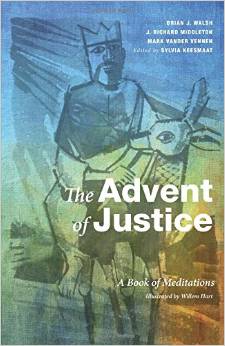
The Advent of Justice

Back when I was working on my PhD in Canada I was asked to contribute to a book of Advent meditations in honor of Citizens for Public Justice (CPJ), a Canadian justice organization run by Christians. To that end Sylvia Keesmaat, Brian Walsh, Mark VanderVennen, and I each wrote meditations for one of the four weeks of Advent readings from the daily Lectionary (seven meditations apiece); all of us had been involved in some way with this important justice organization.

I had been personally impacted by CPJ, including their published literature on a Christian approach to the political sphere and the helpful guides they provided to the various issues as each Canadian election approached. I was also impressed by their political advocacy in the name of Christ on behalf of those negatively affected by unjust social policies in the context of our modern consumer society. CPJ had been an important voice in helping me think through the political implications of my own Christian faith.

Since the Old Testament readings for that Advent season all focused on passages from Isaiah, which connected faith with justice, we decided to make this the focus of our meditations, while also drawing connections to the Gospel readings for each day.

These meditations were published back in 1993 by the CJL Foundation (an arm of CPJ), as a short book called The Advent of Justice. That book was then adopted by the Anglican Diocese of Toronto as an Advent study guide for that year.

A well-known Toronto artist, Willem (Bill) Hart, graciously contributed watercolors for the book cover and as introductions to each week’s meditations.

The Advent of Justice was reprinted the following year (1994) by Dordt College Press; and it’s been used on and off by lots of different people over the years as a guide to reflecting on the meaning of the Advent season.

The Advent of Justice has just been reprinted by Wipf and Stock publishers in time for this year’s Advent season. I was delighted that Northeastern Seminary decided to give copies away at their annual alumni reception (held a week ago). And they have just this past week posted my own Advent reflections from the book (with permission from the publisher) on the Northeastern Seminary website.

For anyone interested, the post for the first day of the week (Sunday) can be found here. The posts for the other days (Monday through Saturday) can be accessed from the right hand column of the website.

A flyer about the book can be accessed here.

Wishing you a blessed and meaningful Advent season.

Whatever Happened to the New Earth?

Here is  a post I wrote for the Baker Academic Blog, introducing my new eschatology book (it covers some ground I have previously blogged about). You can read the post in its original context on the Baker Academic Blog here.

My book, A New Heaven and a New Earth, has been a long time coming.

I wrote it over the last few years. But I’ve been working on it most of my life.

I grew up in Kingston, Jamaica, and enjoyed the beautiful Caribbean Sea ever since I was a toddler. But it wasn’t until I was nineteen that I began to go on hiking trips to Blue Mountain Peak, the highest point on the island.

On one such trip, I watched a breathtaking sunrise at seven and a half thousand feet above sea level. After some minutes of silence, my friend Junior commented wistfully, “This is so beautiful; it’s such a shame that it will all be destroyed some day.” I still remember the dawning awareness: I don’t think it will be. It did not make sense to me that the beauty and wonder of earthly life, which I was coming to embrace joyfully as part of my growing Christian faith, could be disconnected from God’s ultimate purposes of salvation.

Cover ArtTracking a Worldview Shift

This basic intuition or theological insight was confirmed by my study of Scripture during my undergraduate studies at Jamaica Theological Seminary.

Most contemporary Christians tend to live with an unresolved tension between a belief in the resurrection of the body and an immaterial heaven as final destiny. Many also have in the back of their minds the idea of the new heaven and new earth (from the book of Revelation), though they aren’t quite sure what to do with it.

I myself started my theological studies with this very confusion. But as I took courses in both Old and New Testaments and tried to understand the nature of God’s salvation as portrayed in the various biblical writings, it became increasingly clear that the God who created the world “very good” (Genesis 1:31), and who became incarnate in Jesus Christ as a real human being, had affirmed by these very acts the value of the material universe and the validity of ordinary, earthly life.

More than that, I came to realize that the Scriptures explicitly teach that God is committed to reclaiming creation (human and nonhuman) in order to bring it to its authentic and glorious destiny, a destiny that human sin had blocked.

It was during my junior year of theological studies that I came to the startling realization that the Bible nowhere claims that “heaven” is the final home of the redeemed. While there are many New Testament texts that Christians often read as if they teach a heavenly destiny, the texts do not actually say this. Rather, the Bible consistently anticipates the redemption of the entire created order, a motif that fits very well with the Christian hope of the resurrection—which Paul calls “the redemption of the body” (Romans 8:23).

It was after this startling realization that I first challenged an adult Sunday School class I was teaching at Grace Missionary Church (my home church in Jamaica) to find even one passage in the New Testament that clearly said that Christians would live in heaven forever or that heaven was the final home of the righteous.

I even offered a monetary reward if anyone could find such a text. I have been making this offer now for my entire adult life to church and campus ministry study groups and in many of the courses I have taught; I am happy to report that I still have all my money. No one has ever produced such a text, because there simply aren’t any in the Bible.

The Bible’s Best-Kept Secret

After my theological studies in Jamaica I moved to Canada to pursue graduate studies. During this time I coauthored a book with my friend Brian Walsh on developing a Christian worldview entitled The Transforming Vision. This book not only advocated a holistic worldview, without a sacred/secular split, it also explicitly grounded this worldview in the biblical teaching of the redemption of creation, including both the physical cosmos and human culture and society.

After writing The Transforming Vision together, Brian and I teamed up some ten years later to address the implications of this same holistic vision for postmodern culture in Truth Is Stranger Than It Used to Be, which, like the former book, combined biblical studies with cultural analysis.

Since that time the focus of my research has shifted more and more toward biblical studies, particularly Old Testament, the primary academic field in which I teach and write. In all my teaching and writing the consistent background assumption has been the same basic vision of holistic salvation that I have been working with since my undergraduate days in Jamaica—though in recent years I have been able to flesh this out in much more detail.

This holistic vision of God’s intent to renew or redeem creation is perhaps the Bible’s best-kept secret, typically unknown to most church members and even to many clergy, no matter what their theological stripe.

Having had to explain that the Bible envisions a new earth as the final destiny of the redeemed in many different settings and to different audiences, I finally decided to write an article that would marshal the central biblical evidence (as I understood it) for a holistic understanding of salvation, with a focus on eschatology. The article, entitled “A New Heaven and a New Earth,” was published in 2006.

The Time Is Ripe

Soon after its publication Rodney Clapp, who was then senior editor of Brazos Press/Baker Academic, suggested that I turn the article into a book. “The time is ripe,” he said, over a spicy dinner of Thai food, for an accessible and clear book-length statement of holistic eschatology. This book is my attempt to respond to Rodney’s eschatological-sounding challenge.

Whereas earlier centuries have attempted to clarify theological topics such as the incarnation, the Trinity, or justification by faith, the twentieth century has seen more intense focus on eschatology than ever before. Yet much of this eschatological reflection has been confused and inchoate, conflating an unbiblical impetus to transcend earthly life with the biblical affirmation of earthly life. This is true among both professional theologians and church members, and also among Christians of differing theological traditions.

The time is ripe, therefore, for a clearly articulated Christian eschatology rooted in responsible exegesis of Scripture, which is also attuned to the theological claims and ethical implications of the Bible’s vision of salvation. This eschatology will also need to be serviceable for the church, pointing the way toward faithful living in the here and now.

This book is one small contribution toward such an eschatology. Its primary purpose is to clarify how New Testament eschatology, rather than being a speculative add-on to the Bible, actually coheres with, and is the logical outworking of, the consistently holistic theology of the entirety of Scripture. It is the primary purpose of this book to sketch the coherent biblical theology (beginning in the Old Testament) that culminates in the New Testament’s explicit eschatological vision of the redemption of creation.

Along the way the book also explores some of the ethical implications of holistic eschatology for our present life in God’s world. And it investigates what happened to the biblical vision of the redemption of the earth in the history of Christian eschatology, tracing the loss of this vision and its partial recovery in recent times.