Northeastern Seminary—A Hidden Gem

Note: This post has been updated April 2017.

I started teaching biblical studies at Northeastern Seminary in 2011, having previously taught for ten years at Roberts Wesleyan College and for six years before that at Colgate Rochester Crozer Divinity School (all in Rochester, NY).

Northeastern Seminary was founded in 1998 by faculty from the religion, philosophy, and history departments at Roberts Wesleyan College (in consultation with Wesleyan theologian Tom Oden from Drew University). This was the fruition of a multi-year exploration of the possibility of a graduate-level theological institution on the Roberts campus.

Although Northeastern Seminary is, in effect, a graduate school of Roberts Wesleyan College, it is institutionally and legally separate, with its own charter and accreditation.

 My Teaching at Northeastern Seminary

I learned about Northeastern back in January 2002 when I began teaching Old Testament and Hebrew to undergraduate students at Roberts. My faculty position at the College included a part-time appointment at the Seminary, to teach one or two courses per year, plus serve as guest lecturer in various faculty’s courses as needed. After teaching a couple of Master’s-level elective courses at Northeastern, I settled into teaching a “Scriptural Foundations” course for the fledgling D.Min. program, which began in my second year at Roberts.

My teaching at Northeastern currently includes a Core course called “Biblical Worldview: Story, Theology, Ethics” and an introduction to Biblical Exegesis (both courses are taken by all Masters students in their first semester), plus a number of advanced courses in Biblical Exegesis, which have variable content (I have taught sections of Genesis, 1 and 2 Samuel, the Psalms and Job, and case studies in the New Testament use of the Old Testament).
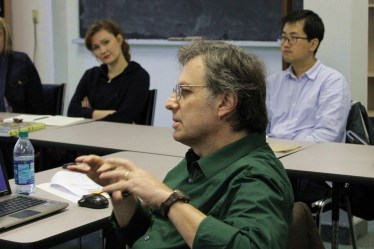
My goal in these courses is to introduce students to the comprehensive, holistic, life-giving vision of the Scriptures (“Biblical Worldview”) and to hands-on, detailed, close reading of biblical texts (“Biblical Exegesis”). Both sorts of courses are intended to help students become responsible interpreters of Scripture for teaching and preaching in the church.

A Unique Tradition and Perspective

Northeastern Seminary continues the tradition of Roberts Wesleyan College, which was founded by B. T. Roberts in 1866. Roberts was an advocate of Wesleyan “social holiness,” so his Christian faith led him to oppose slavery and oppression of the poor, and to support women’s right to vote and even ordination (his book Ordaining Women was published in 1891). Along with a number of others, he founded the Free Methodist Church in 1860.

https://i0.wp.com/media.salemwebnetwork.com/Christianity/HistoryTimeline/20725.jpg

While the Seminary derives from the Free Methodist tradition and is nourished by the vision of B. T. Roberts, it is ecumenical in scope, with students from over thirty denominations, including Baptist, Presbyterian, Pentecostal, independent/ non-denominational, United Church of Christ, Anglican/ Episcopal, Roman Catholic, and various Wesleyan traditions (Free Methodist, United Methodist, Nazarene, Wesleyan, AME, AME Zion, CME).

The student body currently numbers 165 and includes about one-third African-Americans. The average age is 42 (though students range from those just out of college to those in their sixties or seventies).

The Seminary curriculum was developed to cater to working people (both ordained and lay), so courses are offered in the evenings, and students from distance locations in Buffalo, Syracuse, and Albany are linked by video conferencing. Since it opened its doors in 1998 Northeastern Seminary has graduated about 400 students, serving in widely different forms of ministry in North America and throughout the world.

The Seminary is committed to grounding students in the classic tradition of theological orthodoxy (reaching back through the ecumenical creeds to the Bible) with relevance to the current needs of church and society in a postmodern age.

The Core Curriculum at Northeastern

Northeastern Seminary has an unusual Core curriculum, which includes a sequence of four semesters of comprehensive, interdisciplinary, foundational courses (labeled BHT for Bible/History/Theology). Each course is organized around a different historical period:

Semester 1: Biblical Worldview: Story, Theology, Ethics (taught by Dr. J. Richard Middleton).

Semester 2: The Formative Era: From Synagogue to Cathedral – Growth and Change in the Early and Medieval Church (taught by Dr. Rebecca Letterman).

Semester 3: The Protestant Era: Reformation and Revival in the Church (taught by Dr. Josef Sykora).

Semester 4: The Modern and Postmodern Era: The Church in an Age of Science, Technology, and Secularization (taught by Dr. Elizabeth Gerhardt).

These four interdisciplinary courses are each combined with an accompanying Core course in Biblical Exegesis: Introduction to exegesis the first semester, then case studies in various texts of the Old and New Testaments in the following three semesters.
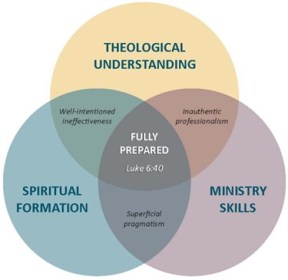
These courses are accompanied by four semesters of an intentional spiritual formation component, which includes retreats, chapel services, and faith sharing groups directed by trained spiritual facilitators, each of whom mentors a group of 6-10 students.

There are also a variety of post-Core courses in Bible, theology, ethics, history, ministry, pastoral/ spiritual formation, and field education that students take (the particular combination depends on which degree program a student is enrolled in).

The curriculum exposes adult learners to serious study of Scripture and to the ecumenical church in its complex development throughout history, while equipping them with practical courses in ministry. This rigorous academic approach is intertwined with spiritual formation so that students integrate their biblical and theological learning with their growing faith.

Programs of Study at Northeastern Seminary

The seminary currently offers five degrees, all of which are fully accredited by the Association of Theological Schools (professional), the Middle States Association of Colleges and Schools (regional), and the New York Board of Regents (state).

Four are Master’s degree programs:

  • M.A (Theological Studies)
  • M.Div.
  • M.A. in Theology and Social Justice
  • M.A. in Transformational Leadership

The fifth is a Doctor of Ministry (D.Min.) degree.

While the first M.A. is the degree of choice for those desiring an academic grounding in theological studies (with the possibility of a thesis), the others are explicitly professional degrees, meant to prepare students for various forms of ministry in the church and the world.

The D.Min. is an advanced professional development degree for those with a minimum of three years ministry experience after the M.Div. (it requires a major research project or dissertation).

Northeastern Seminary has worked out an arrangement with the graduate department of Social Work at Roberts Wesleyan College to allow interested students to complete either the M.Div. or the M.A. (Theological Studies) in tandem with an M.S.W., with less time than it would take to do both degrees separately (due to course overlap).

The Seminary has also entered into an agreement with the religion and philosophy department at Roberts, which, when NY State approval is received, will allow religion students to enter the Seminary after three years of undergraduate study instead of four (students would jointly receive their B.A along with their Seminary degree).

Northeastern Seminary Faculty

The Seminary has seven regular faculty, who teach the Core courses and electives; some faculty are also involved in administration and supervise Field Education.

  • Dr. Douglas R. Cullum (Ph.D., Drew University), Vice President and Dean; Professor of Historical and Pastoral Theology
  • Dr. Elizabeth Gerhardt (Th.D., Boston University School of Theology), Professor of Theology and Social Ethics.
  • Dr. Nelson J. Grimm (Ph.D., University at Buffalo), Director of Field Education and Professor of Applied Theology.
  • Dr. Rebecca S. Letterman (Ph.D., Cornell University), Associate Professor of Spiritual Formation.
  • Dr. J. Richard Middleton (Ph.D., Vrije Universiteit, Amsterdam), Professor of Biblical Worldview and Exegesis.
  • Dr. Esau McCaulley (Ph.D., University of St. Andrews), Assistant Professor of New Testament and Early Christianity.
  • Dr. Josef Sykora (Ph.D., Durham University), Director of the Doctor of Ministry Program; Assistant Professor of Biblical Interpretation.

There are also faculty members at Roberts Wesleyan College who hold special appointments as part-time faculty at the Seminary .

  • Dr. David Basinger (Ph.D., University of Nebraska at Lincoln), Professor of Philosophy and Ethics.
  • Dr. Scott Brenon Caton (Ph.D., University of Rochester), Professor of History and Culture.

The Seminary also has numerous adjunct faculty from the College and the community who teach a variety of elective courses on different topics (some are pastors, others teach in other institutions).

D.Min. Dissertations and M.A. Theses that I’ve Supervised

Although Northeastern Seminary has as its goal the preparation of women and men for various forms of ministry in the contemporary church and world, the curriculum allows for those who desire to pursue academic research in a variety of areas.

Since I began teaching full-time at Northeastern in 2011, I’ve supervised quite a variety of D.Min. dissertations and M.A. theses. Some of these have addressed topics at the interface of theology and biblical studies, while others have explored theological issues in connection with philosophy, ethics, liturgy, and cultural studies. You can get a good sense of the interdisciplinary nature of the Seminary from the titles of the dissertations and theses I’ve supervised:

  • Reclaiming the Biblical Message: A Caribbean Theological Perspective (Ajilon Ferdinand)
  • The Open Vocation of Humanity as Established in the Genesis Cosmogonies and Its Implication on Scripture (Traci Birge)
  • Indwelling the Biblical Story: The Liturgical Grounding of the Church’s Identity and Mission (Jonathan Poag)
  • Living Sacramentally: The Problem of Being and Doing with Special Reference to Thomas Aquinas (Margaret Giordano)
  • The New Creation Fugue: The Interweaving of Individual, Community, and Cosmos in Paul’s Theology of New Creation (Calvin Smith)
  • Two Pauline Ways to Describe the Ethics of the Resurrection Life (Matthew Davis)
  • Introducing the Incarnate Christ: How John’s Logos Theology Sets the Stage for the Narrative Development of Jesus’s Identity (Christopher Cordell Sullivan)

An Open and Ecumenical Orthodoxy

Northeastern Seminary combines the best of classical theological orthodoxy with a generous openness to a variety of viewpoints from many ecumenical traditions. The Wesleyan theological roots that nourish the Seminary are characterized by fidelity to Scripture and the ecumenical creeds of the church, while the contemporary plant puts out shoots in multiple directions and flowers into an open-ended exploration of how the faith (once for all delivered to the saints) relates to the contemporary world, with its often difficult questions and issues.
Northeastern Seminary could therefore be characterized (as I myself was once described, when being introduced as a retreat speaker) as being “more conservative than the conservatives and more liberal than the liberals.” Without wanting to claim that every faculty member is just like me (they are certainly not), I think this paradoxical summary gets at my experience of the Seminary as transcending the typical “culture wars” approach to life found in many theological traditions.

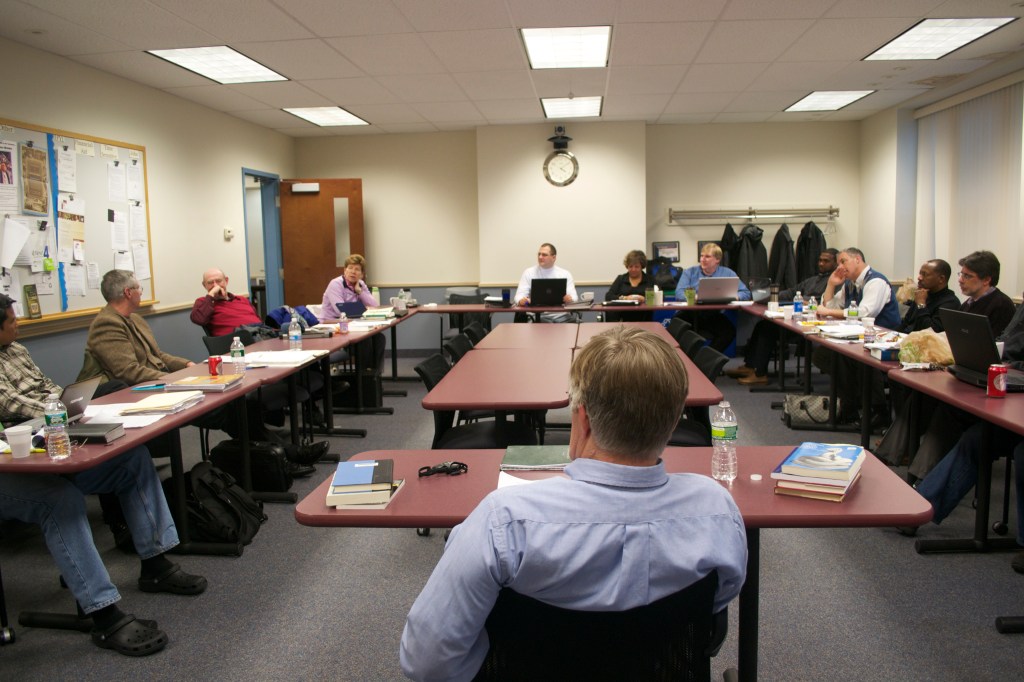
In classes, faculty and students engage in guided investigation of Scripture, tradition, and the world around us, grounded in our commitment to the triune God revealed in the incarnate Christ, yet without narrow assumptions that prejudge important questions in advance.

Our full- and part-time faculty come from Methodist, Lutheran, Charismatic, Episcopal/Anglican, Brethren, and Roman Catholic traditions, and most have been shaped by complex denominational experiences beyond their current church membership (including Presbyterian, American Baptist, Primitive Baptist, and Missionary Church).

While each faculty member has their own theological orientation and disciplinary specialization, we all respect each other and honor both our common faith in Christ and the diversity and expertise we bring to the table. One important clue to the atmosphere of the Seminary is that faculty meetings are often characterized by laughter—we really like each other!

Northeastern Seminary—A Hidden Gem

In short, Northeastern Seminary is a hidden gem. I’m delighted to be teaching at this unique theological school.

If you’re interested in learning more about Northeastern Seminary, you can can find answers to many of your questions on the FAQ page. Further inquires can be directed to the relevant admission staff members.
A Psalm Against David: Why David Didn’t Write Psalm 51

I’m scheduled to present a paper at the Institute for Biblical Research (IBR), a sort of evangelical version of the Society of Biblical Literature (SBL), at their annual meeting in Atlanta, on November 20, 2015. It happens just before the start of the SBL.

The paper is called “A Psalm against David? A Canonical Reading of Psalm 51 as a Critique of David’s Inadequate Repentance in 2 Samuel 12.

The paper is an attempt to read Psalm 51 carefully in light of the superscription, which links it to David’s confrontation by the prophet Nathan in 2 Samuel 12 over his adultery with Bathsheba.

The trouble is that a close reading of the psalm just doesn’t fit with the narrative, at multiple levels. So, what is an evangelical, orthodox Christian to do with that?

Since psalms superscriptions are not original to the psalms, but inserted by later editors (I give evidence for this in the paper), I propose that we take the superscription to Psalm 51 as a (divinely inspired) lectionary suggestion for reading the psalm together with the 2 Samuel narrative.

The result of doing this, I argue, is that the psalm ends up being a critique of David’s superficial “repentance” in 2 Samuel 12. My paper, therefore, challenges the naive, idealistic reading of the figure of David often found in the evangelical church (but then anyone who reads 1-2 Samuel with their eyes open would be disabused of this ideal picture anyway).

The paper is, most fundamentally, my attempt to take the authority of Scripture seriously (regarding both Psalm 51 and 2 Samuel 12 as divinely inspired), with eyes wide open to the complexity of this divinely inspired Scripture.

I tested out a short version of the paper at the recent meeting of the Canadian Evangelical Theological Association in Ottawa, and got good discussion there.

The research group of the IBR in which I’ll be presenting the paper (called Biblical Theology, Hermeneutics, and the Theological Disciplines) posted my draft of a longer, fuller version of the paper so that anyone can read it and send comments to me. I’ll then have a chance to revise the paper in light of the comments, and it will be re-posted in late October, prior to the conference.

The paper will be published (probably in 2017) in a volume of essays coming from the IBR research group, tentatively entitled Explorations in Interdisciplinary Reading: Theological, Exegetical, and Reception-Historical Perspectives, ed. Robbie Castleman, Darian Lockett, and Stephen Presley (Eugene, OR: Pickwick).

I invite you to post your comments or questions here.

Repenting of Heaven (Brian Walsh on A New Heaven and a New Earth)

Brian Walsh’s Reflections on J. Richard Middleton’s A New Heaven and a New Earth (Baker Academic, 2014) presented at the Canadian Evangelical Theological Association, May 31 in Ottawa. Re-posted with permission from the Empire Remixed website.

“This changes everything.”

That is how Richard Middleton closed his talk at the 2015 Jubilee Conference in Pittsburgh. Having presented a stunning lecture focusing on four New Testament texts demonstrating the holistic eschatology presented in his book, A New Heaven and a New Earth, Richard boldly proclaimed that if this eschatology is true, then “this changes everything.”

My students this semester at the University of Toronto came to the same conclusion. About three weeks into our discussion of Richard’s book, there was a moment in class when it dawned on everyone in the room. This changes everything.

What Changes?

Once you ‘repent of heaven,’ (p. 237) as Richard calls us to do; once you abandon as unbiblical the notion of heaven as the eternal destiny of believers; once you see that such a vision “has no structural place in the [biblical] story” because it is “simply irrelevant and extraneous to the plot,” (p. 71) well, this changes everything.

With the collapse of the hegemony of this unbiblical eschatology, pretty much everything in the ‘Great Tradition’ collapses with it. Everything that hangs on the dualistic distortion that gave us an unbiblical heaven theology – from the hierarchical structures of the church, to the establishment of a sacred caste of Christians called the ‘ordained,’ to cathedral architecture that mirrors the heaven/earth, sacred/secular dualism, to a ubiquitous spirituality of ascent– all of this must either collapse or be radically deconstructed. The church’s understanding of her mission and calling in the world, her prayer life and the songs that she sings must all be changed.

This changes everything, and while Richard is not the first to call for such a radical reorientation of Christian hope, he has provided us with the most substantial and in-depth biblical theology of holistic eschatology that we have seen.

A Liberating and Disorienting Book—Moving Beyond a Bifurcated Worldview

For my students the book was both liberating and disorienting. Liberating because it provided the kind of biblical scholarship that they needed to set them free from a bifurcated worldview that is, for them, unfruitful, alienating and downright embarrassing. “Finally,” I could hear them and so many others say, “the last nail has been put in the coffin of this eschatology that doesn’t really know anything about resurrection.”

And yet this is also disorienting. If we repent of heaven, then what do we do with the word? What happens to ‘heaven’ in our pious discourse? Indeed, what is the nature of a non-heavenly directed piety? What do we say at the deathbed of a loved one? Do we strip folks of the language of ‘going-to-heaven-when-I-die’ if it is so comforting? What are we going to do with our hymnody? Every week there are heaven references in the songs we sing at church. Do we repent of singing these songs – traditional hymns and contemporary praise choruses alike?

A Deeper Liberation and Disorientation—The Issue of Cultural Concreteness

But there is an even deeper way in which all of this is both liberating and disorienting.

Early in the book, Richard tells us that when folks get to talking about their understanding of Christian faith, including eschatology, “the elephant in the room” is cultural concreteness. All of this theological talk–even when it explicitly insists upon the connection of the gospel and culture–seems to be ethereal, somehow removed from the concreteness of real “cultural and social meanings, artifacts and institutions.” (p. 23) And what is liberating about Richard’s book is that it seeks to shape a “substantive vision that could guide significant action in the world.” “Ethics is lived eschatology,” (p. 24) he writes , and “redeemed human beings, renewed in God’s image, are to work toward and embody this vision in their daily lives.” (p. 27) Herein is liberation.

But how? Once Richard has so powerfully and evocatively offered us such a holistic eschatological vision, we are left yearning for concreteness, longing for an indication of what this lived eschatology looks like in our real lives at the end of modernity, in the face of catastrophic climate change, in the waning of the American empire, in the violence of post-colonial terrorism, the injustice of the gilded age of global capitalism, the dismantling of the common good, and the increasing irrelevance at best and total accommodation at worst of the church.

A liberating vision can devolve into paralyzing disorientation if you can’t begin to see how this vision illuminates real life in time and place. So perhaps we need to say that just as ‘concreteness’ is the elephant in the room for the church, perhaps that same elephant is lurking in the pages of A New Heaven and a New Earth.

Moving beyond Thinking to Action—Embodying Holistic Eschatology

It is, of course, easy and cheap to criticize an author for what he did not say, rather than engaging what he did say. This is not my intent. Rather, I want to take the ‘this changes everything’ impact of this book very seriously and ask, how this vision of holistic eschatology could in fact, concretely ‘change everything.’

Let me put the question this way: how would we know if A New Heaven and a New Earth was successful in fulfilling the ministry to which it has been called? What is the desired impact of this book, and its vision, in the life of the church in the world? Certainly we don’t evaluate these things by book sales. Nor should we evaluate the impact of Richard’s vision simply by how many people he ‘convinced’ so that they start to ‘think’ differently about eschatology. That would be a good thing, but surely not enough.

It seems to me that Richard offers us his own criteria for the desired outcome of this vision:

In the present, as the church lives between the times, those being renewed in the imago Dei are called to instantiate an embodied culture or social reality alternative to the violent and deathly formations and practices that dominate the world. By this conformity to Christ … the church manifests God’s rule and participates in God’s mission to flood the world with the divine presence. In its concrete communal life the church as the body of Christ is called to witness to the promised future of a new heaven and a new earth, in which righteousness dwells. (p. 175)

To instantiate an embodied culture or social reality in the concrete communal life of the body of Christ, witnessing to a new heaven and a new earth in which righteousness dwells. These are important words: instantiate, embodied, concrete, body, dwells.

What Prevents Us Embodying a Holistic Eschatology?

So what gets in the way? Is it simply that we don’t think correctly about heaven and earth? Is it simply a matter of correcting our theology and then it will all fall into place? No. Richard is too good a worldview thinker to think that thinking will solve the problem of doing. Something much deeper is going on here.

Towards the end of the book, Richard says that we don’t embody social and cultural alternatives because of certain “ingrained bifurcated habits of mind and life.” (p. 272) Ingrained habits, a certain way of inhabiting the world that precludes or at least hampers the full embodiment of this vision. We have ingrained habits of habituation, if you will, in which righteousness – that full bodied shalom of God’s cosmic restoration of all things – has been geographically displaced. Righteousness cannot, ultimately dwell on earth because its home is in heaven.

And so Richard suggests that “we need a hermeneutic of immersion and habitation, so that we might indwell the text and hear Jesus calling our own church practices and lives into question in the radical light of the gospel.” (p 277) Then a few pages later, after telling us that he will not “pontificate about what particular issues Christians should support or oppose today in the so-called culture wars,” (p. 280) he writes that “… Christians need to have their imaginations grasped by the radically holistic vision of redemption that the Bible teaches, and to engage their world … with daily acts of courage and love on behalf of those in need, even if–especially if–they are different from us.” (p. 281)

Yes, yes, yes. A hermeneutic of habitation, indwelling the text – surely this is what Paul meant when he spoke of letting “the word of Christ dwell in you richly” (Col. 3.16). And yes, yes, yes, this is indeed a matter of allowing our imaginations that have been so long held captive in a constricted dualistic worldview to be set free, to be grasped by a holistic vision.

Imagination Is Transformed through Concrete Engagement with the World

But note well, our imaginations are grasped and liberated by a radically biblical vision only in the midst of concrete engagement, only in those daily acts of courage and radical discipleship. You see, while the concrete particularity of our actions are blind without imagination, so also is imagination without such concrete particularity impotent.

Richard calls us to repent of heaven, and he knows that there is no point to repentance if it is not the flip side of conversion. A hermeneutic of habitation, indwelling the biblical story as one’s own, is only possible if there has been a radical re-habituation of our lives to the Kingdom of God.

The Re-Habituation of Our Lives—James K. A. Smith on Christian Formation

Enter Jamie Smith into our conversation. “Christian formation,” Smith writes, “is a conversion of the imagination effected by the Spirit, who recruits our most fundamental desires by a kind of narrative enchantment–by inviting us narrative animals into a story that seeps into our bones and becomes the orienting background to our being-in-the-world.” (Imagining the Kingdom, Brazos, p. 14.)

Smith and Middleton agree. We are talking about the conversion of the imagination here. But how does that happen?

Akin to the exposition of ‘worldview’ that Richard and I offered thirty years ago in The Transforming Vision (IVP, 1984), Smith’s cultural liturgics is an intellectual project that paradoxically argues for the relativization of the intellect. Smith is engaged in “… a theoretical attempt to appreciate our pretheoretical navigation of the world–a theory about the primacy and irreducibility of practice.” (Imagining, p. 75)

As I see it, A New Heaven and a New Earth is a theoretical exercise in biblical theology that seeks to reshape our pretheoretical navigation in the world, that is, to reshape our imaginations. Again, Smith is helpful. “Liturgical animals,” he writes, are imaginative animals who live off the stuff of imagination: stories, pictures, images, and metaphors are the poetry of our embodied existence.” (p. 126)

Richard is seeking the liberation of our imaginations precisely by enchanting us with an alternative telling of the biblical story, that paints a different picture of the world, funded by images of creational flourishing. And he does all of this by deconstructing (and reconstructing) how the creational realm of ‘heaven’ (or ‘the heavens’) has served as a misdirected metaphor of eschatological hope. The problem that Richard is addressing isn’t just an incorrect way of thinking, but more profoundly, the deformation of the imagination by a misplaced telos to human life.

“It is because I imagine the world (and my place in it) in certain ways,” Smith continues, “that I am oriented by fundamental loves and longings. It is because I ‘picture’ the world as this kind of place … that I then picture ‘the good life’ in a certain way … and thus construe my obligation and responsibilities accordingly.” (pp. 124-125) Therefore, imagination precedes desire. “We don’t choose desires; they are birthed in us. They are formed in us as habits, as habitus.” (p. 125) If we are to break free of our ingrained bifurcated habits of mind and life, embrace a hermeneutic of habitation, be enchanted by a narrative of creational flourishing, and reimagine our lives with a telos of cosmic redemption, then we will need a transformed and converted habitus.

How Do We Become Habituated to a New Vision?

Pierre Bourdieu’s notion of habitus as “a way of being, a habitual state … and … a disposition, tendency, propensity, or inclination” to live in certain ways is incredibly helpful here. (Pierre Bourdieu and Loic J. D. Wacquant, An Invitation to Reflexive Sociology, University of Chicago Press, p. 18)

Smith notes that a habitus is “the complex of inclinations and dispositions that make us lean into the world with a habituated momentum to certain directions.” And therefore, “We don’t ‘decide’ our way into every action. Our being-in-the-world is characterized by inclinations that propel us to all sorts of action ‘without thinking.’” (Smith, Imagining, p. 79) We inhabit a habitus with a certain telos and our imaginations and character are formed accordingly.

Listen closely to what Bourdieu says; “the habitus—embodied history, internalized as second nature, and so forgotten as history—is the active presence of the whole past of which it is a product.” (Cited by Smith, p. 83.) This habitus, this inhabited, embodied way-of-being, this narrative with heaven as its ultimate telos, “is the active presence of the whole past of which it is a product.” Think for a moment how long and powerful that past is and you begin to grasp the enormity of the epic struggle into which this book has entered. This does indeed ‘change everything.’

So we see that the issue of cultural concreteness with which I began my remarks isn’t just a matter of asking to see the ‘ethical implications’ of a holistic eschatology. Much more is at stake here. Bearing the weight of Christendom, with its misformed imagination and cultural practices on our shoulders, we need to envision and enact alternative practices to both the Great Tradition of Christian dualism and to the idolatrous and degenerative socio-economic culture of global capitalism.

Again, listen to Smith: “We are attuned to the world by practices that carry an embodied significance. We are conscripted into a Story through those practices that enact and perform and embody a Story about the good life.” (p. 137) We need the concreteness of alternative practices if we are to be conscripted into the story of creational flourishing, cosmic renewal and holistic eschatology. Without that concreteness, the story that Richard is telling cannot be believed, and we will not be attuned to the world of the Kingdom of God coming in all of its creation redeeming power.

Liturgy That Rehearses the Biblical Story

So what concrete practices might we be talking about? For Smith, the most foundational concrete practice is worship. The true story will only shape our perception of the world and transform our character if we learn it “by heart,” at “a gut level.” “And that happens,” Smith argues, “primarily and normatively in the practices of Christian worship–provided that the practices of Christian worship intentionally carry, embody, enact, and rehearse the normative shape of the Christian Story.” (p. 163) Not only does there need to be a transformative liturgical intentionality to the practices of worship, those practices need to enact and rehearse the normative shape of the Christian story. And here we see the most powerful contribution of A New Heaven and a New Earth. In this exercise in biblical theology, Richard has powerfully, comprehensively and convincingly opened up the normative shape of the Christian story.

Liturgical Practices That Need to Be Abandoned

The problem, of course, is that Christians (and everyone else, if you take Smith’s broader notion of homo liturgicus seriously) have always been most deeply shaped through worship, ritual, symbol, image and metaphor. But because that worship has been taken captive by the telos of heaven as our eternal home, it has engendered bifurcated habits of mind and life, resulting in a habitus unfit for inhabiting a restored creation in which righteousness is at home. We are not at home in righteousness because we are not at home in creation, and it is our worship that continues to render us so homeless.

So if the practices of worship have deformed our imaginations then we must repent of those practices. We will need to be intentional about abandoning liturgical practices that reinforce a false telos and continue to leave us with a piety that is private, personalistic and fundamentally disconnected from the wounded world that Jesus came to redeem. And that means:

  • No more songs about going to heaven.
  • No more romanticized “Jesus is my boyfriend” sentimentality.
  • No more prayers that are narcissistically preoccupied with our own lives while fundamentally ignoring the lives of our neighbours down the street and around the world.
  • No more evangelism/social action dichotomies.
  • No more “incanting anemic souls into heaven” while “conniving directly in the murder of Creation.” (Wendell Berry, Sex, Economy, Community and Freedom, Pantheon, pp. 114-115)
  • No more cheap heavenly hope at funerals.
  • No more pious language unrelated to the real economic, ecological, social, political and cultural lives that we lead in this place and at this time.

If our worship is going to liberate our imaginations then it will need to be profoundly biblical, symbolically rich, culturally engaged, unafraid of lament and pain, deeply Eucharistic, and so honestly authentic that it will simply not put up with bullshit.

Practice Resurrection

Ethics is always lived eschatology, and as long as our worship orients us to a false telos, our lives will embody that unbiblical eschatology. But worship alone, or at least the rituals of Christian liturgy alone, are not enough to bring about the liberated imagination that would animate the concreteness of a holistic eschatology.

If resurrection, not heaven, is at the heart of Christian hope, then we need to ‘practice resurrection’ in the daily rituals of our lives and the concrete cultural practices of the discipleship community. Without such transformative practices, Richard’s vision of holistic eschatology is not only left without concreteness, it is rendered unbelievable and literally unknowable. Unless the truth is made flesh, there is no incarnate significance. There is only embodied knowing within bodies–our bodies, and the body-politic that is the church.

You Must Be Born Again

So if you like what Richard has done in this book, if you are enchanted by this story of creational redemption and you are ready to repent of an unbiblical theology of heaven, then you must be born again.

You must be converted in all of your life to practices of regeneration in a culture of extraction,

  • of economic justice in a world of oppression,
  • the common good in the face of an ideology of privatization,
  • hospitality instead of fear,
  • truth in contrast to spin and deceit,
  • care in the face of indifference,
  • lament against sentimentality,
  • and deep creational joy rather than consumptive satiation.

Richard is right. “This changes everything.” Everything.