From Despair to Hope in Psalm 77

I will be presenting a paper on Psalm 77 this November at the Society of Biblical Literature (SBL) in the Biblical Hebrew Poetry program unit. This lament psalm has come to have special meaning for me, since it has helped me in my own journey of faith.

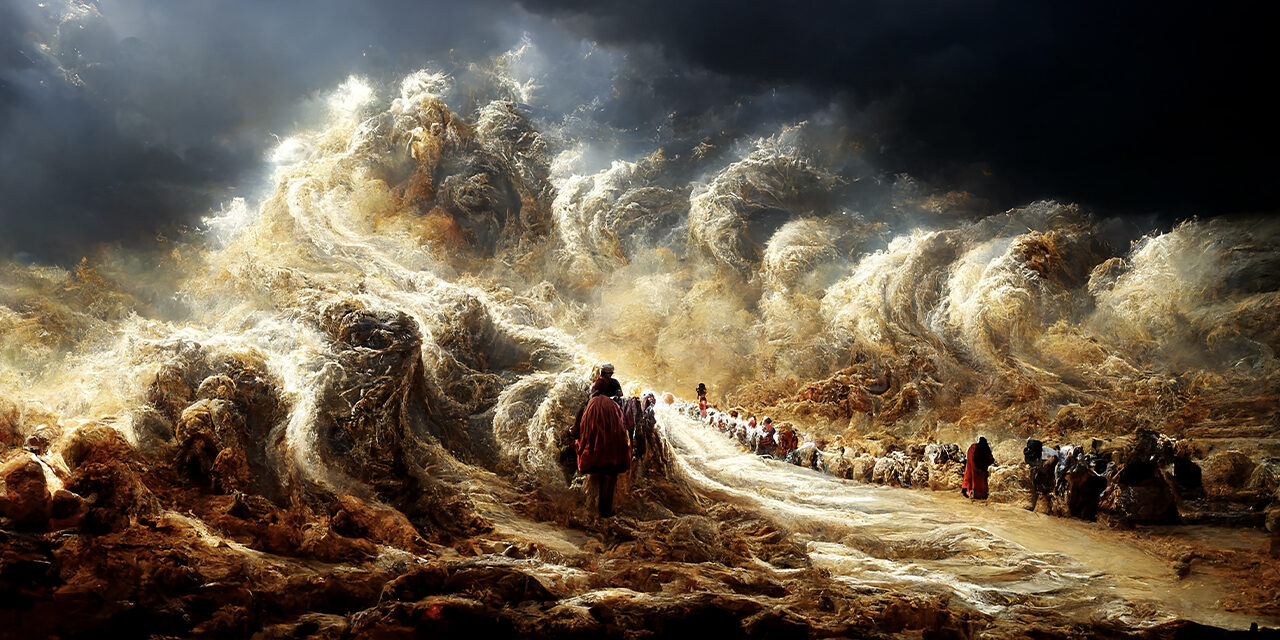
The psalmist begins in despair, crying out to God, and reflects on the good old days, which simply makes him more despondent. The turning point occurs when the psalmist brings to mind the parting of the Sea when Israel was fleeing Egypt. It is a particularly vivid vision, where the Sea stands for the psalmist’s chaotic life. But the psalm is (intentionally) unfinished, allowing the reader to write the final line.

I recently wrote a meditation on the psalm for Light + Light magazine, in advance of the SBL session. This meditation is meant for a non-technical audience, but it isn’t dumbed down. I take the reader through the flow of the psalm, pointing out its structure and relevance for our lives. My starting point is the psalmist’s inability to sleep, possibly due to regrets overwhelming him.

The meditation on Psalm 77 was published online in two parts, Part 1 on September 30, 2022 and Part 2 on October 10, 2022. My own translation of the psalm was included with each part.

Memory Raises Troubling Questions: Nighttime Distress in Psalm 77:1–10

Your Way Was Through the Sea: The Shift from Despair to Hope in Psalm 77:11–20

If you would like to download PDFs of the meditation, Part 1 is available here and Part 2 is available here.

Spanish translations were also posted.

La memoria plantea preguntas inquietantes: Angustia nocturna en el Salmo 77:1–10

Tu camino fue a través del mar: El cambio de la desesperación a la esperanza en el Salmo 77:11–20

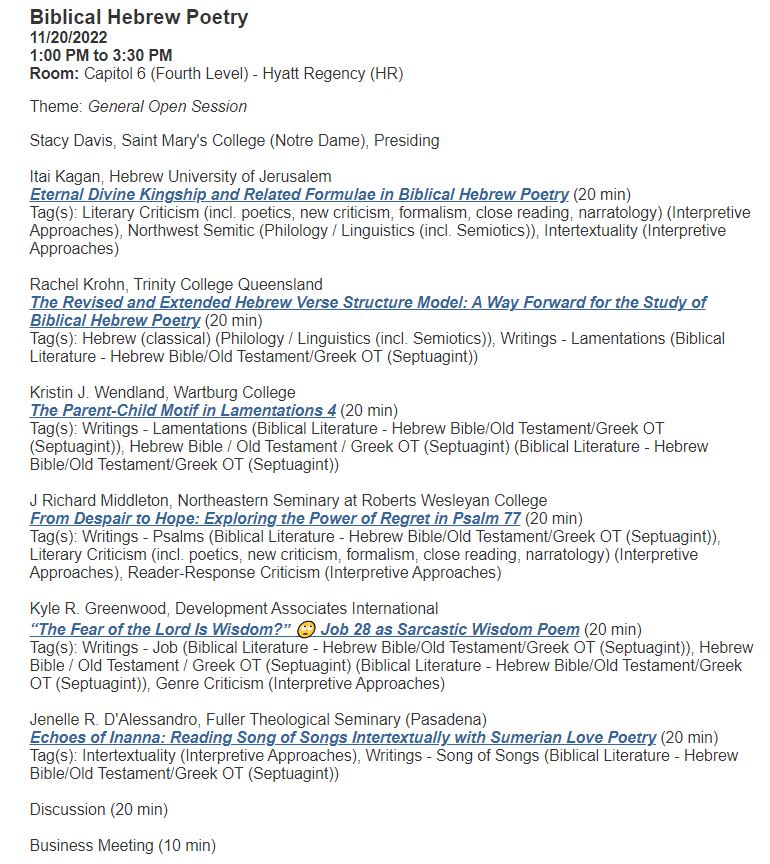
For those interested in the SBL session, it will be held on Sunday, November 20, 1:00–3:30 pm.

Was Abraham a Good Example? (Scot McKnight’s Blog Post on Abraham’s Silence)

New Testament scholar Scot McKnight wrote a blog post on my book Abraham’s Silence: The Binding of Isaac, the Suffering of Job, and How to Talk Back to God (Baker Academic, 2021). The post doesn’t cover the entire argument of the book; it focuses on the concluding section that addresses the Aqedah or Binding of Isaac (Genesis 22). The blog was posted this morning.

Scot also interviewed me about Abraham’s Silence for his Kingdom Roots podcast; we covered a bit more of the book in the interview, including my motivation for writing it and why lament or protest prayer is important in the Bible and the Christian life. I’ll post a notification when the podcast is available.

________________________________________________

“Was Abraham a Good Example?”

Scot McKnight — February 3, 2022

Gen. 22:1   After these things God tested Abraham. He said to him, “Abraham!” And he said, “Here I am.” 2 He said, “Take your son, your only son Isaac, whom you love, and go to the land of Moriah, and offer him there as a burnt offering on one of the mountains that I shall show you.” 3 So Abraham rose early in the morning, saddled his donkey, and took two of his young men with him, and his son Isaac; he cut the wood for the burnt offering, and set out and went to the place in the distance that God had shown him.

The challenge is for the reader and can be asked in a question:

Why the silence? (In those italicized words.)

 Why no protest?

 Protesting and lamenting sin and injustice are thoroughly biblical. Why the silence?

Picture Source: https://en.wikipedia.org/wiki/Binding_of_Isaac#/media/File:Sacrifice_of_Isaac-Caravaggio_(Uffizi).jpg

So many gaps in Genesis 22. So many questions. Our imaginations are stimulated to the highest levels in reading this chapter. Intentionally so.

Long ago I learned from reading Meir Sternberg and Robert Alter to ask about the textual gaps in such texts, and J. Richard Middleton explores all the gaps in Abraham’s Silence.

The details are so many that only a sketch can be given here. What I want to do is give you the big ideas of what Middleton thinks of the silence of Abraham.

In this text it is “God” (Elohim) not YHWH who tested Abraham. This is unusual, and could be a distancing expression. A messenger of YHWH, however, stops the sacrificial act (cf. Gen 22:1, 11). Why the change?

Isaac’s relationship to Abraham, or vice versa, is plumbed at length in this book: in essence, he thinks their relationship is dysfunctional as measured by the textual details. They do not talk on the way there; and Isaac all but disappears after this event; he does not come down the mountain and does not accompany Abraham back. Isaac’s not given a separable story in Genesis that we do find with Abraham, Jacob, and Joseph. Middleton suggests Abraham favored Ishmael over Isaac; he thinks Isaac picks up the idea that God is the One to be feared (all this comes from his careful reading of the text). And “whom you love” he thinks could be translated “You love him, don’t you?”

Perhaps most provocatively, Middleton thinks God is testing Abraham about whether he loves this special son Isaac.

Is Abraham’s silence exemplary?

Abraham’s narrative arc in Genesis: What view of God did Abraham have? In Genesis 18 Abraham whittles it down to 10 survivors but Middleton thinks he does this in a way that does not plumb the depth of God’s mercy, love, and grace.

Middleton sees problems in the traditional reading: (1) How is this a model for commitment? (2) Why did Abraham need to happen? There is no clear evidence of a special relationship of Abraham and Isaac.

Middleton thinks Abraham is being given an opportunity to prove his love for his son. He could have spoken up but he is silent. Then Isaac all but disappears. Even more, Abraham is being tested about his perception of God’s own character. Isaac ups the ante from Lot to Abraham’s own son. Abraham is silent.

Isaac learns not that God is a God of grace and mercy but one to be feared. Notice “the God of Abraham and the Fear of Isaac” (31:42).  Isaac is distanced from his father from this point on; Sarah, too, is never close to Abraham – perhaps not even living with him – from this point on.  It is a “broken family.” It was not Abraham who stopped the knife but an angel sent by the covenant God.

A big challenge to Middleton’s view are the words of the angel that seem to confirm Abraham as exemplary (not to ignore the positive view of Abraham’s Aqedah in much of Judaism and the NT). He probes how to see these words.

“By myself I have sworn”: God steps in because Abraham’s response was not as complete as it could have been. He thinks the ram was behind Abraham and, quite provocatively, he is not convinced Abraham had embraced the idea of God providing a ram instead of his son.

A sketch, for sure, without all the details, but you can get the big ideas from the above.

Middleton thinks Abraham did not in fact pass the test of Genesis 22. He could have protested for his son and his love for his son; he could have interceded; he could have had a more robust faith in God’s provision; he thinks he “just barely passed the test” of God’s character.

https://scotmcknight.substack.com/p/was-abraham-a-good-example


Four Views on “Heaven” (Zondervan, 2022)

Sometime in January 2022, Zondervan will be releasing their newest book in the “Counterpoints: Bible and Theology” Series. The book is entitled Four Views on Heaven. I am one of the four authors, each of whom was invited to write our chapter as a position statement on eschatology; each chapter is followed by responses from the other authors.
It seems strange to me to have a new book published so soon after my last, Abraham’s Silence: The Binding of Isaac, the Suffering of Job, and How to Talk Back to God, which was released less than two months ago (by Baker Academic).

Abraham’s Silence was a major project, six years in the making (research and writing). My contribution to Four Views on Heaven was a lot less intense.

I first learned that something was in the works about the “Heaven” book when the editor, Mike Wittmer, sent me a message on Twitter in 2017.

The tweet was followed up by an email, in which Mike outlined the project, namely to have four position statements on the nature of the final destiny for the redeemed, with responses from each author.

A little over a year later I signed a contract with Zondervan and delivered my chapter and my responses to the other authors in summer 2020.

This is how the Zondervan website describes the book:

Discover and understand the different Christian views of what heaven will be like.

Christians from a variety of denominations and traditions are in middle of an important conversation about the final destiny of the saved. Scholars such as N. T. Wright and J. Richard Middleton have pushed back against the traditional view of heaven, and now some Christians are pushing back against them for fear that talk about the earthiness of our final hope distracts our attention from Jesus.

In the familiar Counterpoints format, Four Views on Heaven brings together a well-rounded discussion and highlights similarities and differences of the current views on heaven. Each author presents their strongest biblical case for their position, followed by responses and a rejoinder that model a respectful tone.

Positions and contributors include:

  • Traditional Heaven – our destiny is to leave earth and live forever in heaven where we will rest, worship, and serve God (John S. Feinberg)

  • Restored Earth – emphasizes that the saved will live forever with Jesus on this restored planet, enjoying ordinary human activities in our redeemed state. (J. Richard Middleton)

  • Heavenly Earth – a balanced view that seeks to highlight both the strengths and weaknesses of the heavenly and earthly views (Michael Allen).

  • Roman Catholic Beatific Vision – stresses the intellectual component of salvation, though it encompasses the whole of human experience of joy, happiness coming from seeing God finally face-to-face (Peter Kreeft).

There are two clarifications needed about both the title of the book and the above description.

Two Clarifications

First, the term “Heaven” in the book title should be understood as shorthand for the eschaton, which in my case is the new earth or renewed cosmos (the “new heavens and new earth”), with a focus on the redemption of creation.

Second, despite the description of the four views (which predates the writing of the book), all authors actually affirm that there will be a new heaven and new earth (the editor could not find a reputable theologian or biblical scholar who thought that salvation consisted in “going to heaven” forever). However, there is still a lot of disagreement on other issues along the way.

For example, the “Traditional Heaven” view is really on Dispensationalism, while the “Heavenly Earth” view claims that all we will do on the redeemed earth is worship God (an earthly “beatific vision”).

I have to say that while I disagreed with much of Peter Kreeft’s chapter on the “Roman Catholic” view, it is very wittily written (you will laugh out loud at some of the turns of phrase there). And Kreeft and I agree on some things that may be surprising.

Respect for Scripture and Each Other

The website description of the “Counterpoints” series stresses that each viewpoint seeks to respect Scripture:

The Counterpoints series presents a comparison and critique of scholarly views on topics important to Christians that are both fair-minded and respectful of the biblical text. Each volume is a one-stop reference that allows readers to evaluate the different positions on a specific issue and form their own, educated opinion.

One of the distinctive features of all the chapters in the Four Views on Heaven book is that every author is charitable to all the others, with no ad hominin attacks or denigration of someone for having a contrary opinion. The respect that accompanies the very real disagreements is salutary and I am delighted to be part of this conversation.

Focus on the Cosmic Temple Theme

Although I have previously written an entire book on eschatology (A New Heaven and a New Earth), my chapter in Four Views on Heaven isn’t simply a repeat or summary of what I’ve written before. Besides addressing some specific questions that the book’s editor put to each contributor, I greatly expanded the theme (already present in my eschatology book) of the world as God’s temple, with God’s desire for his presence to fill all of creation in the eschaton.

This focus was evident in my provisional title for the chapter: “The New Earth: Cosmic Redemption and the Coming of the Shekinah.” Shekinah is the post-biblical Jewish term for the divine Presence, derived from the Hebrew shakan, “to dwell,” with mishkan or “dwelling place” designating the tabernacle in the Old Testament. However, the editor (perhaps) wisely changed the title of my chapter to “A New Earth Perspective,” which is simpler.

You can purchase the book at a good discount from the Zondervan website, as well as other books in the “Counterpoints” series, which typically have four or five views of important topics. One that I have found particularly helpful is Five Views on the Exodus: Historicity, Chronology, and Theological Implications (2021).