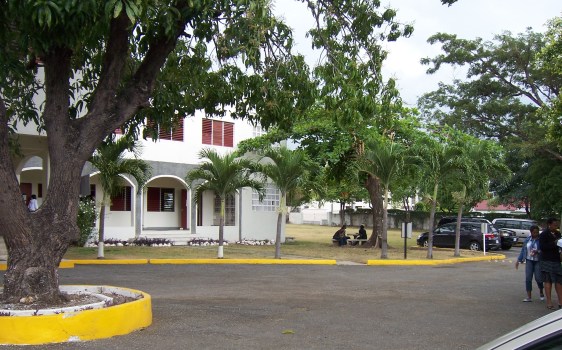
Last September I traveled to Jamaica, where I attended what may well be the first in a series of theology conferences held at Jamaica Theological Seminary (my alma mater). The conference topic was “Biblical Interpretation for Caribbean Renewal” and I was one of the organizers.

The event began with the Zenas Gerig Memorial Lecture on Friday, September 8, 2017, and continued the next day (Saturday, September 9) with a series of papers given by professors, students, and alumni of the Jamaica Theological Seminary (JTS) and the Caribbean Graduate School of Theology (CGST), including some overseas presenters (such as myself).
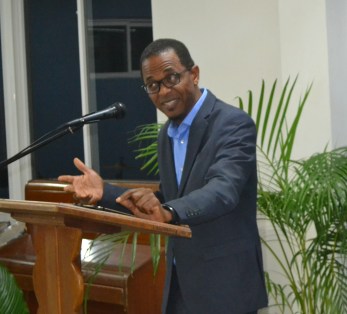
The Friday keynote lecture was delivered by Steed Davidson, Associate Professor of Hebrew Bible / Old Testament at McCormick Theological Seminary in Chicago, with a response by Garnett Roper, the president of JTS. Since this conference was in honor of the 500th anniversary of the Reformation, Davidson addressed “The Hazards and Opportunities of Sola Scriptura for Caribbean Biblical Interpretation.”
Sola Scriptura as a Positive Value
Davidson emphasized the value of Luther’s protest against a corrupt and authoritarian papal church, and how Sola Scriptura (the Bible alone) functioned to ground his protest. Beyond Luther’s appeal to what the Bible teaches (in contrast to the accretions of tradition), was the importance of the Bible being translated into the various European vernaculars (including Luther’s German and the later King James Version).
Davidson further noted that the positive effect of having the Bible in the vernacular of one’s own culture (instead of Latin, which had been understood only by a small elite) was that each culture was able to hear God’s word in their own language.
But no changes are purely innocent.
The Reformation’s Unintended Consequences?
Although translating the Bible into the vernacular may have been intended to open up the Bible to the ordinary believer, most people were not literate enough to read it even in their own language. So while power did shift from the Pope, instead of being transferred to the ordinary people, it was Protestant pastors who became the authoritative interpreters of the Bible; and secular princes filled the vacuum of papal authority (and both were often just as elitist and authoritarian as the Catholic hierarchy had been).
Further, one of the effects of hearing God word in the cadences of one’s language is that when the various European Protestant nations began to exercise colonial power in the “New World,” they understood God as underwriting their colonizing campaigns. Thus “Christianization” and colonization went hand-in-hand.
So it was never really Sola Scriptura in Reformation times. But rather the Bible and its authoritative interpreters, and (even more problematically) the Bible as part of a package of empire, colonization, and oppression.
Neither is it (or should it be) Sola Scriptura today. Rather, we all interpret the Bible through our cultural lenses. Paradoxically, many Christians in the Caribbean downplay their own experience and treat the Bible as a magical book in which to find guidance for making ordinary decisions (this is itself a cultural lens). But since oral tradition and experience are an integral part of Caribbean culture, many Caribbean Christians end up denying part of their identity and heritage in the way they treat the Bible.
Davidson therefore encouraged Caribbean people to consciously and intentionally read Scripture in light of their Caribbean culture and experience, both their historical heritage and their contemporary experience of the world. This involves not only bringing their culture and experience to Scripture, but allowing Scripture to speak to their culture and experience.
(There was more to Davidson’s lecture that this brief summary; but it suffices to highlight some of his emphases.)
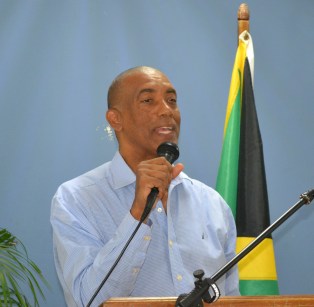 After Davidson’s stimulating presentation, Garnett Roper (the president of JTS) gave a response. Roper agreed with much of Davidson’s argument, but raised the question of whether the imperial and colonial use of the Bible was as integrally related to the Reformers’ actions as Davidson portrayed, or was more in the vein of unintended consequences. The presentation by Davidson (originally from Tobago) and Roper (a Jamaican) generated a great deal of stimulating discussion from the audience.
A Variety of Papers on Scripture, Theology, Identity, and Culture in the Caribbean
Although we had nine papers lined up during the day on Saturday, one presenter who was coming from Philadelphia could not make his flight connection from Florida because of Hurricane Irma (and had to return home).
The paper topics varied quite widely; they included analysis of the Bible (both in whole and in part, addressing both familiar/comforting and troubling texts from the Old and New Testaments); priorities for biblical interpretation in the Caribbean church; the use of systems theory to understand a case study in Jamaican church conflict; the sort of “productive hermeneutics” of the Bible exemplified by Rastafarian discourse; a psychological / anthropological analysis of possession in Haitian voodoo; and how Caribbean people who have been shaped by the experience of slavery might grapple with God’s sovereignty in the process of history.
Since I previously gave the titles of papers to be presented (in an earlier blog post about the conference) I won’t repeat the list here. But you can see the full conference schedule at a glance.
Essay Award for Excellence in Bible and Theology
I have been involved with organizing theology conferences for a number of years (since 2012) and at many of these I have offered an essay prize to stimulate the intersection of the Bible and theology. This prize is awarded in honor of my parents, Jack and Phyllis Middleton. Jack Middleton was a Christian who served as a police officer in the Jamaica Constabulary Force from the end of World War II until his retirement in 1973. Beginning as an Inspector, stationed in Sav-la-Mar (in the parish of Westmoreland), he rose through the ranks to become the head of Special Branch and then Commissioner of Police (the first non-expatriate to hold the office).
 At this conference, The Jack and Phyllis Middleton Memorial Award for Excellence in Bible and Theology was given to Erica Campbell ( Head of the Department of Humanities and Lecturer in Humanities, Theology, and Biblical Studies at JTS) for her paper “The Parable of the Good Samaritan: A Political Reading from a Caribbean Perspective.” This paper (like the previous five papers that have received this award) is to be published in the Canadian-American Theological Review, the journal sponsored by the Canadian-American Theological Association (of which I was president from 2011-2014).
The Importance of This Theology Conference
Instead of commenting on specific points of note in particular papers, let me mention a couple of general observations, two things that struck me as important about the conference as a whole.
First, I saw students and recent alums of JTS and CGST (who were often also pastors), as well as current and past professors, articulate their theological claims in papers presented publicly for an academic audience. I don’t think we can underestimate the value of this both for the presenters (whose proposals were taken seriously and engaged) and the model of academic integrity and boldness that they modeled for the attendees. Grounded in faith, we may engage in serious intellectual grappling with important issues; and faith is enlarged, rather than diminished, even when there is honest disagreement.
This is crucial, because in the Caribbean faith is often separated from scholarship, and the latter is denigrated. The appropriate response is not simply to become “intellectual,” as if this is somehow better than simple faith. Rather, what we need (and what this conference showed) is that not only can faith ground serious intellectual grappling with important issues, but that faith is thereby enriched by such grappling.
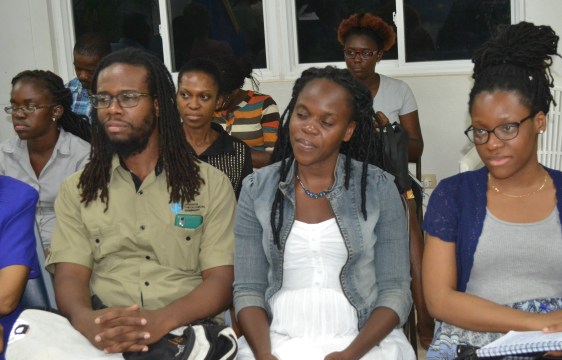
Second, I was struck by the significant degree of engagement from audience members (composed primarily of pastors and students, with at least half being women). Some of those in the audience boldly jumped right into the discussion at the start of the day, raising questions and voicing their opinions; others only found their voice as the day progressed.
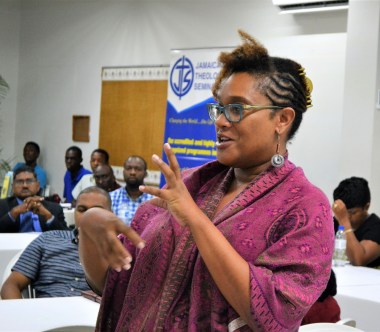 Although discussion was always charitable and respectful, it was also vigorous—indeed, so vigorous that I had a hard time (as conference chair) keeping the sessions to the prescribed time limits. But I look at that as a positive feature.
In this cordial, yet vigorous exchange of views between people of deep faith who value theological reflection for the sake of the church, I saw the beginnings of a genuine academic community of Caribbean theologians and practitioners reaching toward the goal of serious scholarly discourse in the service of faith. This bodes well for the intellectual health of the Caribbean church—if such discourse can be further stimulated and extended.
With that in mind, JTS is considering making a theology conference like this an annual (or possibly biennial) event. So stay tuned for an announcement in the near future. As these conferences become more regular we hope to invigorate the conversation about the Bible and theology for the sake of the Caribbean church and wider society.
A Publication Coming from the Conference
Selected papers from the conference have now been published in a theme issue of the Canadian-American Theological Review. These papers join Erica Campbell’s award-winning paper in a special issue of the journal devoted to the conference theme, “Biblical Interpretation for Caribbean Renewal.” The issue is available both in hard copy and as a PDF file, as are individual articles.
The Canadian-American Theological Review has previously published articles by theologians and scholars from parts of the world beyond Canada and the USA—including Eastern Europe, Africa, and the Caribbean.
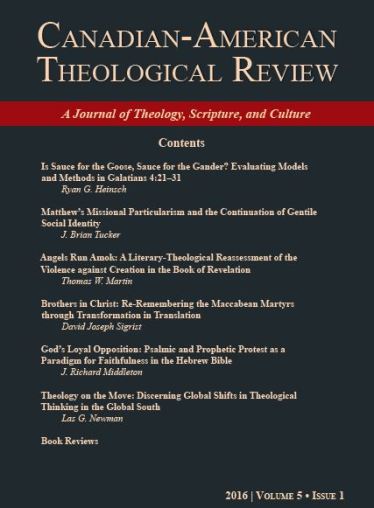
A recent issue of the journal (2016) contained two articles by Caribbean authors. One was by Las Newman (president emeritus of the Caribbean Graduate School of Theology), entitled “Theology on the Move: Discerning Global Shifts in Theological Thinking in the Global South.” The other was my own paper, entitled “God’s Loyal Opposition: Psalmic and Prophetic Protest as a Paradigm for Faithfulness in the Hebrew Bible.”
I am delighted that we now have an entire issue of the Canadian-American Theological Review devoted to Caribbean theology.
Just a reminder: The journal is always open for new submissions of articles and book reviews, and that certainly includes submissions from Caribbean authors. Click here to see the guidelines for articles and book reviews. You are invited to participate in a global theological discussion.
In a follow-up post you can read about what some of us did after the conference, visiting two Rastafarian cultural heritage sites.