Created in God’s Image: The Royal Calling of Humanity (The Kingdom of God, part 3)

This is part 3 of a series of posts on the kingdom of God. Part 1 can be found here. Part 2 can be found here.

The kingdom of God in the teaching of Jesus is a distinctly Jewish idea, rooted in Israel’s Scriptures. To understand the significance of this kingdom we will need to explore some of the biblical backstory—especially the theme of “rule,” a royal metaphor for the exercise of power.

Imago Dei: The Royal Calling of Humanity

The opening chapter of the Bible recounts the creation of humanity (male and female) with the vocation or calling of being God’s “image” on earth (Gen 1:26–28). Genesis 1 here draws on (and interacts with) the royal ideology from the cultures of the ancient Near East (such as Mesopotamia and Egypt), which viewed kings (and sometimes priests) as the “image” of their gods. These human leaders were thought to have a function similar to that of the “image” (or cult statue) of the god, which was located in the temple. Just as the cult statue was thought to mediate the presence and power of the god from heaven to earth, kings (and some priests) claimed to be the gods’ unique earthly delegates, exercising power over the people on the gods’ behalf (a royal function), by which the gods’ presence was made manifest in their society (a priestly function).

Genesis 1 draws on this ancient, highly elitist notion of the “image of God,” but radically democratizes or universalizes it, applying it to all people, male and female (irrespective of their social status). This biblical vision of all people sharing the “royal” status of the “image of God” (imago Dei in Latin), with equal dignity in the sight of the Creator, helps explain a well-recognized historical fact: when the people of Israel came into existence as a nation (after their exodus from Egypt), they existed for centuries without a monarchy—something entirely unique in the ancient Near East. The idea of all humanity created to be God’s image functioned as a radical critique of—and form of resistance to—the royal ideology of the ancient societies among which Israel lived.

In Genesis 1:26–28, the image of God is manifested in the ordinary human exercise of power or agency in earthly life, involving “rule” (or “dominion” in some translations) over the animal kingdom (equivalent to animal husbandry) and “subduing” the earth or land (equivalent to agriculture). In Genesis 2, the human vocation is portrayed (without using the term “image”) as working and protecting a garden of fruit trees that God planted (Gen 2:15). Since God planted the garden, God is portrayed as the first gardener and humans implicitly image God as they continue tending God’s garden. Psalm 8 echoes the theme of animal husbandry from Genesis 1, when it describes humans as created a little less than God (similar to being God’s image in Genesis 1) and granted rule over various forms of animal life—on land, air, and water (Ps 8:5–8).

The image of God (imago Dei) is both a gift (humans are granted the status of being VIPs in God’s world) and a calling or vocation (we are commissioned as God’s ambassadors in the world). Every person is both gifted with royal dignity and also authorized to represent God’s rule in the ordinary practices of earthly life. Whereas Genesis 1 and 2 focus on caring for animals and farming the land, Genesis 4 extends this by mentioning that humans invented and developed cities, nomadic livestock herding, musical instruments, and metal tools (Gen 4:17, 20–21). This suggests that God is imaged by all forms of legitimate cultural innovation, as people develop the potentialities of earthly life.

But Genesis 3 portrays humans rebelling against their Creator (transgressing the limits God instituted) so that the gift of human agency or “rule” becomes distorted and twisted, with corrupting effects on the social order.

Life, Death, and Violence in Human History

In the Garden of Eden narrative, humans are warned that “death” is the consequence of disobedience to God (Gen 2:15–16). This death was not the introduction of mortality, as if humans had previously been immortal and only now would have an ending to their life; the idea of original immortality is an idea imported by later interpreters into the text. Rather, humans are created from “dust” (Gen 2:7), a term used throughout the Bible as a metaphor for mortality (see especially Ps 103:13–14). The “death” warned about in Genesis 2 best understood as the constriction and diminishing of life, where “life” refers to the fullness of earthly flourishing.

Immediately upon disobedience, the original harmony in the garden begins to be distorted, as the primal couple cower in fear before God and in shame of nakedness before each other (Gen 3:7–8, 10), while ordinary human relationships, like marriage, childbirth, and farming, became disharmonious (Gen 3:16–20). Ultimately, humans are exiled from the garden, losing access to the fullness of life (symbolized by the Tree of Life in the center of the Garden) and the intimate presence of God. These consequences are various ways of describing the “death” that results from sin.

Yet humans retain the dignity of being God’s image and the call to represent God is not rescinded (see Gen 9:6). But violence (the misuse of the power or agency associated with the image of God) is introduced into human history, evident in Cain’s murder of his brother out of jealousy (Gen 4:8) and Lamech’s revenge killing of a young man who injured him, while boasting about it to his two wives (Gen 4:23). Distorted human “rule” then spirals out of control, until violence fills the earth and life becomes corrupted (Gen 6:5, 11–12), which generates the flood to cleanse the earth of this corruption.

But the respite is only temporary and human violence culminates in the story of Babel (the normal Hebrew word for Babylon), an empire that tries to dominate others and impose its will (and even language) on conquered peoples (Gen 11:1–9). The tower of Babel is likely a ziggurat, a series of giant steps for the gods to descend from heaven to their favored city, thus providing religious legitimation for the empire. With the rise of every “Babylon” in history, every imperial legitimation of violence in the name of law and order (including Rome in the time of Jesus), God’s purposes for life and flourishing are impeded. In the “Babel” of Genesis 11, God’s purposes for blessing seem to have come to a dead end.

How will God respond to this imperial violence? That is the topic of part 4 of this series (The Story of Israel from Abraham to the Exile).
What Happens between Death and Resurrection? A Symposium on the Intermediate State

This post was updated April 2019.

On January 17, 2019 I participated in a Symposium on the “intermediate state.” This Symposium explored the question of how best to think about what happens to a Christian between death and resurrection.

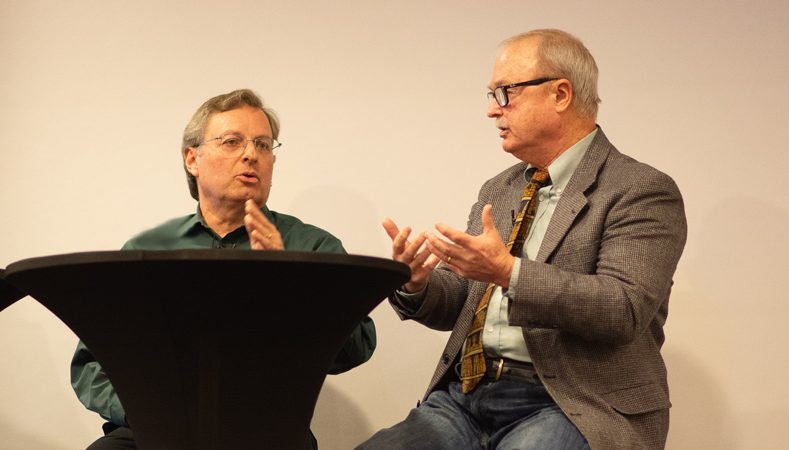
Symposium on the Intermediate State: J. P. Moreland and J. Richard Middleton

The Symposium was sponsored by the Carl F. H. Henry Center for Theological Understanding at Trinity Evangelical Divinity School, in Deerfield, IL.

My dialogue partner was philosopher J. P. Moreland, a famous supporter of “substance dualism” (the view that a person is composed of an immaterial soul and a body). He argued for the traditional view that our souls go to be with God (in heaven), awaiting the resurrection.

As a biblical scholar, I presented my position that the Bible doesn’t teach substance dualism, but rather a holistic view of the person, and that Scripture doesn’t clearly explain what happens between death and resurrection. I am therefore agnostic about the intermediate state.

My presentation focused on biblical exposition of these themes, with attention to 2 Corinthians 5:6–8 (absent from the body, present with the Lord) and Luke 23:39–43 (the thief on the cross). These two biblical texts are often taken as teaching an intermediate state. My exegesis of these texts attempted to show that they both address the final resurrection, not an intermediate state.

In the end, I don’t believe that we need to have an explanation of what happens between death and resurrection. It is sufficient to trust that God, who is faithful, will bring those who are in Christ to the resurrection.

The raw video feed of the Symposium is found here.

  • Tom McCall (head of the Henry Center) opens the event at around the 16 minute mark.
  • Steve Matthewson (a local pastor) introduces the topic and the speakers at about the 17 ½ minute mark.
  • J. P. Moreland begins to speak just before the 21 minute mark.
  • My presentation begins at the 43 ½ minute mark. I had slides with some visuals and lots of biblical texts. However, you will see that the projection system wasn’t working properly.
  • The Q&A begins at the 1 hour and 11 ½ minute mark.

Our Focus Should be on the New Creation

My main point was that the intermediate state shouldn’t be the focus of our faith at all. Rather, biblical hope is for embodied resurrection life in the new heavens and new earth.

This is a point I made in my book on eschatology, A new Heaven and a New Earth: Reclaiming Biblical Eschatology (Baker Academic, 2014). In one of the chapters I included an excursus on the intermediate state (it was not central to the book’s argument), and I intended it merely as an exploration of the biblical evidence, not as an argument for a particular viewpoint.

Yet it is interesting that some reviews of my book brought up this excursus, often claiming to disagree with my position, even though my point was simply that there isn’t enough clear biblical evidence for me to affirm an intermediate state. Sometimes I wish  hadn’t put that excursus in at all, since it seemed to sidetrack some readers. But other readers have told me it was important for them.

The Henry Center’s Exploration of Theological Anthropology

I was invited to participate in this Symposium on the intermediate state not primarily because of my work on eschatology, but due to my prior involvement in the Henry Center’s three-year Creation Project.

Each summer the Center has had a conference (the Dabar Conference) on some aspect of the theme of Creation, and I have been involved every year.

In the first two years I was a paper respondent, in 2016 to Old Testament scholar C. John (“Jack”) Collins and in 2017 to philosopher-theologian William (“Billy”) Abraham, two very wonderful scholars, both of whom I was delighted to get to know.

This year I wrote a keynote paper for the Dabar Conference (June 2018), entitled “Death, Immortality, and the Curse: Interpreting Genesis 2–3 in the Context of the Biblical Worldview,” with two respondents (one a biblical scholar, the other a theologian).

The theme of the Creation Project (and thus of the Dabar Conference) this year (2018-19) is Reclaiming Theological Anthropology in an Age of Science.  But the Project extends beyond the Dabar conferences, and involves numerous other events.

It was because of my analysis of human mortality expressed in the Dabar paper (and a shorter version called “Humans Created Mortal, with the Possibility of Eternal Life,” which was published on the Henry Center website) that I was invited to present my views at the upcoming Symposium.

This is the description of the Symposium (along with presenter bios) on the Henry Center website:

The resurrection of the body is one of the central doctrinal claims of the Christian faith. It is also the source of Christian hope when faced with the death of a loved one.

But what happens between now and then? When a child asks their parent where a departed loved one is “now,” how should Christians respond?

Do the souls of those who have died in faith go to be with the Lord now, awaiting to be reunited with their resurrected bodies?

Or are traditional Christian beliefs in an immaterial soul that is separable from the body misplaced—an unscriptural incursion of Platonic metaphysics that has misshaped our expectations of the afterlife?

The discussion will be followed by a pastoral response and extended audience Q&A on the theological and pastoral implications of the different views.

J. P. Moreland (PhD University of Southern California) is a Distinguished Professor of Philosophy at Talbot School of Theology, Biola University. He is the author or editor of over a dozen books, including The Soul: How We Know It’s Real and Why It MattersThe Blackwell Companion to Substance Dualism, and Philosophical Foundations for a Christian Worldview.

J. Richard Middleton (PhD Vrije Universiteit in Amsterdam) is Professor of Biblical Worldview and Exegesis at Northeastern Seminary. He is the author of A New Heaven and a New Earth: Reclaiming Biblical Eschatology, and The Liberating Image: The Imago Dei in Genesis 1.

Date Thursday, January 17, 2019
Time 11am — 12:30pm CST
Location Main Campus

Hinkson Hall

This event was made possible through the support of a grant from Templeton Religion Trust

What Happens between Death and Resurrection? A Symposium on the Intermediate State

This post was updated April 2019.

On January 17, 2019 I participated in a Symposium on the “intermediate state.” This Symposium explored the question of how best to think about what happens to a Christian between death and resurrection.

Symposium on the Intermediate State: J. P. Moreland and J. Richard Middleton

The Symposium was sponsored by the Carl F. H. Henry Center for Theological Understanding at Trinity Evangelical Divinity School, in Deerfield, IL.

My dialogue partner was philosopher J. P. Moreland, a famous supporter of “substance dualism” (the view that a person is composed of an immaterial soul and a body). He argued for the traditional view that our souls go to be with God (in heaven), awaiting the resurrection.

As a biblical scholar, I presented my position that the Bible doesn’t teach substance dualism, but rather a holistic view of the person, and that Scripture doesn’t clearly explain what happens between death and resurrection. I am therefore agnostic about the intermediate state.

My presentation focused on biblical exposition of these themes, with attention to 2 Corinthians 5:6–8 (absent from the body, present with the Lord) and Luke 23:39–43 (the thief on the cross). These two biblical texts are often taken as teaching an intermediate state. My exegesis of these texts attempted to show that they both address the final resurrection, not an intermediate state.

In the end, I don’t believe that we need to have an explanation of what happens between death and resurrection. It is sufficient to trust that God, who is faithful, will bring those who are in Christ to the resurrection.

The raw video feed of the Symposium is found here.

  • Tom McCall (head of the Henry Center) opens the event at around the 16 minute mark.
  • Steve Matthewson (a local pastor) introduces the topic and the speakers at about the 17 ½ minute mark.
  • J. P. Moreland begins to speak just before the 21 minute mark.
  • My presentation begins at the 43 ½ minute mark. I had slides with some visuals and lots of biblical texts. However, you will see that the projection system wasn’t working properly.
  • The Q&A begins at the 1 hour and 11 ½ minute mark.

Our Focus Should be on the New Creation

My main point was that the intermediate state shouldn’t be the focus of our faith at all. Rather, biblical hope is for embodied resurrection life in the new heavens and new earth.

This is a point I made in my book on eschatology, A new Heaven and a New Earth: Reclaiming Biblical Eschatology (Baker Academic, 2014). In one of the chapters I included an excursus on the intermediate state (it was not central to the book’s argument), and I intended it merely as an exploration of the biblical evidence, not as an argument for a particular viewpoint.

Yet it is interesting that some reviews of my book brought up this excursus, often claiming to disagree with my position, even though my point was simply that there isn’t enough clear biblical evidence for me to affirm an intermediate state. Sometimes I wish  hadn’t put that excursus in at all, since it seemed to sidetrack some readers. But other readers have told me it was important for them.

The Henry Center’s Exploration of Theological Anthropology

I was invited to participate in this Symposium on the intermediate state not primarily because of my work on eschatology, but due to my prior involvement in the Henry Center’s three-year Creation Project.

Each summer the Center has had a conference (the Dabar Conference) on some aspect of the theme of Creation, and I have been involved every year.

In the first two years I was a paper respondent, in 2016 to Old Testament scholar C. John (“Jack”) Collins and in 2017 to philosopher-theologian William (“Billy”) Abraham, two very wonderful scholars, both of whom I was delighted to get to know.

This year I wrote a keynote paper for the Dabar Conference (June 2018), entitled “Death, Immortality, and the Curse: Interpreting Genesis 2–3 in the Context of the Biblical Worldview,” with two respondents (one a biblical scholar, the other a theologian).

The theme of the Creation Project (and thus of the Dabar Conference) this year (2018-19) is Reclaiming Theological Anthropology in an Age of Science.  But the Project extends beyond the Dabar conferences, and involves numerous other events.

It was because of my analysis of human mortality expressed in the Dabar paper (and a shorter version called “Humans Created Mortal, with the Possibility of Eternal Life,” which was published on the Henry Center website) that I was invited to present my views at the upcoming Symposium.

This is the description of the Symposium (along with presenter bios) on the Henry Center website:

The resurrection of the body is one of the central doctrinal claims of the Christian faith. It is also the source of Christian hope when faced with the death of a loved one.

But what happens between now and then? When a child asks their parent where a departed loved one is “now,” how should Christians respond?

Do the souls of those who have died in faith go to be with the Lord now, awaiting to be reunited with their resurrected bodies?

Or are traditional Christian beliefs in an immaterial soul that is separable from the body misplaced—an unscriptural incursion of Platonic metaphysics that has misshaped our expectations of the afterlife?

The discussion will be followed by a pastoral response and extended audience Q&A on the theological and pastoral implications of the different views.

J. P. Moreland (PhD University of Southern California) is a Distinguished Professor of Philosophy at Talbot School of Theology, Biola University. He is the author or editor of over a dozen books, including The Soul: How We Know It’s Real and Why It MattersThe Blackwell Companion to Substance Dualism, and Philosophical Foundations for a Christian Worldview.

J. Richard Middleton (PhD Vrije Universiteit in Amsterdam) is Professor of Biblical Worldview and Exegesis at Northeastern Seminary. He is the author of A New Heaven and a New Earth: Reclaiming Biblical Eschatology, and The Liberating Image: The Imago Dei in Genesis 1.

Date Thursday, January 17, 2019
Time 11am — 12:30pm CST
Location Main Campus

Hinkson Hall

This event was made possible through the support of a grant from Templeton Religion Trust