The Problem of Animal Suffering in a Good Creation—Engaging Ronald Osborn’s Death Before the Fall (IVP, 2014), Part 3

In two previous posts I began to examine Ronald E. Osborn, Death Before the Fall: Biblical Literalism and the Problem of Animal Suffering (Downers Grove, IL: IVP Academic, 2014).

In the first post I introduced the book and summarized Osborn’s critique of narrow literalism in the way the biblical creation accounts are often read. In the second post I affirmed (and even strengthened) his case for understanding animal predation as part of the good world God made.

In this post I will summarize Osborn’s argument for God’s redemption of animal suffering, and raise some questions about it.

Osborn had early on mentioned “the central riddle of this book” (p. 13), which was the tension between the beauty and terror of animals in the wild.

In chapter 12 Osborn mounted a good case for viewing animal predation (and the suffering this naturally causes) as part of God’s good creation. As I noted in my previous post, I found his argument from the book of Job (supplemented with the perspective of various Psalms) convincing.

However, Osborn is not content with making this point.

In chap. 13 (“Creation & Kenosis”), Osborn explores the other side of his tension, namely that it does not seem satisfactory to simply affirm the goodness of animal mortality and predation, given the very real suffering evident in the animal world. He calls this a “deep scandal” (p. 157) and notes that “There are things under heaven and in earth that we should not be at peace with, and the jaws of Behemoth, I would submit, are one” (p. 157).

Osborn therefore turns to the theological notion of kenosis, in connection with the Patristic doctrine of theosis, to address this problem.

In the end, his claim is that Christ’s self-emptying and death was for the redemption of all suffering, even that which predates human evil.

Kenosis

The theological idea of kenosis is derived from Philippians 2, where Paul describes Christ’s self-humbling (verse 7).

5Let the same mind be in you that was in Christ Jesus,
6 who, though he was in the form of God,
did not regard equality with God
as something to be exploited,
7 but emptied [eknōsen] himself,
taking the form of a slave,
being born in human likeness.
And being found in human form,
8 he humbled himself
and became obedient to the point of death—
even death on a cross.

This is the first half of a poem or hymn that Paul quotes, the second half of which affirms Christ’s exaltation after death, and makes clear his deity (by using language from Isaiah that in its original context referred to YHWH’s uniqueness).

Traditionally, the idea of kenosis is associated with Christ giving up or letting go of his deity (or of his attributes of deity), suggesting that the incarnation involved a subtraction or lessening.

However, this misreads the text, which affirms instead that Christ (who legitimately has all the power of deity) did not use this for his own advantage, but (in humility) became a servant, even to death, to bring us salvation. This is the core of N. T. Wright’s argument in his chapter on Philippians 2 in The Climax of the Covenant.

The point is clear if we ask why Christ can be an example for us (verse 5).

He didn’t model becoming empty of deity (whatever that might mean); that wouldn’t be relevant to us. Rather, Christ modeled the compassionate use of power and privilege. If the one who is equal to the Father used his deity for our sakes, how much more should we use our God-given privileges to serve others in love.

It seems to me that Osborn tends towards using kenosis as an umbrella term to refer to Christ holding in abeyance his divine attributes, which led to his suffering (so he incorporates suffering under kenosis). This is why he can identify kenosis with open theism, which affirms God’s self-limitation in order to generously allow creatures space for genuine freedom. But one can be sympathetic with open theism (as I am) without affirming kenosis in Osborn’s sense.

 Theosis

Osborn pairs his notion of kenosis with theosis, also known as “deification” or “divinization.” Although I find some articulations of this doctrine problematic, since they seem to confuse the categories of creator and creation, I understand the impetus of theosis, both in the church fathers and today among authors like Michael Gorman.

The biblical warrant for using language of theosis is usually 2 Peter 1:4, which affirms that God has promised that we “may escape from the corruption that is in the world because of lust, and may become participants of the divine nature.” Of course, this doesn’t mean becoming God, but godlike in our character.

But beyond the transformation into godlikeness, the theosis doctrine, especially in Irenaeus (second century church father), is also associated with a goal-oriented vision of salvation. That is, the transformation that redemption effects is not a return to primitive origins, but along with repairing what went wrong, brings humanity to its intended telos or goal, which sin impeded.

So this combination of kenosis and theosis allows Osborn to articulate a vision of God’s compassionate suffering in Christ, which serves to bring the cosmos, with its immense animal suffering, to God’s intended telos of perfection where all suffering is eradicated.

I have to admit that I am attracted to Osborn’s vision.

Indeed, it is similar to my own articulation of the telos of salvation in my book A New Heaven and a New Earth. Like Osborn, I would go beyond Irenaeus in applying this goal-oriented vision of salvation to the cosmos and not just to humanity.

As many biblical scholars are coming to recognize, the Bible envisions a movement from a garden in the context of God’s creation of heaven and earth, to a garden-city in the context of a new heaven and a new earth, where God is fully present.

So, the goodness of the original creation is not the same as the perfection God has in mind for the cosmos.

I also find Osborn’s affirmation of God working non-coercively in and through ordinary processes of nature and history compelling. He notes that God’s sovereignty does not predetermine everything in advance, but gives creatures freedom to develop (p. 161). This, he explains, is the basis both of the evolutionary process and of the animal suffering this process has engendered.

Why Does the Cosmos Need Redeeming?

A problem is evident, however, in chapter 13 when Osborn comes to evaluate the evolutionary process, with its resultant suffering.

Should we think of this suffering as “natural evil,” that is, something that is wrong in some fundamental sense, and so needs redeeming?

Or is the evolutionary process, along with the suffering this has caused over the eons, part of the good (though wild and unpredictable) creation God has made?

In chapter 12, on the book of Job, Osborn had argued for the natural death and suffering of animals in the evolutionary process as part of God’s good world. Yet in chapter 13, he argues that this world of animal death and suffering needs redeeming.

But why would animal mortality and suffering need redeeming? Two answers are possible.

First, they could need redeeming because they are the result, in some way, of human sin. But Osborn has already (rightly) rejected the idea that nature is “fallen” due to human sin. Rather, he views animal suffering as simply part of what a world of living organisms involves, especially an evolving world.

Alternately, nature could need redeeming because it is intrinsically deficient (here the deficiency would be precisely the animal suffering involved in the evolutionary process).

Did God Create a Deficient Cosmos?

I want to affirm the basic intuition I sense in Osborn here, that the world seems out of whack with how it should be. And he clearly has a sense of kinship with, and compassion for, animals that is laudable.

Nevertheless, Osborn comes perilously close to a theme that is gaining momentum among Christian writers who take evolution seriously, namely that the death of Christ atones not just for sin and its consequences (which I affirm), but for God’s inadequate or deficient creation of the cosmos. In a sense, God is atoning for his own sin in creating a deficient world.

I think that the issue comes down not to whether evolution should be accepted (I agree with Osborn that it makes more sense of the evidence than any alternative). Rather, the issue is whether we think of the chaotic wildness of the cosmos (of which evolution can be considered a part) as part a of a good creation or as “natural evil” which needs to be redeemed.

We cannot have it both ways. Either a good creator brought into being a good, though not “perfect,” world. Or God is not a good creator, and so cannot be trusted. And no amount of kenosis can atone for this.

The Need to Distinguish Creation from Fall and Redemption

According to Osborn, “God creates as he redeems and redeems as he creates” (p. 160). But I would want to maintain that God’s generous power evident in creation (which does not require God’s suffering) is distinct from God redemptive action to reverse the fall (which certainly requires God’s suffering).

I fully agree with Osborn that the kenosis of the cross (rightly understood) opens our eyes to see the realities of good and evil; but when he states that “When Christ cries ‘It is finished’ on Easter Friday the creation of the world is at last completed” (p. 165), I must dissent.

Otherwise creation and fall are indistinguishable, and God is not a good creator.

This means that we need to think carefully about the interconnection between God’s telos or goal for creation (which does not depend on the introduction of sin) and the need for redemption (which does). I myself haven’t fully sorted this issue out.

In the end, Osborn’s book is a strange tissue of great insights and contradictory proposals. Should we accept the testimony of Job (and the psalms) that God views animal predation as good? Or do we go with our instincts that this is all “natural evil” requiring redemption?

Perhaps Osborn will take some time to think through these issues and write some more on the topic. It is certainly an agenda for my own theological explorations.
Why Christians Don’t Need to Be Threatened by Evolution

GENESIS RECAST Conference

For too long Christians in North America have thought the Bible was in conflict with biological evolution. Yet many orthodox Christian theologians of the nineteenth century (including Charles Hodge and B. B. Warfield) saw no conflict in principle.

The Manufactured “War” between Science and Religion

This famous “war” of science and religion (of which the creation-evolution battle is the most prominent example) is a relatively recent invention, manufactured from the atheist side by John William Draper (History of the Conflict Between Religion and Science, 1874) and by Andrew Dickson White (A History of the Warfare of Science with Theology in Christendom, 1896), and on the Christian side by fundamentalists who misread the Genesis creation accounts as scientific.

But this is a serious genre mistake. Many atheists treat “science” as a full-fledged worldview that claims to tell us that there is nothing to reality but the natural world and that the scientific method gives us all the valid knowledge there is. Likewise many Christians treat the Bible as a science textbook, when the point of creation accounts in the ancient world (of which Israel was a part) is to explain the meaning of life and how we are to live.

Of course, the issues are a bit more complex than that. But to find out more you will need to attend an important conference that is coming to the Buffalo, NY area on September 18-19, 2015.

Genesis Recast—The War with Science Is Over

This is the provocative name of the conference, which will headline John Walton, Old Testament professor from Wheaton College, on how the read the Genesis creation accounts. His orthodox Christian faith in connection with his expertise in the Bible and the ancient Near East admirably equips him to guide us in how the interpret the Genesis creation accounts in line with their original intent.

Of course, we need to go well beyond a declaration of “peace” between the Bible and science.

The Positive Role of a Biblical View of Creation

The biblical view of creation claims that the cosmos is “very good” (Gen 1:31) and is imbued with God’s wisdom and order (Prov 3:19-20). Indeed, the wisdom literature of the Bible encourages us to understand the world, in which God’s wisdom is embedded, that we might live better in it.

Furthermore, God’s creation of humanity in his own image, with the task to rule the earth (Gen 1:26-28) and tend the garden of creation (Gen 2:15), implies an exalted role for human beings, which includes the possibility of science. As stewards of earthly life, we are commissioned with a vocation that encompasses (but is not limited to) the scientific understanding of the world in which we live.

Not only can the world be studied scientifically, but a biblical view of God’s good creation suggests that human knowledge of the world (while not infallible) is possible and (when proper testing is in place) is reliable and trustworthy.

So far from being threatened by evolution, Christians who embrace a biblical understanding of creation may see the hand of God in the deep time of the cosmos and the complex processes of biological evolution. In fact, we may be in awe of the amazing creativity of this great God of ours.

Living with Unanswered Questions

Does this mean that we’ve solved all problems of how theology and the Bible relate to what we are learning about the cosmos and the evolution of life on this planet? By no means. I myself am working on these issues and have lots of questions. But whoever said that we would have all the answers, especially within our lifetime?

Expecting all the answers now is a decidedly modern form of hubris.

Instead, Christians need to learn the virtue of patience, and to take a long view of things. If we trust in the God of creation, revealed supremely in Jesus Christ, the incarnate Word, we can learn to live with the unanswered questions we have—indeed, to love the questions, as Rilke suggested, until that day when we live into the answers.

More Information on the Genesis Recast Conference

While John Walton is the keynote speaker for the Buffalo conference, there are other speakers, addressing issues relating to the New Testament, genetics, and implications for the church. You can find details about the other speakers on the conference website, as well as in my previous post on the subject.

Registration is so cheap as to be ridiculous. If you live within driving distance, there is no excuse not to go, since a conference of this caliber won’t come this way again in a long while.

I hope to see you there!

If you need flyers (4×6) or posters (13×19) for your church or organization, let the conference organizer know [iyouthguy@gmail.com], and he will send them to you.

What I Learned at the Evolution Conference

I promised a report on the the March 26-28, 2015 conference of the Colossian Forum entitled “Re-imagining the Intersection of Evolution and the Fall” held at Garrett-Evangelical Theological Seminary in Evanston, IL. I’ve been back for a week now, so it’s time to share some of my thoughts.

In general, I had a stimulating time of listening to thoughtful speakers and networking with a variety of scientists, theologians, philosophers, historians, and biblical scholars—a very worthwhile event.

My presentation on “Reading Genesis 3 Attentive to Human Evolution” was well received, and resulted in many great conversations afterwards.

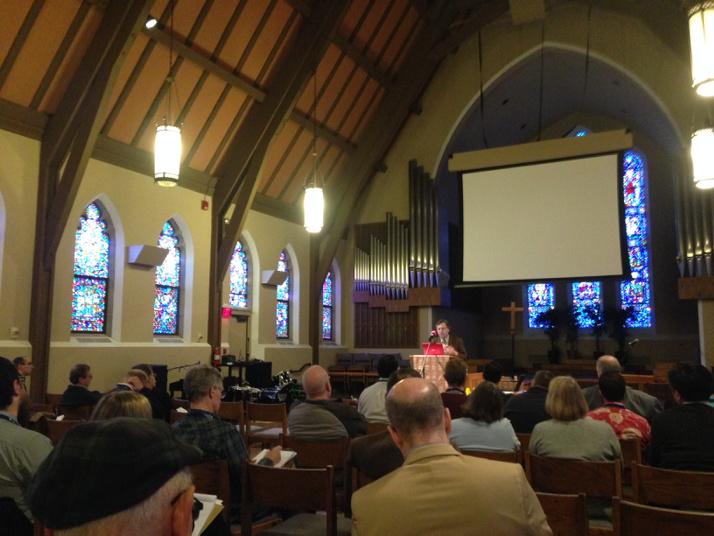
Photo of me giving my presentation on March 27, tweeted by Jamie Smith.

New Opportunities Arising from the Conference

While at the conference I was asked by BioLogos, the organization that funded the conference, to do a series of blog posts on the topic of my presentation (which I accepted). I was also invited to a BioLogos meeting of pastors, scholars, and others in San Francisco this Fall (all expenses paid) on the theme of the science/ faith intersection, called “Celebrating Creation.”

While at the conference I had a meeting with Jim Kinney and Steve Ayers, from Baker Academic (the publisher of my latest book, A New Heaven and a New Earth). Jim invited me to publish my next book with them, something I am happy to do. It is tentatively titled The Silence of Abraham, the Passion of Job (on lament prayer). I just sent Baker Academic a preliminary proposal.

What was my basic takeaway from the conference? There were two main points that struck me as important.

Taking Evolution Seriously

The first thing that struck me is that there are many orthodox Christian scholars, working in different fields, who fully embrace the evidence for the biological evolution of humanity over millions of years; they have no trouble being committed Trinitarian Christians while taking evolution seriously. This was a heartening realization, because it coheres with what I believe should be the outworking of a biblical doctrine of creation. Believing that the Creator made a world that is “very good” (Gen 1:31) suggests that we should trust that reliable knowledge of creation is possible, and this knowledge includes the findings of science, including evolutionary science.

Of course, science is an ever-changing field, as new data are uncovered, and not everything that scientists claim at a particular moment will still be claimed in the future. This is certainly true of the details of hominin evolution, including issues like precisely when Homo sapiens migrated from Africa or the precise dating of the male and female ancestors of all persons living today (which depends on understanding the rate of mutations of the Y chromosome and Mitochondrial DNA). Nevertheless, the general outlines are pretty clear and the fact of evolution is not really in dispute in the scientific community.

Taking the Christian Faith Seriously

If there was one significant difference of opinion that I picked up at the conference, it was over the issue of how we relate the Christian faith (including the doctrine of sin/the fall) to evolutionary science. While many scientists and some theologians at the conference clearly wanted to harmonize (in some way) the biblical accounts of origins and the fall with what we know (or think we know) about biological evolution, not all were convinced this was the best route to go.

The reasons were twofold.

The first has to do with the ever-changing field of scientific knowledge. Peter Harrison (a past Gifford lecturer, who has written extensively on the history of religion and science) gave a brilliant presentation on historical attempts to relate biblical teaching about the cosmos to contemporaneous science. He showed how quickly harmonizations of the Bible and science in the modern period had to be revised, as science grew and progressed, leaving some of the authors of new books on the subject looking quite foolish. So we shouldn’t be too quick to jump to an explanation of how biblical truth relates to the latest science.

But the second reason for resisting immediate harmonization is even more important. The biblical accounts of creation and fall have their own integrity, and these accounts make theological claims about origins in their own right. The danger in harmonization (laudable though it is to try and show connections between theology and science) is that we are in danger of changing what the text is actually claiming (for example, many attempts to connect the biblical accounts of origins to evolution end up denying the Bible’s affirmation of a good creation or the historical origin of human sin).

We need to attend to the fact that the Bible wasn’t written to satisfy our scientific curiosity about the cosmos, but rather has a salvific and ethical purpose. This was a point made especially by theologians and biblical scholars at the conference.

It was the judgment of many (though not all) at the conference that the church needs to attend to its own articulation of the significance of creation and fall, indwelling its own scriptural narratives in their full depth, without feeling pressured to make the Bible “fit” what science is currently telling us. This is not a matter of mistrusting science, but rather of respecting the integrity of the biblical witness to God’s purposes for the world articulated in texts like Genesis 1-3.

I was particularly struck this past weekend, as my church celebrated the paschal, mystery followed by Easter, in a series of services, of the amazing richness of the biblical story of Christ’s victory over death, which is meant to frame all of our lives, and guide us towards holy living. Far from us needing to explain away our faith to make it fit contemporary science, the existential truth and power of this deep mystery is a guide for living and thinking, including our thinking about and our practice of science.

My Own Approach to Evolution and the Fall

Not all the presentations at the conference explicitly addressed Genesis 3, the the classic “Fall” narrative. But, as an Old Testament scholar, that was the focus for my own paper.

When I began working on my paper, I initially framed it as an alternative to naive concordism and Non-Overlapping Magisteria (NOMA). The former approach is what I grew up with in the conservative evangelical church, where Scripture was understood as teaching scientific truth about the cosmos, including a young earth and a non-evolutionary history of biological organisms. The result is that much of modern science is rejected, and the rest is made to harmonize with Scripture.

NOMA is the approach advocated by Stephen Jay Gould, the famous agnostic scientist who wanted to respect what the various religious traditions said. He therefore affirmed that their truth was of a different order from that of the sciences, so that the various “magisteria” (science and religion) could never actually contradict each other.

I was dissatisfied with both approaches—the former since it doesn’t take science seriously and the latter since it seems to erect a concrete wall between science and faith that admits of no interaction.

I initially conceived of my paper as an attempt to get beyond both concordism and NOMA. To that end I set out to explore various theological motifs in Genesis 2-3, such as the creation of humans and animals from the earth, the meaning of the tree of life, the prohibition of the tree of the knowledge of good and evil, the significance of the snake and its dialogue with the woman, the subsequent narrative of transgression and judgment, and the spread of sin and violence in Genesis. Along the way, I made some tentative and speculative comments about how elements of this story might relate to a virtue ethics approach to the development of moral consciousness and also with the state of our current knowledge of evolutionary anthropology.

While some of my suggestions for possible connections with evolution were intriguing, in the end I came to the conclusion that our primary need is to understand the story of Genesis 2-3 in its own right before we try to relate it to evolutionary history. We need to take the time to understand (and indwell) this powerful narrative as the deepest truth of our origins as human beings and the origins of our falling out with God and one another. Only then will be in any position to think clearly about how this text might relate to human evolution.

Note: The conference proceedings are now published as essays in Evolution and the Fall (Eerdmans, 2017), ed. by William T. Cavanaugh and James K. A. Smith.