Designed to Work: Made in God’s Image—A Post from Bob Robinson

Hands.

Hands that can hold a wrench or a paintbrush or a guitar or a scalpel or a child.

Eyes.

Eyes that can look through a telescope to study the glory of the heavens and through a microscope to investigate the intricacies of cells. Eyes that can gaze upon that which is beautiful and that which is ugly. Eyes that can see what is right and what needs to be corrected.

Ears. Toes. Biceps. Knees. Nostrils.

In the beginning there was God, designing a world that he deemed “very good” (Genesis 1:31). And at the pinnacle of this amazing creation were the human beings. Designed by God for amazing and various tasks. Designed by God for His glory.

Yes, human beings are glorious creatures. We are glorious because we reflect the glory of God, who said, “Let us make mankind in our image, in our likeness, so that they may rule over the fish in the sea and the birds in the sky, over the livestock and all the wild animals, and over all the creatures that move along the ground” (Gen. 1:26).

Over against the novel idea that we need to find our self-esteem and find affirmation about how great we are, the Bible says we inherently have dignity because we have been made to reflect God as image bearers. This is both an ennobling thing and a humbling thing, for the glory of being a human being is a derived glory. It shines only because God made us this way, and it is spectacular only because it is a reflection of God.

The Image of God

For centuries, there has been a lot of speculation on what this “image and likeness” means—some say it is our ability to reason, others say it is our ability to relate to one another. Could be. Probably these are major parts of what it means.

But what does the actual text say? According to Genesis 1:28, the image of God looks like a job description!

  1. Be fruitful and increase in number
  2. Fill the earth
  3. Subdue and rule the earth

First, we are designed to be fruitful in making babies and thus making communities of people, living together in flourishing relationships. In other words, reflecting the triune God, we are to relate with each other, lovingly providing for each other’s needs. Families, friends, neighbors, co-workers, and customers. Neighborhoods, towns, cities, states, nations, and the world.

I need to contemplate my relationships for a moment. How am I nurturing them, making space for connections, for hospitality, for conversations? How am I seeking the welfare of the community in which God has placed me (see Jer. 29:7)?

Second, we were designed to fill the earth with our cultural goods, making stuff from the raw material that God has so graciously created. In other words, we are to reflect the creator God by creating stuff ourselves. The whole earth is filled with God’s glory—all we need to do is look around us at the marvels of his creation. Now God tells us to fill the earth as well. And as we do so, the earth is filled with even more of his glory.

Therefore, I need to remember that my work has deep significance. When I contribute to culture by working to provide goods and services, I am reflecting the good Creator of all things, filling the earth with the good things that provide for those around me. How am I participating with God in bringing blessing to others through my work? How is my work a very practical means to love my neighbor?

Third, we are designed to subdue and rule the earth, to place it under our benevolent control. In other words, God makes us his vice-regents in charge of his good creation. But rather than doing what humans often do, we are not to exploit it; we are to “cultivate and care for it” (see Gen. 2:15). And the good creation is not merely limited to the natural beauty of birds and trees, sea and fish, and mountains and elk. The good creation is also all the things that God has dialed into the world—families, business, education, government, entertainment, etc. God is the Lord of it all and has placed us in charge under his rule.

How am I doing in this task of watching over the things of this world? What can I do to see God’s Kingdom come and will be done on earth as it is in heaven? Where I see things that are good, beautiful, and right, how can I help these things develop and be sustained? Where I see things that are wrong, unjust, or sinful, what is God calling me to do about it?

Designed to Work: From Architects to Computer Technicians to Farmers

So it is a very practical thing, this image of God in mankind. We see it play out in all sorts of ways, in all sorts of people, in all sorts of fields.

Take David Greusel, for example. He’s an architect that has figured out how his gift for design reflects God’s glory. David writes,

What does redeemed architecture look like? Does it have Bible verses encoded in the decoration? Scrolls of scripture hidden in the mortar joints? I think not. To my way of thinking, redemptive design seeks the good of the city, and of the people in the city, whether they live or work in the building or not. This means the building has to be a good neighbor, reinforcing the street and not alienating passers-by. It should promote human flourishing, whether as a place of dwelling, work, or recreation, and help people to be, in Andy Crouch’s phrase, most gloriously themselves. And regardless of its use, it should point to a higher reality, not with encoded Bible verses, but with excellence in design and craft. (“Designed to Work: Redeeming Architecture” by David Greusel)

Or look over at Mike Wittmer’s friend Jordan, a computer technician. As Mike observed this young Christian man in his work, juggling the task of fixing the computer in front of him while fielding phone calls for tech support, he is in awe.

Jordan’s job contributes to this larger endeavor. His behind the scenes role supports the technology that enables others to make something of the world … He never lost his composure through the entire ordeal. He exuded patience, the fruit of the Spirit that takes the longest to ripen, and so showed that he has been walking with Jesus for a long time. (“Designed to Work: What Do You Make Possible?” by Mike Wittmer)

And then there’s Billy Coffey’s story of farmers Clive and Darrell Howard, father and son. Darrell has decided that the life of farming is not what he wants, so he plans, “The university first, and then a proper job. Someplace in the city. Downtown, with a view of the skyline instead of the ridgeline. Suits instead of coveralls. Early retirement. The country club.” Clive wants the best for Darrell, but he worries that Darrell has not grasped the goodness of God’s design for hard work. He wants his son to experience how work, in and of itself, brings purpose.

It isn’t that he views his son’s goals as less than the life Darrell had been born into. Whether sitting in a corner office or plowing the back forty, so long as Darrell works, Clive will be happy. Work itself is Clive’s concern, and not specifically on the farm. What place will work have in the life of his son? That’s what Clive Howard wonders.(“Designed to Work: Are We Meant for Toil?” by Billy Coffey)

______________________________

Bob Robinson is a writer, speaker, mistake repeater, forgetful husband, silly father, and depender on grace and mercy. He consults with (re)integrate, he ministers with CCO, and he edits with The High Calling, where the above post originally appeared as part of a blog series entitled “Designed for Work” (see below) Read more of Bob’s work at www.re-integrate.org/magazine. Follow his tweets @Bob_Robinson_re.

______________________________

Designed to Work

“We are exploring together. We are cultivating a garden together, backs to the sun. The question is a hoe in our hands and we are digging beneath the hard and crusty surface to the rich humus of our lives.” Parker J. Palmer, Let Your Life Speak: Listening for the Voice of Vocation.

Work is not a curse. Before the Fall, God placed Adam and Eve in the garden and invited them to participate with him by cultivating the earth and tilling the soil and coaxing seedlings to find the sun. Our work is one way we participate in restoration. We were designed to work, and our good work is worship. In this series, Designed to Work, we’ll explore together and celebrate the gift of work, given to us by a God who loves us deeply.

The Eschaton Has Arrived—Actually Just the Book

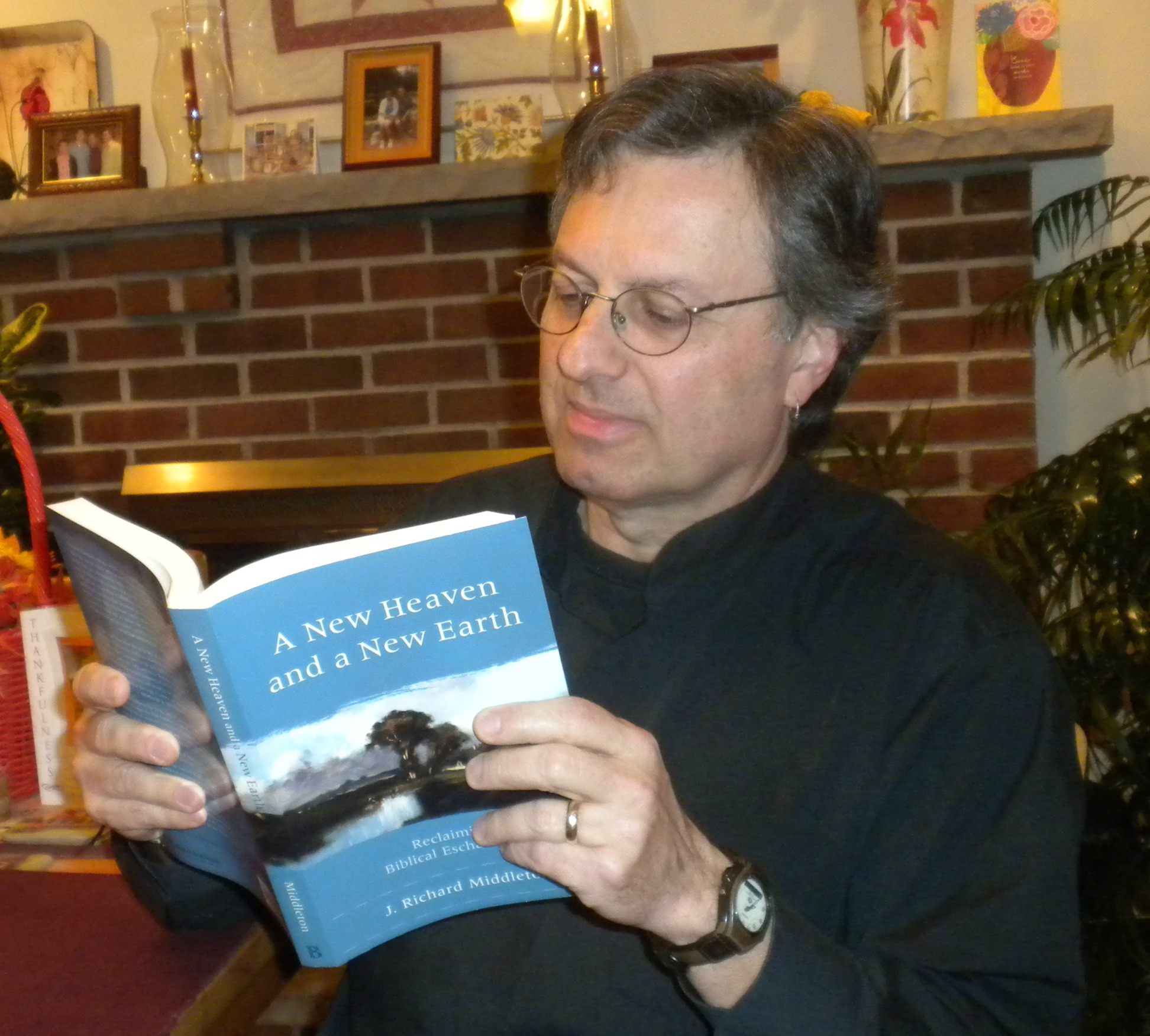
Today I received a copy of my newly published book A New Heaven and a New Earth: Reclaiming Biblical Eschatology. My publisher (Baker Academic) informed me it arrived at their offices on Friday (Halloween) and they immediately sent me a copy.

I know I should be used to this by now (since this isn’t my first book), but I tend to write about one book per decade (I’m a bit slower than Tom Wright or Jamie Smith), so it’s not often I get to see one of my books fresh off the press. Actually, I seem to be picking up publication speed, since the gap between my first and second books was eleven years, then ten years between the second and third, and now nine years between the third and fourth—though I wasn’t actually working on each book for the entire in-between time.

Originally, A New Heaven and a New Earth was supposed to have been published a couple of years earlier (2012). I received the invitation from Baker to write the book back in fall 2007 and did a bit of research in summer 2008. Then I spent much of my sabbatical in spring and summer 2009 working on the project and got some of the chapters written. I had originally planned a short seven-chapter book, with the idea of doing more work in summer 2010 and completing it it in 2011, but a computer crash when I was nearly done (in August 2011) set me back just as the teaching semester was about to begin. So I put off completing it till the following summer.

This led Baker to advertize it as being published in 2013, which was jumping the gun, since I had not submitted a manuscript even by the end of summer 2012.

By then I had concluded there was more that I wanted to say, so I added a few more chapters. At that point I also realized that some chapters were becoming overly long, so I divided them into two (some long chapters really had two separate chapters hiding there). In the end, the book became thirteen chapters (or twelve chapters plus an appendix, as the publisher has organized it).

I submitted the completed manuscript to Baker at the start of October 2013. Due to the recession many publishers (Baker included) had cut staff, and they told me that they had more books in the pipeline than they could get to the shelves as quickly as they would like. So I knew it would be a while before mine would be published. They indicated it would be about a year (the book did have to go through required rounds of editing, from the publisher, back to me, and around again a couple of times).

Various websites selling the book have indicated differing publication dates, either late November or early December. But during the past summer Baker informed me that the book would be ready by November 1—and they were actually a day early!

I don’t know exactly when the book will be available in stores (online or brick-and-mortar), but I’ve been told it will be ready for a conference on Faith and Work that I’m speaking at this coming weekend (November 7-8). And it will also be on sale at the annual meetings of various academic societies in San Diego in the third week of November (the Evangelical Theological Society, the Institute for Biblical Research, the Society of Biblical Literature, and the American Academy of Religion).

So the eschaton hasn’t arrived; but the book certainly has.

Singing Lies in Church

In a previous post entitled “The Bible’s Best Kept Secret” I summarized the logic of redemption in the Scriptures—that God loves this world and intends to redeem it. Grounded in the holistic worldview of the Old Testament, the New Testament envisions God’s renewal of creation at Christ’s return, rather than God taking us out of this world to “heaven,” conceived of as an immaterial realm. Indeed, contrary to much popular eschatology, nowhere does the Bible ever say that “heaven” is the eternal destiny of the righteous.

The Eschatology of Classic Christian Hymns

So why do so many in the church assume a heavenly afterlife? The answer lies in Christian hymnody. It is primarily from what they sing that those in the pew (or auditorium) typically learn their theology, especially their eschatology. And the trouble is that a holistic vision of the future is found only rarely in popular Christian piety or in the liturgy of the church. Indeed, it is blatantly contradicted by many traditional hymns (and contemporary praise songs) sung in the context of communal worship.

Preparing for Heaven

From the classic Charles Wesley hymn, “Love Divine, All Loves Excelling,” which anticipates being “changed from glory into glory/ till in heaven we take our place,” to “Away in a Manger,” which prays, “And fit us for Heaven, to live with Thee there,” congregations are exposed to—and assimilate—an otherworldly eschatology.

Some hymns, like “When the Roll Is Called up Yonder,” inconsistently combine the idea of resurrection with the hope of heaven: “On that bright and cloudless morning when the dead in Christ shall rise,/ And the glory of His resurrection share;/ When His chosen ones shall gather to their home beyond the skies,/ And the roll is called up yonder, I’ll be there.

Some hymns even interpret resurrection without reference to the body at all, such as “Must Jesus Bear the Cross Alone?” which in one stanza regards death as liberation (“Till death shall set me free”) and in another asserts: “O resurrection day!/ When Christ the Lord from Heav’n comes down/ And bears my soul away.”

A hymn like “When We All Get to Heaven” may be too obvious, but notice that “The Old Rugged Cross” ends with the words, “Then He’ll call me some day to my home far away/ Where his glory forever I’ll share.”

And “Just a Closer Walk with Thee” climaxes with the lines: “When my feeble life is o’er,/ Time for me will be no more;/ Guide me gently, safely o’er/ To Thy kingdom shore, to Thy shore.

A Perpetual Worship Service

This notion of a perpetual worship service in an otherworldly afterlife is a central motif in many hymns, like “My Jesus I Love Thee,” which affirms that “In mansions of glory and endless delight,/ I’ll ever adore Thee in heaven so bright.”

Likewise, “Come Christians, Join to Sing” affirms that “On heaven’s blissful shore,/ His goodness we’ll adore,/ Singing forevermore,/ ‘Alleluia! Amen!’”

In a similar vein, “As with Gladness Men of Old” asks in one stanza that “when earthly things are past,/ Bring our ransomed souls at last/ Where they need no star to guide” and in another stanza expresses the desire that “In the heavenly country bright/ . . . There forever may we sing/ Alleluias to our King!”

From Hymns to Contemporary Praise Songs

Thankfully, most hymnals no longer have the sixth verse of “Amazing Grace,” which predicts: “The earth shall soon dissolve like snow,/ The sun forbear to shine;/ But God, who called me here below,/ Will be forever mine.

Yet Chris Tomlin’s contemporary revision of this classic hymn, known as “Amazing Grace (My Chains Are Gone),” reintroduces this very verse as the song’s new climax, ready to shape the otherworldly mindset of a fresh generation of young worshipers unacquainted with hymnals.

And this just begins to scratch the surface of worship lyrics that portray the final destiny of the righteous as transferal from an earthly, historical existence to a transcendent, immaterial realm.

As the popular theologian and preacher A. W. Tozer is reputed to have said: “Christians don’t tell lies; they just go to church and sing them.”

Perhaps that is too harsh; nevertheless, I can testify to the steady diet of such songs that I was exposed to, growing up in the church in Kingston, Jamaica, which certainly reinforced the idea of heaven as otherworldly final destiny.

An Alternative Vision of the Future

I am, however, perpetually grateful that along with such exposure I came to know, through sheer proximity, the this-worldly theology of Rastafarianism, especially as mediated through the music of Bob Marley and the Wailers. While I am a committed Christian and thus cannot affirm everything found in Rasta theology, I nevertheless discern a deeply rooted biblical consciousness in the lyrics of many Wailers’ songs.

For example, the song “We an’ Dem” (on the Uprising album) claims that “in the beginning Jah created everything/ and he gave man dominion over all things” and “Pass It On” (on the Burnin’ album) asserts that “In the kingdom of Jah/ Man shall reign.” These lyrics express (in androcentric language, admittedly) the biblical vision of this-worldly dignity granted humans at creation, a dignity which will be restored in the kingdom of God.

And Peter Tosh’s version of “Get Up, Stand Up” (a song he co-wrote with Marley), understands well the implications of eschatology for ethics, when it contrasts the doctrine of the rapture with a desire for justice on earth:

“You know, most people think,/ A great God will come from the skies,/ And take away every little thing/ And lef’ everybody dry./ But if you know what life is worth,/ You would look for yours/ Right here on earth/ And now we see the light,/ We gonna stand up for our rights.” (From the Equal Rights album.)

The song goes on to critique the “preacher man” for taking the focus off earthly life and affirms that the singer is “Sick and tired of this game of theology,/ die and go to heaven in Jesus name.”

This is the very theology that leads Marley, in the song “Talkin’ Blues” (from the Natty Dread album), to admit, “I feel like bombing a church,/ now that you know that the preacher is lying.”

But if Tozer is right, it isn’t just the preacher who is lying, but also the worshipers who blithely sing hymns of escape to an ethereal heaven—when the Bible teaches no such thing.

What the Bible does teach is the theme of my new book, A New Heaven and a New Earth: Reclaiming Biblical Eschatology (Baker Academic, 2014).