On My Way to Jubilee 2015

It’s Saturday afternoon and I’m sitting in the Atlanta airport, waiting for a flight to Pittsburgh. I’ll be speaking at the annual Jubilee conference tomorrow (Sunday) morning. This year’s conference theme is “This Changes Everything”————a reference to the radical message of the gospel. A brochure for the Jubilee 2015 conference can be found here, for those interested.

I’ll be giving the last of four keynote talks that stretch from Friday through Sunday. The topics for the talks are Creation, Fall, Redemption, and Restoration. The title of my talk is “Restoration————The Destiny of God’s Good Creation,” and I hope to take the attendees (mostly college students) on a tour of Scripture, to introduce them to the depth and length and height of God’s amazing love for this world, a love that leads to God’s commitment to redeem and restore creation.

I’m sort of going in to the conference blind, since I won’t have heard the other talks that precede my own; I will get there just in time for supper this evening. I would have liked to have been part of the entire event, which started on Friday. But my wife and I were already committed to being in Jamaica to take care of her mom and stepdad who live there (they are in their eighties); we left the cold and snow for sunny Jamaica ten days ago and we praise God for the wonderful things we were able to accomplish while we were there.

That prior commitment initially led me to turn down the invitation to speak at Jubilee 2015 since I couldn’t be in two places at once. But the good people who plan the conference wouldn’t give up and offered to fly me up directly from Jamaica to Pittsburgh, and then send me home to Rochester.

So, goodby sunshine! Welcome snow and cold!

I’ll let you know how it goes (the conference, not the cold).
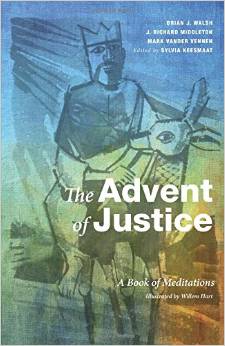
The Advent of Justice

Back when I was working on my PhD in Canada I was asked to contribute to a book of Advent meditations in honor of Citizens for Public Justice (CPJ), a Canadian justice organization run by Christians. To that end Sylvia Keesmaat, Brian Walsh, Mark VanderVennen, and I each wrote meditations for one of the four weeks of Advent readings from the daily Lectionary (seven meditations apiece); all of us had been involved in some way with this important justice organization.

I had been personally impacted by CPJ, including their published literature on a Christian approach to the political sphere and the helpful guides they provided to the various issues as each Canadian election approached. I was also impressed by their political advocacy in the name of Christ on behalf of those negatively affected by unjust social policies in the context of our modern consumer society. CPJ had been an important voice in helping me think through the political implications of my own Christian faith.

Since the Old Testament readings for that Advent season all focused on passages from Isaiah, which connected faith with justice, we decided to make this the focus of our meditations, while also drawing connections to the Gospel readings for each day.

These meditations were published back in 1993 by the CJL Foundation (an arm of CPJ), as a short book called The Advent of Justice. That book was then adopted by the Anglican Diocese of Toronto as an Advent study guide for that year.

A well-known Toronto artist, Willem (Bill) Hart, graciously contributed watercolors for the book cover and as introductions to each week’s meditations.

The Advent of Justice was reprinted the following year (1994) by Dordt College Press; and it’s been used on and off by lots of different people over the years as a guide to reflecting on the meaning of the Advent season.

The Advent of Justice has just been reprinted by Wipf and Stock publishers in time for this year’s Advent season. I was delighted that Northeastern Seminary decided to give copies away at their annual alumni reception (held a week ago). And they have just this past week posted my own Advent reflections from the book (with permission from the publisher) on the Northeastern Seminary website.

For anyone interested, the post for the first day of the week (Sunday) can be found here. The posts for the other days (Monday through Saturday) can be accessed from the right hand column of the website.

A flyer about the book can be accessed here.

Wishing you a blessed and meaningful Advent season.

Was Abraham’s Attempt to Sacrifice Isaac a Faithful Response to God?

In my last post I mentioned that I had just attended the 2014 Congress of Humanities and Social Sciences, at Brock University, in St. Catharines, ON, Canada.

One of the academic societies I participated in was the Canadian Society of Biblical Studies, where I presented a paper on Genesis 22, known in Jewish tradition as the Aqedah or “binding” of Isaac (Abraham “bound” [‘aqad] Isaac and placed him on the altar; Gen 22:9). I titled my paper (somewhat ironically): “Unbinding the Aqedah from the Straightjacket of Tradition.”

The gist of my paper was that contrary to traditional readings in both Judaism and Christianity, we should not understand Abraham’s response as a paradigm of virtue. Rather, I argued that Abraham’s response of blind obedience to the command to sacrifice his son was sub-par. It was better than outright disobedience. But a truly faithful response would have been to follow the example of the lament psalms (and Job) by questioning God, even protesting that this command wasn’t right.

Central to my argument was the fact that Abraham had previously (in Gen 18) protested the possibility that God might destroy Sodom, despite the fact that there were righteous/innocent people living there (the Hebrew word tsadîq can mean either). Whereas Abraham’s motive for that protest was the fact that his nephew Lot and his family were living in Sodom, it is strange that when God tells him to offer up his own son as a burnt offering, Abraham’s silence is deafening. He says nothing whatsoever (he certainly does not protest the death of this innocent victim), but blindly moves to obey—and has to be stopped in the act by an angel calling from heaven: “Abraham, Abraham! . . . don’t do anything to the boy!”

It is also significant that the text reports that Abraham returned to his servants and that they went off together, but that Isaac is not mentioned at the end of the story (Gen 22:19). Also significant is that Isaac is then reported as living in a different geographical location from Abraham (and Sarah is living elsewhere, by the way), and father and son never again see each other. This is why the subtitle of my paper was: “How Abraham Lost His Son.”

In the end, I argue that the test (“God tested Abraham”; Gen 22:1) was not whether Abraham would obey. Rather, what was being tested was Abraham’s discernment of the character of God. Was this a God of mercy or a deity just like one of the other ancient Near Eastern gods who required child sacrifice?

Well, there’s a lot more to be said (and the paper says more, and even recognizes the arguments against this interpretation). But this should give you the gist of what I presented. I am presently expanding the paper and preparing it for publication.

What’s your response to this interpretation of Genesis 22? Do you find it jarring? Or does it resonate with you? Why?