The Eschaton Has Arrived—Actually Just the Book

Today I received a copy of my newly published book A New Heaven and a New Earth: Reclaiming Biblical Eschatology. My publisher (Baker Academic) informed me it arrived at their offices on Friday (Halloween) and they immediately sent me a copy.
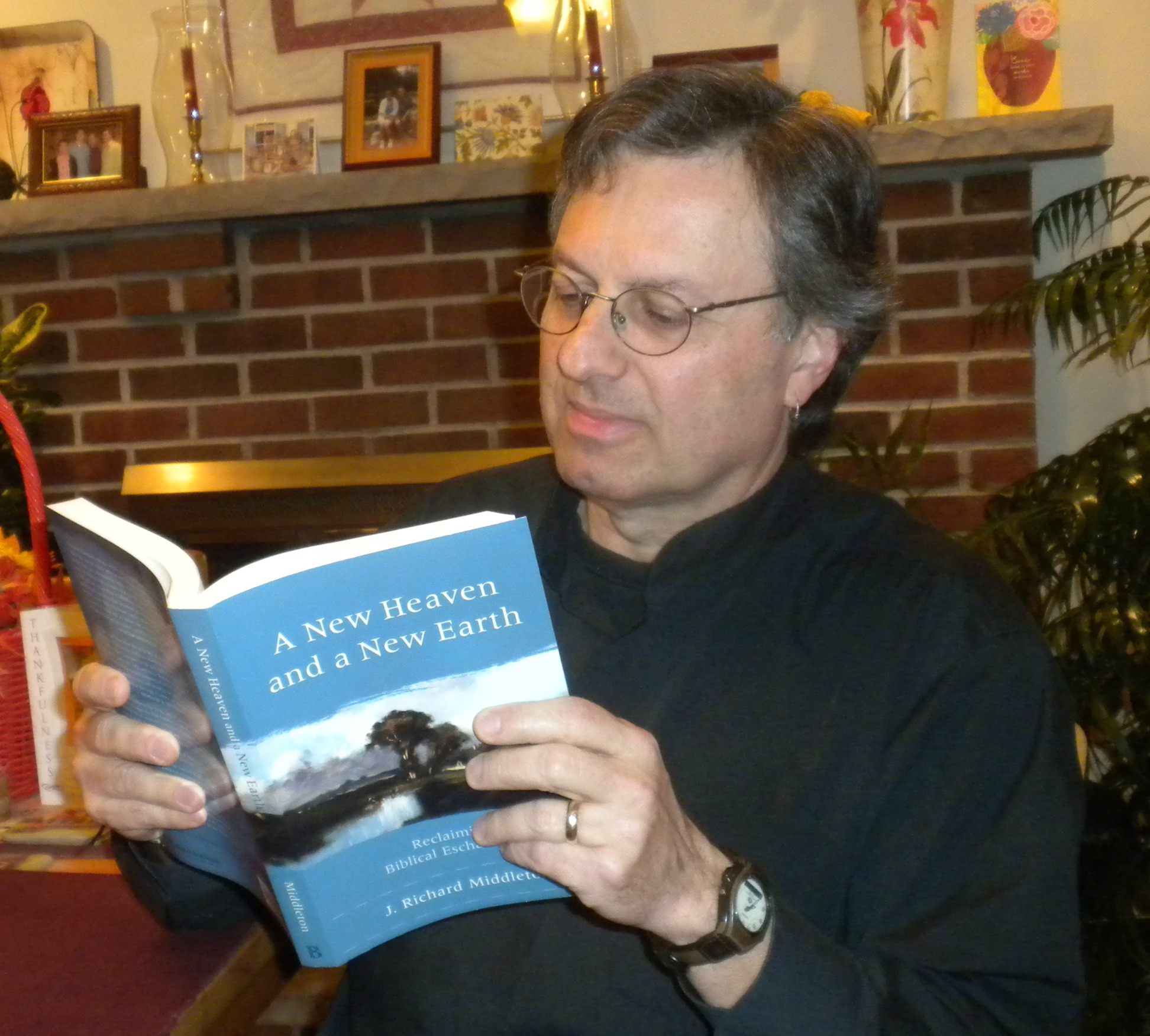
I know I should be used to this by now (since this isn’t my first book), but I tend to write about one book per decade (I’m a bit slower than Tom Wright or Jamie Smith), so it’s not often I get to see one of my books fresh off the press. Actually, I seem to be picking up publication speed, since the gap between my first and second books was eleven years, then ten years between the second and third, and now nine years between the third and fourth—though I wasn’t actually working on each book for the entire in-between time.

Originally, A New Heaven and a New Earth was supposed to have been published a couple of years earlier (2012). I received the invitation from Baker to write the book back in fall 2007 and did a bit of research in summer 2008. Then I spent much of my sabbatical in spring and summer 2009 working on the project and got some of the chapters written. I had originally planned a short seven-chapter book, with the idea of doing more work in summer 2010 and completing it it in 2011, but a computer crash when I was nearly done (in August 2011) set me back just as the teaching semester was about to begin. So I put off completing it till the following summer.

This led Baker to advertize it as being published in 2013, which was jumping the gun, since I had not submitted a manuscript even by the end of summer 2012.

By then I had concluded there was more that I wanted to say, so I added a few more chapters. At that point I also realized that some chapters were becoming overly long, so I divided them into two (some long chapters really had two separate chapters hiding there). In the end, the book became thirteen chapters (or twelve chapters plus an appendix, as the publisher has organized it).

I submitted the completed manuscript to Baker at the start of October 2013. Due to the recession many publishers (Baker included) had cut staff, and they told me that they had more books in the pipeline than they could get to the shelves as quickly as they would like. So I knew it would be a while before mine would be published. They indicated it would be about a year (the book did have to go through required rounds of editing, from the publisher, back to me, and around again a couple of times).

Various websites selling the book have indicated differing publication dates, either late November or early December. But during the past summer Baker informed me that the book would be ready by November 1—and they were actually a day early!

I don’t know exactly when the book will be available in stores (online or brick-and-mortar), but I’ve been told it will be ready for a conference on Faith and Work that I’m speaking at this coming weekend (November 7-8). And it will also be on sale at the annual meetings of various academic societies in San Diego in the third week of November (the Evangelical Theological Society, the Institute for Biblical Research, the Society of Biblical Literature, and the American Academy of Religion).

So the eschaton hasn’t arrived; but the book certainly has.

Singing Lies in Church

In a previous post entitled “The Bible’s Best Kept Secret” I summarized the logic of redemption in the Scriptures—that God loves this world and intends to redeem it. Grounded in the holistic worldview of the Old Testament, the New Testament envisions God’s renewal of creation at Christ’s return, rather than God taking us out of this world to “heaven,” conceived of as an immaterial realm. Indeed, contrary to much popular eschatology, nowhere does the Bible ever say that “heaven” is the eternal destiny of the righteous.

The Eschatology of Classic Christian Hymns

So why do so many in the church assume a heavenly afterlife? The answer lies in Christian hymnody. It is primarily from what they sing that those in the pew (or auditorium) typically learn their theology, especially their eschatology. And the trouble is that a holistic vision of the future is found only rarely in popular Christian piety or in the liturgy of the church. Indeed, it is blatantly contradicted by many traditional hymns (and contemporary praise songs) sung in the context of communal worship.

Preparing for Heaven

From the classic Charles Wesley hymn, “Love Divine, All Loves Excelling,” which anticipates being “changed from glory into glory/ till in heaven we take our place,” to “Away in a Manger,” which prays, “And fit us for Heaven, to live with Thee there,” congregations are exposed to—and assimilate—an otherworldly eschatology.

Some hymns, like “When the Roll Is Called up Yonder,” inconsistently combine the idea of resurrection with the hope of heaven: “On that bright and cloudless morning when the dead in Christ shall rise,/ And the glory of His resurrection share;/ When His chosen ones shall gather to their home beyond the skies,/ And the roll is called up yonder, I’ll be there.

Some hymns even interpret resurrection without reference to the body at all, such as “Must Jesus Bear the Cross Alone?” which in one stanza regards death as liberation (“Till death shall set me free”) and in another asserts: “O resurrection day!/ When Christ the Lord from Heav’n comes down/ And bears my soul away.”

A hymn like “When We All Get to Heaven” may be too obvious, but notice that “The Old Rugged Cross” ends with the words, “Then He’ll call me some day to my home far away/ Where his glory forever I’ll share.”

And “Just a Closer Walk with Thee” climaxes with the lines: “When my feeble life is o’er,/ Time for me will be no more;/ Guide me gently, safely o’er/ To Thy kingdom shore, to Thy shore.

A Perpetual Worship Service

This notion of a perpetual worship service in an otherworldly afterlife is a central motif in many hymns, like “My Jesus I Love Thee,” which affirms that “In mansions of glory and endless delight,/ I’ll ever adore Thee in heaven so bright.”

Likewise, “Come Christians, Join to Sing” affirms that “On heaven’s blissful shore,/ His goodness we’ll adore,/ Singing forevermore,/ ‘Alleluia! Amen!’”

In a similar vein, “As with Gladness Men of Old” asks in one stanza that “when earthly things are past,/ Bring our ransomed souls at last/ Where they need no star to guide” and in another stanza expresses the desire that “In the heavenly country bright/ . . . There forever may we sing/ Alleluias to our King!”

From Hymns to Contemporary Praise Songs

Thankfully, most hymnals no longer have the sixth verse of “Amazing Grace,” which predicts: “The earth shall soon dissolve like snow,/ The sun forbear to shine;/ But God, who called me here below,/ Will be forever mine.

Yet Chris Tomlin’s contemporary revision of this classic hymn, known as “Amazing Grace (My Chains Are Gone),” reintroduces this very verse as the song’s new climax, ready to shape the otherworldly mindset of a fresh generation of young worshipers unacquainted with hymnals.

And this just begins to scratch the surface of worship lyrics that portray the final destiny of the righteous as transferal from an earthly, historical existence to a transcendent, immaterial realm.

As the popular theologian and preacher A. W. Tozer is reputed to have said: “Christians don’t tell lies; they just go to church and sing them.”

Perhaps that is too harsh; nevertheless, I can testify to the steady diet of such songs that I was exposed to, growing up in the church in Kingston, Jamaica, which certainly reinforced the idea of heaven as otherworldly final destiny.

An Alternative Vision of the Future

I am, however, perpetually grateful that along with such exposure I came to know, through sheer proximity, the this-worldly theology of Rastafarianism, especially as mediated through the music of Bob Marley and the Wailers. While I am a committed Christian and thus cannot affirm everything found in Rasta theology, I nevertheless discern a deeply rooted biblical consciousness in the lyrics of many Wailers’ songs.

For example, the song “We an’ Dem” (on the Uprising album) claims that “in the beginning Jah created everything/ and he gave man dominion over all things” and “Pass It On” (on the Burnin’ album) asserts that “In the kingdom of Jah/ Man shall reign.” These lyrics express (in androcentric language, admittedly) the biblical vision of this-worldly dignity granted humans at creation, a dignity which will be restored in the kingdom of God.

And Peter Tosh’s version of “Get Up, Stand Up” (a song he co-wrote with Marley), understands well the implications of eschatology for ethics, when it contrasts the doctrine of the rapture with a desire for justice on earth:

“You know, most people think,/ A great God will come from the skies,/ And take away every little thing/ And lef’ everybody dry./ But if you know what life is worth,/ You would look for yours/ Right here on earth/ And now we see the light,/ We gonna stand up for our rights.” (From the Equal Rights album.)

The song goes on to critique the “preacher man” for taking the focus off earthly life and affirms that the singer is “Sick and tired of this game of theology,/ die and go to heaven in Jesus name.”

This is the very theology that leads Marley, in the song “Talkin’ Blues” (from the Natty Dread album), to admit, “I feel like bombing a church,/ now that you know that the preacher is lying.”

But if Tozer is right, it isn’t just the preacher who is lying, but also the worshipers who blithely sing hymns of escape to an ethereal heaven—when the Bible teaches no such thing.

What the Bible does teach is the theme of my new book, A New Heaven and a New Earth: Reclaiming Biblical Eschatology (Baker Academic, 2014).

Making All Things New—Faith and Work 2014 Conference

In about a week I will be speaking at what looks to be a very exciting conference in New York City.

The conference is called “Making All Things New—Imagination & Innovation Required,” sponsored by the Center for Faith and Work, which is affiliated with Redeemer Presbyterian Church.

This is how the website describes the conference:

“The Faith and Work Conference is a two day gathering of industry leaders, cultural commentators, and leading theologians to reflect on the vital, inevitable intersection of our work and faith. Through keynote talks, exhibitions, workshops, and cultural outings, we’ll explore the role of imagination and innovation as expressions of God’s grace in our world. Artists and educators, designers and technicians, homemakers, engineers, managers, entrepreneurs, doctors, and everyone in between are invited to help us celebrate the remarkable reality that work matters.”

The conference begins Friday evening, November 7, and continues all day Saturday, November 8.

Timothy Keller (founding pastor of Redeemer Presbyterian Church) will give a keynote talk on Friday evening, framing the conference in terms a Christian imagination.

My own keynote, entitled “A Sacred Calling for Sacred Work,” will be on Saturday morning.

Other speakers include David Brooks (columnist for the New York Times), on a social imagination, as well as Dave Evans, Nancy Ortberg, and Margaret Newman.

The afternoon has an “Imagination and Innovation Expo,” with “workshops, tastings, conversations, screenings, demos and more.”

The conference ends with theologian and poet Christian Wiman leading participants through an imaginative exercise to envision the future together.

Bios for all the presenters are listed here.