Beyond Eurocentrism—A Future for Canadian Biblical Studies

On May 31, 2021 I had the privilege of giving my presidential address to the Canadian Society of Biblical Studies (CSBS). This is something every outgoing president does at the end of their term.

A Delayed Presidential Address

I was in the unusual situation of being president of CSBS for two consecutive years (2019–21), something unprecedented in the eighty-eight year history of the Society (which was formed in 1933). In every previous case, a person is elected to become vice-president for a year, then serves as president for the following year, then gives their presidential address.

However, the COVID-19 pandemic resulted in the cancelation of the 2020 annual meeting, at which we would have had the election of new officers (those whose terms were up) and at which I would have given my presidential address. Without a formal election of new officers, all the elected officers whose term was up continued pro tem until the next annual meeting.

The executive decided that despite the ongoing pandemic we couldn’t go another year without an annual meeting. But because of the pandemic, they decided that the 2021 annual meeting would be purely virtual.

Since I hadn’t been able to give my presidential address in 2020, I gave it (virtually) in 2021.

A Different Presidential Address

However, it was on a different topic from what I had originally planned.

In 2020 I had planned to focus my presidential address on the Aqedah (Genesis 22), in anticipation of the book I was writing, entitled Abraham’s Silence: The Binding of Isaac, the Suffering of Job, and How to Talk Back to God (Grand Rapids: Baker Academic, 2021).

However, new issues arose in the CSBS, along with some external prods, which resulted in me giving a presentation on the past and future of biblical studies in Canada.

In “Beyond Eurocentrism: A Future for Canadian Biblical Studies,” I traced the history of biblical studies in Canada and challenged biblical scholars in Canada to explicitly bring their social and religious context to bear on their academic work, while allowing the Bible to speak to their context.

Here is the abstract of my paper:

The history of Canadian biblical studies, like biblical studies south of the border, has been defined by the attempt to protect academic study of the Bible from religious and ecclesiastical control. Although legitimate in its time, this has resulted in the fictitious ideal of an academic discipline uncontaminated by the contemporary contexts of the interpreter. Not only is such an ideal unattainable (since everyone brings their contexts, explicitly or implicitly, to their academic work), it is ethically problematic, since it has legitimated the Eurocentric orientation of the field as normative, resulting in the marginalization of alternative voices and perspectives.

Thankfully, biblical scholars have begun to take cognizance of how we read the Bible in terms of existential questions arising from our social and ecclesial locations. Besides many publications on the subject of contextual biblical studies over the past thirty years (perhaps beginning with Stony the Road We Trod), the Society of Biblical Literature sponsored two seminars in 2020 called “#Black Scholars Matter.”

Canadian biblical scholars, however, have been slower than our American counterparts to recognize the importance of the interpreter’s context for our field. The question this essay raises is whether we can envision a future for Canadian biblical studies beyond Eurocentrism.

Although I was addressing the Canadian context, I drew significantly on my Jamaican background (including Jamaican traditions of resistance to power) in order to make a particular proposal for the practice of biblical studies in Canada.

You can watch the video of my presidential address here.

The text of the address is being published in the Canadian-American Theological Review. I will post a link here when it is available.
The Liberating Image—The Practical Significance of Being Made in God’s Image

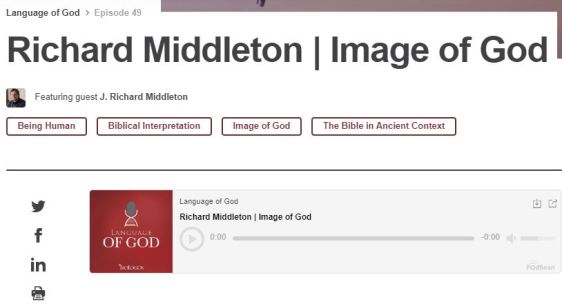
Back in November 2019, when I was attending the Society of Biblical Literature annual meeting in San Diego, I met up with Jim Stump, vice-president of BioLogos. I’ve known Jim for about five years and he asked if he could interview me for the Language of God podcast series that BioLogos sponsors.

The focus of the interview was a topic dear to my heart—what it means to be made in the image of God (imago Dei).

The podcast page introduces the interview this way:

“We were made in the image of God, but what does that really mean? Whom does that apply to? What does that call us to? The Bible is very central to understanding the answers to these questions, as is cultural context. In this episode, biblical worldview professor, Richard Middleton joins Jim Stump in an attempt to answer some of the questions about human identity through both of those lenses.”

This is some of what Jim Stump said on Facebook about the interview.

“Here we talk about the Bible and science (like what each has to say about Adam and Eve), but mostly focus on his specialty: the image of God. I’m biased and prone to believe what I want to be the case, but I think this is a really interesting conversation.”

You can listen to the full interview here on the BioLogos podcast website.

Although Jim does eventually ask me to speculate on how the imago Dei might relate to the development of Homo sapiens, the interview focuses on what the Bible says about the image in its ancient Near Eastern context and its relevance for living in God’s world. I essentially summarize the main thrust of my book The Liberating Image: The Imago Dei in Genesis 1 (Brazos, 2005).

Prior to the book, I had written a programmatic article on the subject, with almost the same title: “The Liberating Image? Interpreting the Imago Dei in Context,” published in Christian Scholar’s Review 24 (1994): 8–25.

Jim Stump is from the Missionary Church, the same denomination that I was a member of as a teen and young adult in Jamaica. I did my undergraduate degree in theology at the Jamaica Theological Seminary, which was founded in 1960 by the Missionary Church Association of Jamaica. It turns out that Jim had spoken at a 2007 commencement ceremony at my seminary.

Although the image of God is the focus of the BioLogos interview, I also talk a bit about what Jamaica is like (in response to Jim’s questions).

If you are interested in further reflections on the applicability of the imago Dei to matters of ethics and justice, you can read the blog post I was invited to write for the Imago Dei Fund. It is called “The Ethical Challenge of the Image of God in the 21st Century – Human Rights and Beyond.

And if you want to explore a bit more about how the imago Dei (and the Fall) might (I emphasize that word) relate to what we know of the origins of Homo sapiens, I discuss these topics in a presentation I gave for the Canadian and Christian Scientific Affiliation, called “Human Distinctiveness and the Origin of Evil in Biblical and Evolutionary Perspectives.”

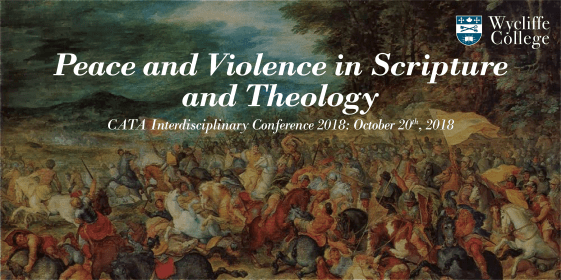
Peace and Violence in Scripture and Theology (October 2018 Conference of the Canadian-American Theological Association)

The Canadian-American Theological Association is having their annual Fall theology conference at Wycliffe College, Toronto School of Theology, on October 20, 2018.

The conference, co-sponsored with Wycliffe College, will focus on the theme:

PEACE AND VIOLENCE IN SCRIPTURE AND THEOLOGY

Dr. Gordon K. Oeste will deliver the keynote lecture, Feasting with the Enemy: Redemptive Readings of Biblical War Texts.

Dr. Oeste, the Teaching Pastor at Cedar Creek Community Church in Cambridge, Ontario, is the author of Legitimacy, Illegitimacy, and the Right to Rule: Windows on Abimelech’s Rise and Demise in Judges 9 (Bloomsbury T & T Clark, 2013). He is currently co-authoring a book on warfare in the Bible.

A panoply of papers will be presented from all theological disciplines on subjects related to Peace and Violence in Scripture and Theology, as well as other subjects that engage culture, the church, and various academic fields.

The conference runs from 8:45 a.m. until 4:00 p.m., and twenty-six papers are scheduled for presentation.

You may download the full conference schedule here.

For online registration, please go to: https://www.wycliffecollege.ca/cata

Our Fall CATA conference promises to be a very full and enriching day that  will offer new ideas and stimulating discussion with scholars,  students, and  laity.

For more information, please email mtaylor@wycliffe.utoronto.ca

Co-sponsored by: Wycliffe College and The Canadian-American Theological Association Location: Wycliffe College, 5 Hoskin Avenue, Toronto M5S 1H7.