
No Dualisms! Byron Borger of Hearts and Minds Bookstore

The book display at the Jubilee 2015 conference that I recently spoke at was organized and staffed (as it is every year) by bookseller extraordinaire, Byron Borger of Hearts and Minds Books.

When I say “book display” I should put that in the plural; there were multiple tables with an amazing array of works in theology, biblical studies, ethics, and topics on how faith relates to every aspect of culture and society.

Byron has an encyclopedic knowledge of good books, both classical and contemporary, and he has done a phenomenal job over the years introducing many Christians to a depth of life-transforming knowledge that they otherwise would not have known about.

The book displays also featured works written by speakers at this year’s Jubilee conference, including my own recent eschatology book, A New Heaven and a New Earth (plus all my other books!).
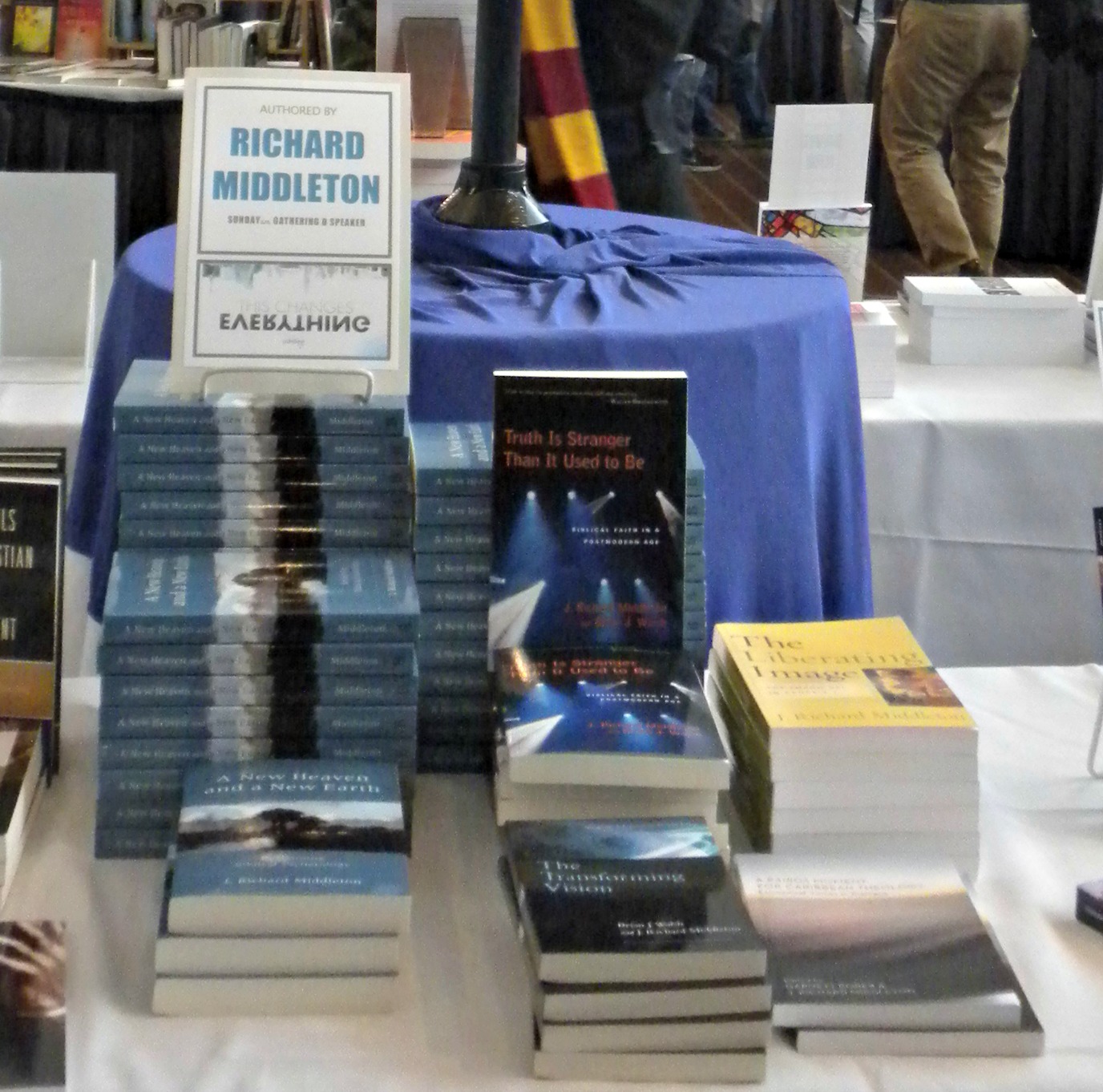
In fact, Byron has written two reviews of my eschatology book, one extended, the other briefer—to accompany his naming it as biblical studies “book of the year” (given the number of books Byron reads, that’s quite an honor).

Byron recently posted a comment on his Facebook page about one of my blogs (from about a year ago) that addressed the relationship of my own eschatological vision to that of New Testament scholar Tom Wright (via Brian Walsh).

Here is Byron’s post:

I have often noted how N.T. Wright dedicated his first big “Origins” book (“The New Testament and the People of God”) to Brian Walsh. Brian tells a bit about his studying Colossians with Wright in his and Sylvia Keesmaat’s “Colossians Remixed” and how he pressed Tom to more fully proclaim the full-orbed redemption the text insists upon. (And what a joy to have a back cover endorsement blurb right next to Tom on that extraordinary book!)

Here, the co-author of Brian’s “Transforming Vision” (one of my all time favorite books) J Richard Middleton shows the connection between TV, which they were writing even while Brian was engaging Tom Wright with a more comprehensive view of God redeeming all things. Now that Richard has written the definitive book on wholistic eschatology (“A New Heaven and a New Earth”) — and spoken about it at Jubilee last week — I thought I’d share his rumination on this little story.

Three cheers for their phrase “no dualisms” which CCO used to have printed up on staff tee-shirts! Three cheers for Tom, Brian, Sylvia, and Richard. I am thankful to know about such significant authors, and to praise God for these generative friendships.

Well, I couldn’t find a picture of the T-shirt that Byron mentions, but I did find this:

Byron, thanks for all your work for the kingdom!

Redeeming Reason with John Mullholland

I met John Mulholland, who works at the University of Chicago Law Library, back in 2007. Over the years John has been a consistent proponent of a holistic Christian worldview, including its relevance for the university, and has organized many conferences on the subject, helping many to reflect on what it means to serve Christ in academia.

At John’s invitation I came to speak at an event called “The Redemption of Reason” at the University of Chicago in October 2007; I gave two talks, one on God’s validation of Job’s lament in the speech from the whirlwind, a second on the meaning of the imago Dei as God’s call for whole-life service.

Recently I became aware of a Facebook page that John has been involved with, that is grounded in the heritage of Charles Malik, the Lebanese Christian intellectual and diplomat who was president of the UN General Assembly.

Malik, who was Eastern Orthodox, studied with Alfred North Whitehead and Martin Heidegger and earned a PhD in philosophy from Harvard, and later taught in both the US and Lebanon. He entered the civil service in Lebanon and besides service to that country he was instrumental in developing the UN charter of rights and served as president of the UN General Assembly from 1958-59. Malik also wrote in the area of theology and I have heard his name dropped and seen his works cited especially when I was a campus minister with Inter-Varsity Christian Fellowship, back in the 1980s.

One of my M.A. students (Cord Sullivan), who is coming on staff with IVCF at the University of Buffalo, has a Malik quote as the byline for his email: “more potently than by any other means, change the University and you change the world.” Now you can see why this Facebook page is called the “Charles Malik Society for Redeeming Reason.” I’m glad I discovered it.

Recently, John posted some comments there about the talk on “Restoration” I gave at Jubilee 2015.

A gift of Shalom from Professor J. Richard Middleton for this little venture, where we seek to engage the university and culture as Christians with the Good News of Jesus. Middleton, NT Wright and others now see an holistic message of salvation, which empowers us to do both deeds of mercy, but also deeds of creation in science, art, medicine, et al.

Nicholas Wolterstorff echoes this work by Middleton and others with remarks about God’s call to us all to be messengers of Shalom in this world, agents of God’s mission – see esp. p.72

Then John quotes some of my blog post on the Jubilee conference, and concludes by saying:

Click around Middleton’s blog to find more resources. Here is the table of contents for his new book, A New Heaven and a New Earth.

I recommend the postings on the Malik/Redeeming Reason Facebook page for inspiration and enlightenment on seeking God’s kingdom in the academic realm.

Thanks, John, for your service in the cause of Christ that goes back a long way!

On My Way Home from Jubilee 2015

On Saturday I uploaded a post in the Atlanta airport on my way to speak at Jubilee 2015 in Pittsburgh. Here I am a day later writing this post in the airport on my way home (though I am only posting now, after arriving back in Rochester).

I did have to clear a foot of snow off my driveway just to get into my garage (but enough about winter in Rochester already).

Restoration—The Destiny of God’s Good Creation

I gave my talk on “Restoration—The Destiny of God’s Good Creation” to a group of some 3,000 college students in the final plenary session of the conference Sunday morning. I was honored to have been invited to speak at Jubilee. I had attended the Jubilee conference once in the past when I was an IVCF campus minister, and I have always been impressed with the CCO, the campus ministry group based in Pittsburgh that has sponsored this conference for almost 40 years, helping college students learn how to worship God with their whole lives.

Speaking to a large group like this is always a strange experience, especially when I don’t actually know my audience (and the lights on the stage were so bright that I couldn’t see anyone beyond the front row). I much prefer the back-and-forth of dialogue that you get in a classroom with an interactive group. I love to help students actively process what they are learning; and I love the “aha” moment you sometime see in their eyes.

Nevertheless, I think I communicated what I set out to—the biblical emphasis on God’s love for creation, a love clearly displayed in God’s unswerving intent to redeem heaven and earth. My point was that we should love what God loves. So an understanding of biblical eschatology can lead us to care deeply about this world—both the natural world and the world of human culture and society—since God hasn’t given up on this world, but is in the business of restoring creation to its full glory.

Two Contrasting Views of the World

I opened my talk by contrasting two classic quotes, one by Dwight L. Moody (the prominent evangelist of the Third Great Awakening), the other by Abraham Kuyper (founder of the Free University of Amsterdam, past prime minister of the Netherlands), who introduced American Christians to the idea of a Christian worldview in his famous “Stone Lectures” at Princeton. Both were born the same year (1837).

In an 1877 sermon, Moody explained:

“I look on this world as a wrecked vessel. God has given me a life-boat, and said to me, ‘Moody, save all you can.’”

This contrasts with what Kuyper said in an 1880 speech:

“There is not a square inch in the whole domain of our human existence over which Christ, who is sovereign Lord of all, does not cry: ‘Mine!’”

The Comprehensive Scope of Salvation—Five Key Restoration Texts

This vivid contrast between viewing the world as a wrecked vessel, from which we must escape, or as Christ’s world, even after sin, set the stage for looking at five key New Testament texts that clearly articulate God’s intent to restore creation (click here for a chart).

  • Acts 3:17-21 – the restoration of all things, as foretold by the prophets (v. 21)
  • Ephesians 1:7-10 – the bringing together of all things in heaven and on earth (v. 10)
  • Colossians 1:16-20 – the reconciliation of all things, whether on earth or in heaven, through the blood of the cross (v. 20)
  • Romans 8:19-23 –the liberation of creation from its bondage to decay (v. 21); the redemption of the body (v. 23)
  • 2 Peter 3:10-13the “finding” of the earth after judgment (v. 10); the renewal of heaven and earth (v. 13)

The Biblical Plot—A Coherent Story of Restoration

After we looked at these five New Testament texts, I invited the audience to accompany me on a whirlwind tour of the biblical drama from creation to eschaton, tracing the basic plot structure of the Bible’s narrative (click here for a diagram). I sketched three levels of the biblical plot, beginning with the initial narrative sequence of creation.

  • Level I Creation—The Original Human Calling in God’s Creation
  • Level II Israel—The Mission of God’s OT People among the Nations
  • Level III Jesus—The Climax of a Series of God’s Redemptive Agents
  • Level II The Church—The Community of Jew and Gentle as God’s NT Redeemed People
  • Level I Eschaton—The Renewed Humanity in God’s New Creation

I wanted to show that there is a return to the original narrative sequence (creation) in the eschaton, so that our basic human calling to tend the earth and develop culture to God’s glory is renewed.

I probably tried to accomplish too much, since I combined two topics that I usually divide into two class sessions when I teach this material. The result was that I ended up going ten minutes over my allotted time of 25 minutes.

Toward the end I used this picture of Sean Purcell doodling a quote from my eschatology book.

A video of the talk is now posted on You Tube.

I ended the talk with the title of the conference: This Changes Everything!

You can find a two-minute video montage of the Jubilee 2015 conference here.