Kudos to My Colleagues at Northeastern Seminary (Rochester NY)

I am privileged to be part of a wonderful Seminary, and I work with excellent faculty colleagues.

Here I want to highlight three faculty members in particular, with a focus on their recent (and upcoming) accomplishments. Indeed, the first is still future at the time of writing this post.

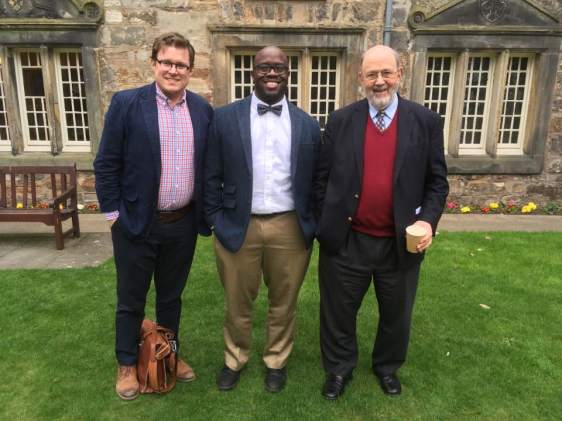
Esau McCaulley

Esau McCaulley is Assistant Professor of New Testament and Early Christianity.

Prof. McCaulley will be defending his PhD dissertation on Monday, April 3, at the University of St. Andrews (his supervisor is N. T. Wright)—that’s tomorrow, as of this writing. The defense is scheduled for 1:00 pm UK time (7:00 am EDT).

The defense was successful!

Prof. McCaulley’s dissertation topic is Paul’s application of the Old Testament idea of Israel’s inheritance to Jesus in the letter to the Galatians.

Last year (November 2016) he presented a paper based on his dissertation in the Biblical Theology Research Group of the Institute for Biblical Research. His paper was entitled Exile, Restoration, and the Inheritance of the Son: Jesus as Servant and Messiah in Galatians 1:4.

Josef Sykora

Dr. Josef Sykora (PhD, Durham University) is Director of the Doctor of Ministry Program and Assistant Professor of Biblical Interpretation.

Prof. Sykora’s 2016 dissertation on the elect and non-elect in the Old Testament (supervised by Walter Moberly) has just been accepted for publication by Eisenbrauns publishers, in their prestigious series called “Siphrut: Literature and Theology of the Hebrew Scriptures.” His forthcoming book is tentatively titled “The Unfavored: Judah and Saul in the Narratives of Genesis and 1 Samuel.”

Rebecca Letterman
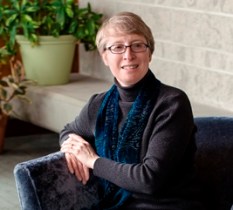
Rebecca Letterman (PhD, Cornell University) is Associate Professor of Spiritual Formation.

Over the last few years Prof. Letterman has been hard at work with Susan Muto (executive director of the Epiphany Association and Dean of the Academy of Formative Spirituality in Pittsburgh, PA), co-authoring a book on spirituality and the developmental process of human life, based on the brilliant work of Christian psychologist and spiritual director Adrian van Kaam.

The co-authored book, called Understanding Our Story: The Life’s Work and Legacy of Adrian van Kaam in the Field of Formative Spirituality, has recently been published by Wipf and Stock. Both Doug Cullum (Vice President and Dean of Northeastern Seminary) and I have written endorsements for this intellectually and spiritually stimulating book.

Congratulations to my three faculty colleagues for these accomplishments. I am proud to know you and to work with you in theological education for the Kingdom of God.

Longer Still (Post Election Reflections of a Black Man amongst the Evangelicals)

Here is a new post by my colleague Esau McCaulley, prof. of New Testament at Northeastern Seminary.

The Scriptures that contain the stories of Israel, the Messiah Jesus, and the early church have long shaped how I viewed the world. It was the bible that affirmed black personhood in the fac…

Source: Longer Still (Post Election Reflections of a Black Man amongst the Evangelicals)

Three Recent Theses Completed at Northeastern Seminary

Three Master’s theses that I supervised were recently completed, two last year and one this summer. They are all substantial pieces of theological research, with clear implications for the life of the church.

  • Living Sacramentally: The Problem of Being and Doing with Special Reference to Thomas Aquinas (Margaret Giordano)
  • The New Creation Fugue: The Interweaving of Individual, Community, and Cosmos in Paul’s Theology of New Creation (Calvin Smith)
  • Two Pauline Ways to Describe the Ethics of the Resurrection Life (Matthew Davis)

Although my area of expertise is Old Testament, none of these theses were in that area. Meg Giordano’s thesis was in philosophy, while Calvin Smith’s and Matt Davis’s were in New Testament. So for the Giordano thesis I had to draw on my own M.A. in philosophy (my thesis addressed God language in Thomas Aquinas and Paul Tillich), and for the Smith and Davis theses, I could draw on my research for my recent book on eschatology, A New Heaven and a New Earth.

Meg Giordano’s thesis addresses the contemporary problem, particularly evident in Protestant churches in the evangelical tradition, of downplaying “works” (actions, good deeds) by emphasizing “faith” (this is often tied to the claim that “being” is more important than “doing”). Not only is this is a totally bogus distinction (we can’t simply “be” without “doing” anything; and faith without works is dead [James 2:14-26]), but she shows that the writings of Thomas Aquinas are helpful for exploring how action may be thought of as the core of being. Although there are tensions in Aquinas’s formulation (which Giordano explores), Aquinas drew on Aristotle, whose primary category of being was “energeia” or activity, a signal improvement over Plato’s more passive concept of Being (many Christian theologians have been more influenced by Plato).

Through this study, Giordanto aims to “reclaim the value of action in the life of the individual and in the relationships of community,” in such a manner that our action can be thought of as sacramental—living so that our ordinary lives “can be centers that activate in others grace, peace, and even connectedness to the presence of Christ, and to lay down our lives to ensure that they be so.”

Despite its clear philosophical character, this thesis resonated with me as a biblical scholar, since it is clear from both the Old and New Testaments that the goal of salvation is sanctification or transformation, which is manifested in a concrete life of discipleship and obedience to God.

Calvin Smith’s thesis addresses the interpretive question—which continues to surface in New Testament scholarship—of whether Paul’s references to “new creation” (Galatians 6:15; 2 Corinthians 5:17) speak primarily to the transformation of the individual or the community (the way the debate is often set up) or even to the entire cosmos (which is the primary reference of “new creation” in Second Temple Judaism).

His profound argument is that there is an interweaving of all three in Paul’s writings, and it is impossible to understand any of these emphases without the others.

As Smith aptly puts it: “There are two basic relationships to attend to: new creatures [individuals] making up the new community; and the new community as the signpost for the new cosmos. Altogether it is a cumulative relationship with the new community as the central link.” Smith likens the interweaving of these three motifs to a musical fugue. He writes: “This thesis is, in a way, an attempt to learn this fugue by separating the three parts and practicing each part before putting them all back together.”

Matt Davis’s thesis addresses the typical disjunction, both in contemporary theology and in the life of the church, between eschatology and ethics, with a focus on the resurrection. To overcome this disjunction, Davis focuses on two Pauline ways of speaking of resurrection life, signaled by Paul’s two-fold use of investiture language.

The first use of the investiture metaphor is Paul’s language of the resurrection as putting on a new body, in 1 Corinthians 15 and in 2 Corinthians 4–5, while the second is the more explicitly ethical language of putting on the new humanity, along with its practices, found in Ephesians 4 and Colossians 3. As Davis explains: “The eschatological foundation in 1 Cor 15 and 2 Cor 4–5 sets up Eph 4 and Col 3 as texts of profound ethical practices to follow. Paul stressed the community life and tied it to the transformation because of the Christ event.”

Davis wants to follow up by applying his research to the local church. He explains: “My plan is to create a church discipleship program from this labor of love, something that will help the church to practically and actively live out the resurrection life in the world.”

What They Are Doing Now

Meg Giordano has been adjunct professor of philosophy at Le Moyne College, Syracuse, NY for the past year; she has just begun a PhD in philosophy at the Institute for Christian Studies, Toronto.

Calvin Smith has been a pastor at Valley Chapel Free Methodist Church. Perry, NY for the past two years; he is currently exploring doctoral programs in New Testament and theology.

Matt Davis has been working in the Golisano Library at Roberts Wesleyan College for the last number of years, while also serving as adjunct professor in the religion department of the College. He has just begun a PhD in ministry studies at McMaster Divinity College, Hamilton, ON.

I’ve written before about Northeastern Seminary, where I teach, and what a special place I have found it to be.