Beyond Eurocentrism—A Future for Canadian Biblical Studies

On May 31, 2021 I had the privilege of giving my presidential address to the Canadian Society of Biblical Studies (CSBS). This is something every outgoing president does at the end of their term.

A Delayed Presidential Address

I was in the unusual situation of being president of CSBS for two consecutive years (2019–21), something unprecedented in the eighty-eight year history of the Society (which was formed in 1933). In every previous case, a person is elected to become vice-president for a year, then serves as president for the following year, then gives their presidential address.

However, the COVID-19 pandemic resulted in the cancelation of the 2020 annual meeting, at which we would have had the election of new officers (those whose terms were up) and at which I would have given my presidential address. Without a formal election of new officers, all the elected officers whose term was up continued pro tem until the next annual meeting.

The executive decided that despite the ongoing pandemic we couldn’t go another year without an annual meeting. But because of the pandemic, they decided that the 2021 annual meeting would be purely virtual.

Since I hadn’t been able to give my presidential address in 2020, I gave it (virtually) in 2021.

A Different Presidential Address

However, it was on a different topic from what I had originally planned.

In 2020 I had planned to focus my presidential address on the Aqedah (Genesis 22), in anticipation of the book I was writing, entitled Abraham’s Silence: The Binding of Isaac, the Suffering of Job, and How to Talk Back to God (Grand Rapids: Baker Academic, 2021).

However, new issues arose in the CSBS, along with some external prods, which resulted in me giving a presentation on the past and future of biblical studies in Canada.

In “Beyond Eurocentrism: A Future for Canadian Biblical Studies,” I traced the history of biblical studies in Canada and challenged biblical scholars in Canada to explicitly bring their social and religious context to bear on their academic work, while allowing the Bible to speak to their context.

Here is the abstract of my paper:

The history of Canadian biblical studies, like biblical studies south of the border, has been defined by the attempt to protect academic study of the Bible from religious and ecclesiastical control. Although legitimate in its time, this has resulted in the fictitious ideal of an academic discipline uncontaminated by the contemporary contexts of the interpreter. Not only is such an ideal unattainable (since everyone brings their contexts, explicitly or implicitly, to their academic work), it is ethically problematic, since it has legitimated the Eurocentric orientation of the field as normative, resulting in the marginalization of alternative voices and perspectives.

Thankfully, biblical scholars have begun to take cognizance of how we read the Bible in terms of existential questions arising from our social and ecclesial locations. Besides many publications on the subject of contextual biblical studies over the past thirty years (perhaps beginning with Stony the Road We Trod), the Society of Biblical Literature sponsored two seminars in 2020 called “#Black Scholars Matter.”

Canadian biblical scholars, however, have been slower than our American counterparts to recognize the importance of the interpreter’s context for our field. The question this essay raises is whether we can envision a future for Canadian biblical studies beyond Eurocentrism.

Although I was addressing the Canadian context, I drew significantly on my Jamaican background (including Jamaican traditions of resistance to power) in order to make a particular proposal for the practice of biblical studies in Canada.

You can watch the video of my presidential address here.

The text of the address is being published in the Canadian-American Theological Review. I will post a link here when it is available.

My Amazing Faculty Colleagues Presenting at the Society of Biblical Literature 2020

I am privileged to teach at a Seminary that is associated with a liberal arts college. I have wonderful faculty colleagues at both institutions.

Northeastern Seminary is on the campus of Roberts Wesleyan College (in Rochester, NY) and while they are formally separate institutions, there is much practical overlap and collaboration between both the institutions and the faculty.

Of late, there have been joint meetings of the Seminary faculty with the faculty of the Department of Religion and Philosophy at the College. And, although faculty members find their home primarily in either the Seminary or the College, some of us teach in both institutions.

Here I want to highlight some of my faculty colleagues (in both institutions) who are presenting papers at the 2020 annual meeting of the Society of Biblical Literature, which is being held virtually this year (the first time in this format since I began attending in 1991).

Fredrick David Carr Presents on December 8

My colleague in New Testament, Fredrick David Carr, will present his paper on December 8 in a session on Healthcare and Disability in the Ancient World.

David’s paper, called “Experiencing Changes and Changing Experiences: Pauline Transformation and Altered Sensory Capacities,” addresses the apostle Paul’s account in Philippians 3:1–11 of how his sense of identity changed after he was confronted by Christ (which moved him from being a persecutor of the church to the status of apostle).

In his paper, David examines the changes experienced by those who receive cochlear implants, including new relationships and a different sense of selfhood, to “shed light onto the experiential and subjective dimensions of the transformations that Paul describes in Philippians 3,” including his sense that what he previously viewed as “gain” is now counted as “loss.”

Kristin Helms Presents on December 10

My colleague in Old Testament, Kristin Helms, will present her paper on December 10 in a session on the Literature and History of the Persian Period.

Kristin’s paper, called “The Roaming Eyes of Yahweh in Zech 4:10b and the Context of Persian Religions,” examines the background of the strange image in Zechariah’s fifth vision of a lampstand, which is identified with the “eyes of YHWH” roaming through the earth.

In her paper, Kristin examines competing suggestions for where Zechariah got his image, and ends up suggesting that it is drawn not only from the network of persons in ancient Persia known as “the eyes and ears of the king” (suggested by some scholars), but also from the portrayal of Mithra in Persian religion, who is “associated with fire, light, and eyes that roam throughout the earth for the sake of seeking out injustice.” She apples this background to Zechariah 4:10b, suggesting that the text uses this imagery “to encourage the people that YHWH, the Emperor of the cosmos and maintainer of justice, is at work to bring about a hopeful, purified future.”

Josef Sykora Presented on December 2

My colleague in Old Testament, Josef Sykora, presented his paper on December 2 in a session on Intertextuality and the Hebrew Bible.

Josef’s paper, called “A Different Kind of Crusade: Jesus’s Commissioning of His Disciples in Luke 10:1–24 as Reworking the Rules for Warfare in Deuteronomy 20:10–14,” examines the parallels and divergences between the texts in Deuteronomy 20 and Luke 10, to see if it is plausible that Jesus is intentionally drawing on the ancient rules of warfare.

He insightfully demonstrates that both Deuteronomy and Luke give similar instructions to those who are sent out, including an offer of peace to those they encounter and two possible outcomes depending on the responses of those they meet. Yet while Luke’s Gospel presents a battle with the powers of evil and the disciples are parallel to Israel’s soldiers, the texts diverge in that in Luke it is God and not the disciples who bring judgment.

My Own Paper Presented on December 1

Although I was scheduled to give a paper at SBL in a session on the Theology of the Hebrew Scriptures, the organizers decided to postpone the session until next year, when (hopefully) the SBL will meet in person (in San Antonio, TX).

However, I did present in the Institute for Biblical Research (an affiliated organization, which meets under the umbrella of the SBL), in a session on The Relationship between the New Testament and the Old Testament.

My paper, initially called “Herod as Pharaoh and Nebuchadnezzar: A ‘Political’ Reading of the Prophets in Matthew’s Infancy Narrative,” examined the way that Matthew’s Gospel cited Old Testament texts from the Prophetic books to address the political situation at the time of Jesus’s birth. The actual paper I gave had a slightly different title from what was listed in the program, since I adapted it to the timeframe I had for presentation.

The paper I presented was called “Herod as Pharaoh? Jesus as David? Matthew’s ‘Political’ Reading of the Prophets in the Infancy Narratives” (click here for the paper). I suggested that when we read Matthew 1–2 as a “feel good” story for the Christmas season, we miss the astute sociopolitical critique of the Jerusalem power structure that Matthew intended by his use of quotations from Hosea 11:1 and Micah 5:2 (with a line from 2 Samuel 5:2 spliced in). There is nothing sentimental about Matthew’s portrayal of the newly born king of the Jews, who would be a very different sort of leader not only from Herod, but also from David of old.

My Upcoming Presentation on December 7

I also have a short presentation coming up on December 7 (tomorrow) in a session on Science, Technology, and Religion at the American Academy of Religion (which meets in conjunction with the SBL).

This session is devoted to a recently published book, called The T&T Clark Companion of Christian Theology and the Modern Sciences, ed. by John P. Slattery, Bloomsbury Companions (London: Bloomsbury T&T Clark, 2020).

Everyone who contributed a chapter in this book was invited to give a brief presentation on their chapter. Of the many who contributed chapters, eight of us, along with the editor, agreed.

As part of this session, I will give a short explanation of my chapter, called “The Genesis Creation Accounts.”

I recently wrote a blog post (here) on the book and my article.

If you are registered for the AAR-SBL annual meeting, you are invited to attend any of these session that interest you.

The Heart of Torah: Jewish and Christian Voices on the Relationship of Biblical Exegesis to Theological Interpretation

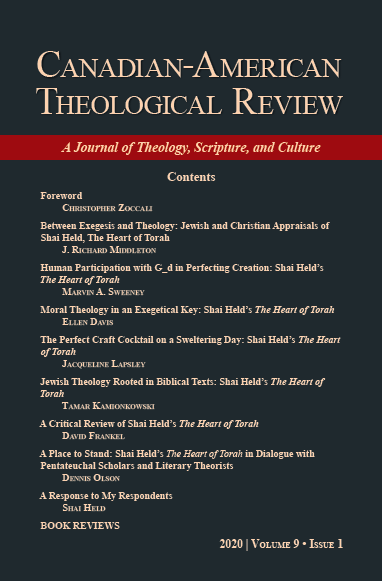
The latest issue of the Canadian-American Theological Review (the journal of the Canadian-American Theological Association) has just been published. This is a theme issue, which collects the papers presented in a panel discussion at the Society of Biblical Literature last year (November 2019) on Shai Held’s two-volume work, The Heart of Torah, (Jewish Publication Society, 2017). These papers were given by Jewish and and Christian biblical scholars.

Although it hadn’t been planned that way, the presentations (hence the published essays) all focused, in one way or another, on the question of the relationship of biblical exegesis to theology. Or, to put it in Jewish terms, the relationship between peshat (literary-contextual readings of the Bible) and midrash (readings that go beyond the intent of text, in order to explore contemporary significance).

While all the articles are agreed that these are both legitimate approaches to the Bible, there is some disagreement about how these should be related, and Held’s response addresses this issue head on.

This has a parallel with recent discussion among Christian biblical interpreters about the value of the “Theological Interpretation of Scripture” and whether this is at odds with historical-critical study of the Bible. For an excellent discussion of why these two shouldn’t be severed, see Joel Green’s essay, “Rethinking ‘History’ for Theological Interpretation,” published in the Journal of Theological Interpretation (2011).

An Introduction to Shai Held

Rabbi Shai Held is Dean and Chair of Jewish Thought at the Hadar Institute, an ecumenical egalitarian study center in New York City that he helped found in 2006, along with Rabbis Elie Kaunfer and Ethan Tucker.

My initial introduction to Shai Held was in January 2015 when he contacted me to discuss the imago Dei in Genesis 1, in preparation for a public lecture he was going to give on human dignity and police violence against African Americans. He had read my book The Liberating Image and wanted to clarify some aspects of the interpretation. We first communicated by email, then had a telephone conversation on the topic.

Since then I have attended the Hadar Institute (previously called Mechon Hadar) for two of their annual Executive Seminars and I wrote an initial blog about my experience.

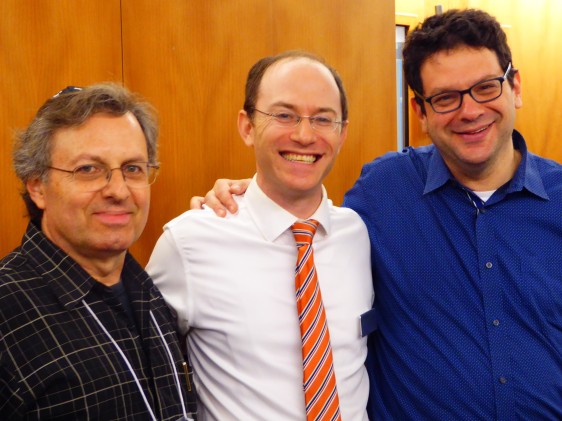
Middleton with Rabbis Elie Kaunfer and Shai Held at Hadar, July 2016

Shai Held (son of Ugaritic scholar Moshe Held) has written an in-depth study of the theology of Abraham Heschel (Abraham Joshua Heschel: The Call of Transcendence) that explores the complexity of his thought. This is his published dissertation, written under the supervision of Jon D. Levenson at Harvard.

Here is a newspaper article (The Times of Israel, September 2017) on Shai Held’s combination of Jewish piety and social ethics.

The Heart of Torah

Held’s latest publication, The Heart of Torah, 2 vols. (Jewish Publication Society, 2017), is a compilation of short theological-ethical essays on selected passages from the weekly Torah portion in the Jewish lectionary cycle. Volume 1 covers texts in Genesis and Exodus, while volume 2 covers texts in Leviticus to Deuteronomy.

Along with approximately 7,000 others, I subscribed to receiving these essays every week by email; and I have been profoundly moved by Held’s insights. So when I found out that the essays would be published in a two-volume collection, I contacted a number of Christian biblical scholars to join me in writing endorsements for the publication.

I then organized a panel discussion on The Heart of Torah at the Society of Biblical Literature annual meeting in San Diego, November 24, 2019 and I collected the papers for publication in the Canadian-American Theological Review.

You can download my introduction to the theme issue of the journal here.

If you want to read the entire issue (consisting in my introduction, six papers on The Heart of Torah, Held’s response, and some excellent book reviews), you will need to log on to the website of the Canadian-American Theological Association. This requires an inexpensive one-year membership (which includes subscription to the journal).

Depending on your library’s subscription to online materials, you might be able to access the journal that way.

This the lineup of articles.

  • Marvin Sweeney, “Human Participation with G_d in Perfecting Creation”
  • Ellen Davis, “Moral Theology in an Exegetical Key”
  • Jacqueline Lapsley, “The Perfect Craft Cocktail on a Sweltering Day”
  • S. Tamar Kamionkowski, “Jewish Theology Rooted in Biblical Texts”
  • David Frankel, “A Critical Review of Shai Held’s The Heart of Torah
  • Dennis Olson, “A Place to Stand: Shai Held’s The Heart of Torah in Dialogue with Pentateuchal Scholars and Literary Theorists”
  • Shai Held, “A Response to My Respondents”