A New Venture with Global Scholars Canada

I have had a wonderful and fulfilling full-time teaching career, which began some thirty years ago at Colgate Rochester Crozer Divinity School and continued through my move to Roberts Wesleyan University and Northeastern Seminary.

I formally retired from the Seminary in 2024 and have since focused on writing (though as Emeritus Professor I will still teach from time to time).

I am currently working on two books (both are partially complete). One is on the ethics of power in 1 Samuel 1–15 (contracted with Eerdmans). The other is on the liberating worldview of the Scriptures (for Baker Academic); this is a complete rewrite of The Transforming Vision, the book I coauthored with Brian Walsh when we were both graduate students.

Discernment Process

When I retired, I had a clear sense that writing was going to be my major focus (I have three other book contracts beyond the two mentioned above). But I have also been in a period of discernment for new ventures that God might be calling me to.

Here is a somewhat humorous poem I wrote the year before I retired, while on a retreat at the Gell Center in the Finger Lakes (a beautiful rural area south of Rochester, NY where I live). I broke up some of my sentences to mimic my breathing as I climbed uphill.

Uphill All the Way

J. Richard Middleton

Panting and huffing, he lugged
his sixty-eight-year-old frame
over rotting logs, snagging
his foot on a broken limb, stumbled, yet doggedly
kept ascending the steep climb. No
horizon in sight. Just trees, trees as far as vision. Yet
far easier to make out than his future
after retirement. After
twenty-seven years of pouring
his heart out
to indifferent students,
grading mediocre papers (and the odd
brilliant piece), correcting
bad grammar. It was time. Something
new beckoned. If only
he could see what it was.

October 2023
Gell Center, Finger Lakes

Contrary to the poem (which is only partly autobiographical), I’ve had excellent students throughout the years, who have gone on to do wonderful things for God’s kingdom. I’ve had the joy and privilege of keeping in touch with many of them.

Post-Retirement Opportunities

Since retirement, I have kept getting invitations to speak on topics close to my heart for various organizations, and I certainly could just take up such opportunities as they arise. But I have been wondering if there is a more strategic way to use my gifts and academic experience.

Being originally from the Caribbean, I have been especially interested in theological education for the global church. I’ve kept in touch with Jamaica Theological Seminary (where I earned my BTh) and the Caribbean Graduate School of Theology (where I taught while on sabbatical some years back). Both schools have recently contacted me about being involved in a variety of ways, including teaching, faculty development, and integrating a Christian worldview into the curriculum.

I am also a Canadian, having lived fifteen years in Ontario, where I worked as a campus minister and completed two graduate degrees, prior to my teaching career in the USA.

My period of discernment led me to join Global Scholars Canada (GSC), an organization that links Canadian scholars in a variety of fields with opportunities for teaching and mentoring in the Majority World.
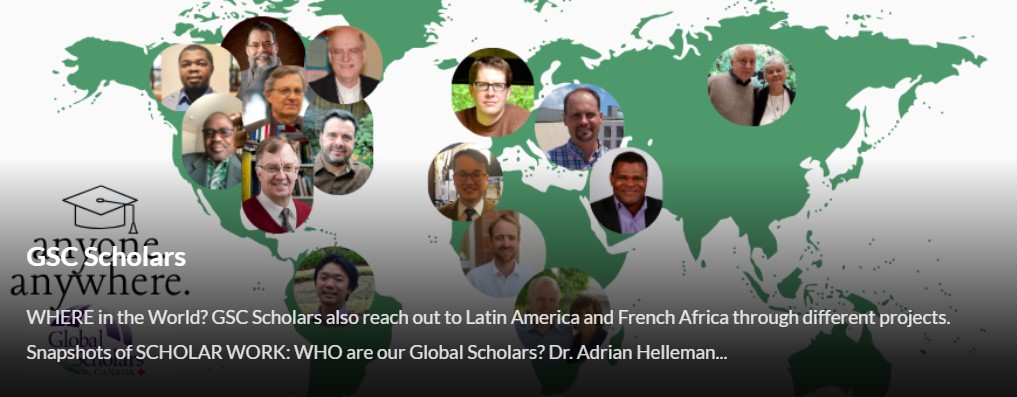
Peter Schuurman, the director of Global Scholars Canada (GSC), wrote a short piece introducing me to the GSC community.

My Vision and Mission

I am hoping to leverage my Canadian and Jamaican experience and my expertise in biblical studies and the Christian worldview to help other scholars, whether in Canada or other countries, bring their faith to bear on their academic vocation in a way that witnesses to God’s kingdom purposes for the redemption of all of life.

I see my mission as raising the level of biblical literacy among Christian academics, but also among pastors and laypeople, by immersing them in serious, yet inspiring and practical, study of Scripture.

My fuller vision and mission statement can be found on my Global Scholars Canada webpage.

I am coming on board Global Scholars Canada as a part-time global scholar. Full-time scholars typically get placed in teaching positions overseas, negotiated between GSC and the hiring institution, with GSC helping to raise funds to supplement what the hiring institution is unable to cover.

Given that I have been ministering “overseas” since I left Jamaica as a young adult, and that I am part-time, my situation is somewhat different. I will be involved in specific short-term assignments that Global Scholars Canada will set up, such as speaking at conferences or mentoring young academics.

Two Specific Assignments

Global Scholars Canada is a partner with the Society of Christian Scholars, an international community of Christian academics that developed from a consultation (some sixteen years ago) of eleven scholars from six countries. The Society has numerous individual and organizational partners and affiliates throughout the world.

One of the affiliates is the Caribbean Network of Christian Scholars.
My very first assignment as a global scholar was an invitation that came through a member of the Caribbean Network, who is the librarian for the Society of Christian Scholars. I will be doing an online presentation for the Society’s Library Reading Group meeting in June 2026. I’ve been asked to introduce the article I wrote for the book of Caribbean theology that I coedited with Garnett Roper some years ago (the article explores a creation theology for the Caribbean).

My next assignment will be to give a paper at the first international conference sponsored by the Society of Christian Scholars, which will be held at the Pan-African Christian University in Nairobi, Kenya, in early August 2026. My paper is entitled “The Vocation of the Christian Scholar: A Caribbean Biblical Studies Perspective.”

At the urging of Global Scholars Canada, I will be taking along a younger scholar, Chris Landon (who is currently working on his PhD at McMaster Divinity College), as a mentee. He may also be presenting a paper at the conference.

Although the conference is only a few days, it will be quite an undertaking, given the travel (and recovery) time and the cost of airfare and conference registration (which includes lodging and food).

Fundraising—Something I don’t Usually Do

Global Scholars Canada is committed to covering 90% of the cost of any mentees attending the conference (so they will cover this for Chris). They don’t cover quite as much for their scholars. But I am extremely grateful that their contribution will reimburse about half my expenses. I will need to raise the other half (which comes to about USD 1,100 = CAD 1,500).

Anyone interested in contributing towards these expenses (as charitable giving in the US or Canada), can check out the relevant links below. It will be much appreciated.

The Global Scholars Canada website has a list of different ways to give (online or by cheque) in support of their scholars. The first four ways are for Canadian donations (you just designate the scholar you are supporting).

The fifth way takes you to the website of the Society of Christian Scholars, where you can make a USD donation online or by a mailed check (with the scholar designated).

Newsletter

I will soon be starting a quarterly newsletter, reporting on some of my activities for Global Scholars Canada; if you are interested in receiving this, you can sign up on my GSC webpage (scroll down to the end for the sign-up form).

You’re invited to join me in this new adventure!


On Deconstruction and Reconstruction of the Christian Faith

There has been a lot of talk over the past twenty years or so about “deconstructing” the Christian faith (especially its evangelical versions). The problem, however, is that sometimes there is no substantial reconstruction that aims to recover the authentic, classical faith tradition—beyond its distortions.

I Began Deconstruction as an Undergraduate Theology Student

Although I would not have described it that way at the time, I was engaged in deconstruction (and reconstruction) of my faith from the very start of my undergraduate theological studies in Jamaica. I was blessed with a pastor at Grace Missionary Church and with professors at Jamaica Theological Seminary who welcomed healthy questioning and modeled an open and generous—fully orthodox—Christianity.

I have come to realize that this openness to questioning inherited traditions was also a function of doing theology in the Majority World, since both professors and students were vividly aware of the need for contextualization of the faith for the sake of the Caribbean church. We were thus prepared to challenge received versions of our church traditions, especially when they were shaped by Eurocentric or American biases. Professors and (especially) students in my Jamaican context were unafraid to dismantle what we thought was unhelpful, while seeking to be grounded in a better version of the core tradition of our faith.

As a result of my formative theological education in Jamaica, the deconstruction-reconstruction dialectic has been central to all my teaching and writing over the years.

Deconstruction and Reconstruction in My Writing

As a biblical scholar, committed to the renewal of the church, I have typically challenged received interpretations of Scripture in my books and articles. My approach has been to try and show that these interpretations are not rooted in a best reading of Scripture nor are they helpful for faithful living in our complex world.

To that end I have written books on a holistic Christian worldview (The Transforming Vision), the relevance of the Bible in our postmodern context (Truth Is Stranger than It Used to Be), humanity created in God’s image (The Liberating Image), new creation eschatology (A New Heaven and a New Earth), and Abraham’s silent attempt to sacrifice Isaac in the context of the Bible’s prayers of vocal protest (Abraham’s Silence).

In each case, I have attempted to propose better interpretations of these topics than what I found in the received tradition—better in that they arise from more careful reading of Scripture and that they have transformative implications for human life in the real world.

Deconstruction and Reconstruction in My Teaching—Toward a Christian Worldview

This dialectic of deconstruction and reconstruction is at the core of a signature course on a Christian worldview that I have been teaching (and constantly developing) for many decades, focusing on biblical theology in dialogue with the contemporary world.

The early versions of this course (which I taught when I was a campus minister in Southern Ontario, Canada) led to a co-authored book with Brian Walsh, called The Transforming Vision: Shaping a Christian World View (IVP, 1984).

In a couple of years I will begin working on a new version of that book, based on the way the course has evolved over the years. My tentative title for the new book is Dancing in the Dragon’s Jaws: The Bible’s Liberating Worldview (to be published with Baker Academic).

The course challenges students to rethink their orientation to life by re-reading Scripture as a grounding story that takes seriously our pain and our hopes. The course combines engaged biblical interpretation with historical analysis of the church’s sacred/secular dualism, the western myth of conquest and progress, and the postmodern condition, while encouraging students to explore their calling in God’s world.

I’ve been teaching this course since 2002 for undergraduates at Roberts Wesleyan University under the title “Exploring the Christian Worldview.” I’ve also taught a version of the course since 2011 for graduate students at Northeastern Seminary, where it was called “Being in the Story.” Its current name is “Biblical Worldview: Scripture, Theology, Ethics.”

More than any other course, this one often leads to student disorientation. As the course progresses, it is common for students to exclaim with dismay, “Oh no, I need to unlearn everything I have been taught!” I usually point out that they may need to unlearn some things, but that they typically have a pretty solid and stable core of faith to build on.

Starting with Trust, before Deconstruction

I have learned not to begin with deconstruction. A hermeneutic of suspicion is an important second step in the learning process; but we need to start with a hermeneutic of trust (and trust is where we end too). First, I offer students a more excellent way; then comes the critique of unhelpful tradition.

The metaphor that I use to explain my pedagogy is as follows: I begin by offering students the rich, plush carpet of biblical faith, then I gently begin to pull the threadbare rug of bad theology and inadequate biblical interpretation out from under them. They usually step quite eagerly onto the plush carpet.

At the end of one memorable course in Old Testament theology, which I taught at the Caribbean Graduate School of Theology in Jamaica while on sabbatical, a student stood up on the last day of class and said (with a huge smile on his face): “Professor, you destroyed my theology!”

Of course, he had found something better. That’s the way deconstruction ought to work.

Beyond Eurocentrism—A Future for Canadian Biblical Studies

On May 31, 2021 I had the privilege of giving my presidential address to the Canadian Society of Biblical Studies (CSBS). This is something every outgoing president does at the end of their term.

A Delayed Presidential Address

I was in the unusual situation of being president of CSBS for two consecutive years (2019–21), something unprecedented in the eighty-eight year history of the Society (which was formed in 1933). In every previous case, a person is elected to become vice-president for a year, then serves as president for the following year, then gives their presidential address.

However, the COVID-19 pandemic resulted in the cancelation of the 2020 annual meeting, at which we would have had the election of new officers (those whose terms were up) and at which I would have given my presidential address. Without a formal election of new officers, all the elected officers whose term was up continued pro tem until the next annual meeting.

The executive decided that despite the ongoing pandemic we couldn’t go another year without an annual meeting. But because of the pandemic, they decided that the 2021 annual meeting would be purely virtual.

Since I hadn’t been able to give my presidential address in 2020, I gave it (virtually) in 2021.

A Different Presidential Address

However, it was on a different topic from what I had originally planned.

In 2020 I had planned to focus my presidential address on the Aqedah (Genesis 22), in anticipation of the book I was writing, entitled Abraham’s Silence: The Binding of Isaac, the Suffering of Job, and How to Talk Back to God (Grand Rapids: Baker Academic, 2021).

However, new issues arose in the CSBS, along with some external prods, which resulted in me giving a presentation on the past and future of biblical studies in Canada.

In “Beyond Eurocentrism: A Future for Canadian Biblical Studies,” I traced the history of biblical studies in Canada and challenged biblical scholars in Canada to explicitly bring their social and religious context to bear on their academic work, while allowing the Bible to speak to their context.

Here is the abstract of my paper:

The history of Canadian biblical studies, like biblical studies south of the border, has been defined by the attempt to protect academic study of the Bible from religious and ecclesiastical control. Although legitimate in its time, this has resulted in the fictitious ideal of an academic discipline uncontaminated by the contemporary contexts of the interpreter. Not only is such an ideal unattainable (since everyone brings their contexts, explicitly or implicitly, to their academic work), it is ethically problematic, since it has legitimated the Eurocentric orientation of the field as normative, resulting in the marginalization of alternative voices and perspectives.

Thankfully, biblical scholars have begun to take cognizance of how we read the Bible in terms of existential questions arising from our social and ecclesial locations. Besides many publications on the subject of contextual biblical studies over the past thirty years (perhaps beginning with Stony the Road We Trod), the Society of Biblical Literature sponsored two seminars in 2020 called “#Black Scholars Matter.”

Canadian biblical scholars, however, have been slower than our American counterparts to recognize the importance of the interpreter’s context for our field. The question this essay raises is whether we can envision a future for Canadian biblical studies beyond Eurocentrism.

Although I was addressing the Canadian context, I drew significantly on my Jamaican background (including Jamaican traditions of resistance to power) in order to make a particular proposal for the practice of biblical studies in Canada.

You can watch the video of my presidential address here.

The text of the address is being published in the Canadian-American Theological Review. I will post a link here when it is available.