Alfredo Valentin is a Nuyorican (a member of the Puerto Rican diaspora in New York city), whose specialty is “urban apologetics.”
This is a genre of apologetics that addresses questions especially relevant to the black and brown Christian demographic who are being targeted for proselytizing by religious groups like the Nation of Islam , the Israelite Church of God in Jesus Christ, or Israel United in Christ. Such groups often play on issues of identity and race, suggesting that orthodox Christianity is a religion of whiteness.
Alfredo tries to educate his listeners in an intelligent way about the claims of genuine Christian orthodoxy, often by interviewing scholars and practitioners in the faith who has particular insight to share about Scripture or theology.
Since one of the primary issues in urban apologetics is identity (Who are we? and What is our purpose in life?), the topic of the image of God is directly relevant.
Having written a book on the image of God (The Liberating Image), as well as various articles and blog posts on the subject, I’m looking forward to the conversation.
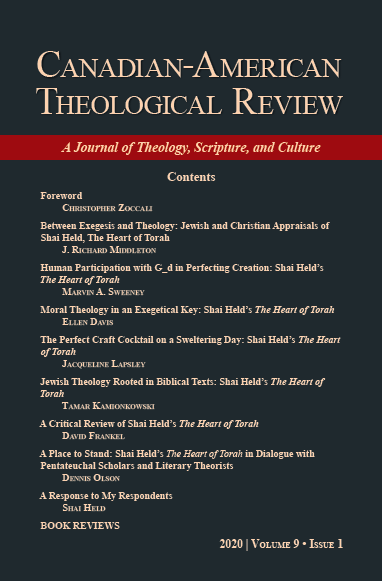
The latest issue of the Canadian-American Theological Review (the journal of the Canadian-American Theological Association) has just been published. This is a theme issue, which collects the papers presented in a panel discussion at the Society of Biblical Literature last year (November 2019) on Shai Held’s two-volume work, The Heart of Torah, (Jewish Publication Society, 2017). These papers were given by Jewish and and Christian biblical scholars.
Although it hadn’t been planned that way, the presentations (hence the published essays) all focused, in one way or another, on the question of the relationship of biblical exegesis to theology. Or, to put it in Jewish terms, the relationship between peshat (literary-contextual readings of the Bible) and midrash (readings that go beyond the intent of text, in order to explore contemporary significance).
While all the articles are agreed that these are both legitimate approaches to the Bible, there is some disagreement about how these should be related, and Held’s response addresses this issue head on.
This has a parallel with recent discussion among Christian biblical interpreters about the value of the “Theological Interpretation of Scripture” and whether this is at odds with historical-critical study of the Bible. For an excellent discussion of why these two shouldn’t be severed, see Joel Green’s essay, “Rethinking ‘History’ for Theological Interpretation,” published in the Journal of Theological Interpretation (2011).
An Introduction to Shai Held
Rabbi Shai Held is Dean and Chair of Jewish Thought at the Hadar Institute, an ecumenical egalitarian study center in New York City that he helped found in 2006, along with Rabbis Elie Kaunfer and Ethan Tucker.
My initial introduction to Shai Held was in January 2015 when he contacted me to discuss the imago Dei in Genesis 1, in preparation for a public lecture he was going to give on human dignity and police violence against African Americans. He had read my book The Liberating Image and wanted to clarify some aspects of the interpretation. We first communicated by email, then had a telephone conversation on the topic.
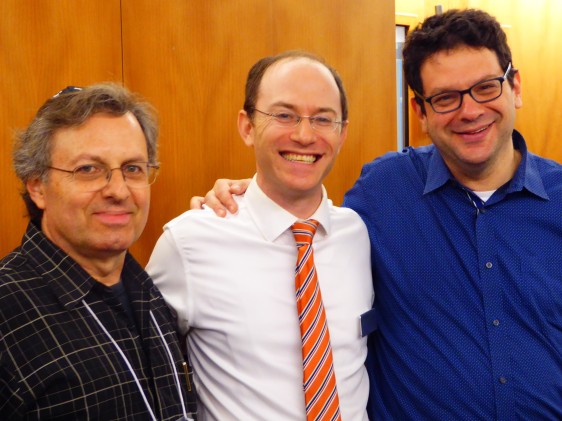
Middleton with Rabbis Elie Kaunfer and Shai Held at Hadar, July 2016
Shai Held (son of Ugaritic scholar Moshe Held) has written an in-depth study of the theology of Abraham Heschel (Abraham Joshua Heschel: The Call of Transcendence) that explores the complexity of his thought. This is his published dissertation, written under the supervision of Jon D. Levenson at Harvard.
Along with approximately 7,000 others, I subscribed to receiving these essays every week by email; and I have been profoundly moved by Held’s insights. So when I found out that the essays would be published in a two-volume collection, I contacted a number of Christian biblical scholars to join me in writing endorsements for the publication.
Back in November 2019, when I was attending the Society of Biblical Literature annual meeting in San Diego, I met up with Jim Stump, vice-president of BioLogos. I’ve known Jim for about five years and he asked if he could interview me for the Language of God podcast series that BioLogos sponsors.
The focus of the interview was a topic dear to my heart—what it means to be made in the image of God (imago Dei).
The podcast page introduces the interview this way:
“We were made in the image of God, but what does that really mean? Whom does that apply to? What does that call us to? The Bible is very central to understanding the answers to these questions, as is cultural context. In this episode, biblical worldview professor, Richard Middleton joins Jim Stump in an attempt to answer some of the questions about human identity through both of those lenses.”
“Here we talk about the Bible and science (like what each has to say about Adam and Eve), but mostly focus on his specialty: the image of God. I’m biased and prone to believe what I want to be the case, but I think this is a really interesting conversation.”
Although Jim does eventually ask me to speculate on how the imago Dei might relate to the development of Homo sapiens, the interview focuses on what the Bible says about the image in its ancient Near Eastern context and its relevance for living in God’s world. I essentially summarize the main thrust of my book The Liberating Image: The Imago Dei in Genesis 1 (Brazos, 2005).
Jim Stump is from the Missionary Church, the same denomination that I was a member of as a teen and young adult in Jamaica. I did my undergraduate degree in theology at the Jamaica Theological Seminary, which was founded in 1960 by the Missionary Church Association of Jamaica. It turns out that Jim had spoken at a 2007 commencement ceremony at my seminary.
Although the image of God is the focus of the BioLogos interview, I also talk a bit about what Jamaica is like (in response to Jim’s questions).
And if you want to explore a bit more about how the imago Dei (and the Fall) might (I emphasize that word) relate to what we know of the origins of Homo sapiens, I discuss these topics in a presentation I gave for the Canadian and Christian Scientific Affiliation, called “Human Distinctiveness and the Origin of Evil in Biblical and Evolutionary Perspectives.”