The Heart of Torah: Jewish and Christian Voices on the Relationship of Biblical Exegesis to Theological Interpretation

The latest issue of the Canadian-American Theological Review (the journal of the Canadian-American Theological Association) has just been published. This is a theme issue, which collects the papers presented in a panel discussion at the Society of Biblical Literature last year (November 2019) on Shai Held’s two-volume work, The Heart of Torah, (Jewish Publication Society, 2017). These papers were given by Jewish and and Christian biblical scholars.
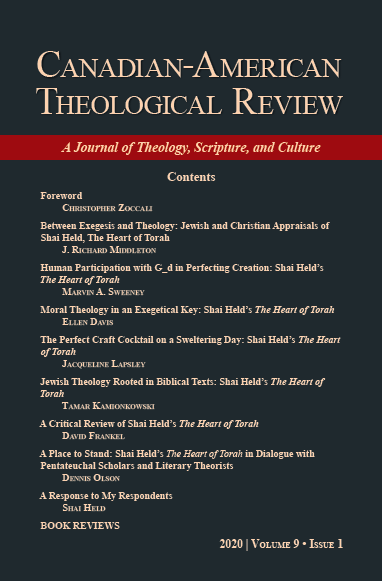
Although it hadn’t been planned that way, the presentations (hence the published essays) all focused, in one way or another, on the question of the relationship of biblical exegesis to theology. Or, to put it in Jewish terms, the relationship between peshat (literary-contextual readings of the Bible) and midrash (readings that go beyond the intent of text, in order to explore contemporary significance).

While all the articles are agreed that these are both legitimate approaches to the Bible, there is some disagreement about how these should be related, and Held’s response addresses this issue head on.

This has a parallel with recent discussion among Christian biblical interpreters about the value of the “Theological Interpretation of Scripture” and whether this is at odds with historical-critical study of the Bible. For an excellent discussion of why these two shouldn’t be severed, see Joel Green’s essay, “Rethinking ‘History’ for Theological Interpretation,” published in the Journal of Theological Interpretation (2011).

An Introduction to Shai Held

Rabbi Shai Held is Dean and Chair of Jewish Thought at the Hadar Institute, an ecumenical egalitarian study center in New York City that he helped found in 2006, along with Rabbis Elie Kaunfer and Ethan Tucker.

My initial introduction to Shai Held was in January 2015 when he contacted me to discuss the imago Dei in Genesis 1, in preparation for a public lecture he was going to give on human dignity and police violence against African Americans. He had read my book The Liberating Image and wanted to clarify some aspects of the interpretation. We first communicated by email, then had a telephone conversation on the topic.

Since then I have attended the Hadar Institute (previously called Mechon Hadar) for two of their annual Executive Seminars and I wrote an initial blog about my experience.
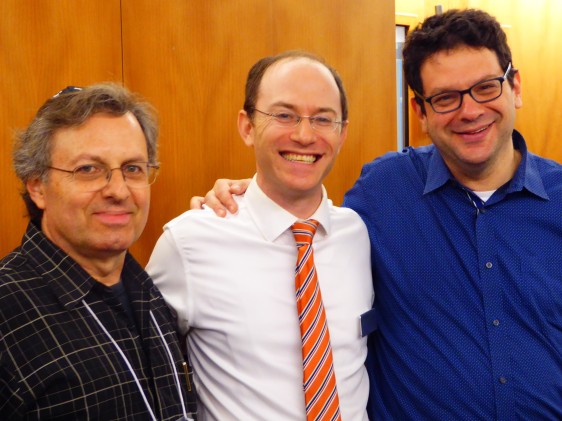
Middleton with Rabbis Elie Kaunfer and Shai Held at Hadar, July 2016

Shai Held (son of Ugaritic scholar Moshe Held) has written an in-depth study of the theology of Abraham Heschel (Abraham Joshua Heschel: The Call of Transcendence) that explores the complexity of his thought. This is his published dissertation, written under the supervision of Jon D. Levenson at Harvard.

Here is a newspaper article (The Times of Israel, September 2017) on Shai Held’s combination of Jewish piety and social ethics.

The Heart of Torah

Held’s latest publication, The Heart of Torah, 2 vols. (Jewish Publication Society, 2017), is a compilation of short theological-ethical essays on selected passages from the weekly Torah portion in the Jewish lectionary cycle. Volume 1 covers texts in Genesis and Exodus, while volume 2 covers texts in Leviticus to Deuteronomy.

Along with approximately 7,000 others, I subscribed to receiving these essays every week by email; and I have been profoundly moved by Held’s insights. So when I found out that the essays would be published in a two-volume collection, I contacted a number of Christian biblical scholars to join me in writing endorsements for the publication.

I then organized a panel discussion on The Heart of Torah at the Society of Biblical Literature annual meeting in San Diego, November 24, 2019 and I collected the papers for publication in the Canadian-American Theological Review.

You can download my introduction to the theme issue of the journal here.

If you want to read the entire issue (consisting in my introduction, six papers on The Heart of Torah, Held’s response, and some excellent book reviews), you will need to log on to the website of the Canadian-American Theological Association. This requires an inexpensive one-year membership (which includes subscription to the journal).

Depending on your library’s subscription to online materials, you might be able to access the journal that way.

This the lineup of articles.

  • Marvin Sweeney, “Human Participation with G_d in Perfecting Creation”
  • Ellen Davis, “Moral Theology in an Exegetical Key”
  • Jacqueline Lapsley, “The Perfect Craft Cocktail on a Sweltering Day”
  • S. Tamar Kamionkowski, “Jewish Theology Rooted in Biblical Texts”
  • David Frankel, “A Critical Review of Shai Held’s The Heart of Torah
  • Dennis Olson, “A Place to Stand: Shai Held’s The Heart of Torah in Dialogue with Pentateuchal Scholars and Literary Theorists”
  • Shai Held, “A Response to My Respondents”

The Liberating Image—The Practical Significance of Being Made in God’s Image

Back in November 2019, when I was attending the Society of Biblical Literature annual meeting in San Diego, I met up with Jim Stump, vice-president of BioLogos. I’ve known Jim for about five years and he asked if he could interview me for the Language of God podcast series that BioLogos sponsors.

The focus of the interview was a topic dear to my heart—what it means to be made in the image of God (imago Dei).

The podcast page introduces the interview this way:

“We were made in the image of God, but what does that really mean? Whom does that apply to? What does that call us to? The Bible is very central to understanding the answers to these questions, as is cultural context. In this episode, biblical worldview professor, Richard Middleton joins Jim Stump in an attempt to answer some of the questions about human identity through both of those lenses.”

This is some of what Jim Stump said on Facebook about the interview.

“Here we talk about the Bible and science (like what each has to say about Adam and Eve), but mostly focus on his specialty: the image of God. I’m biased and prone to believe what I want to be the case, but I think this is a really interesting conversation.”

You can listen to the full interview here on the BioLogos podcast website.

Although Jim does eventually ask me to speculate on how the imago Dei might relate to the development of Homo sapiens, the interview focuses on what the Bible says about the image in its ancient Near Eastern context and its relevance for living in God’s world. I essentially summarize the main thrust of my book The Liberating Image: The Imago Dei in Genesis 1 (Brazos, 2005).

Prior to the book, I had written a programmatic article on the subject, with almost the same title: “The Liberating Image? Interpreting the Imago Dei in Context,” published in Christian Scholar’s Review 24 (1994): 8–25.

Jim Stump is from the Missionary Church, the same denomination that I was a member of as a teen and young adult in Jamaica. I did my undergraduate degree in theology at the Jamaica Theological Seminary, which was founded in 1960 by the Missionary Church Association of Jamaica. It turns out that Jim had spoken at a 2007 commencement ceremony at my seminary.

Although the image of God is the focus of the BioLogos interview, I also talk a bit about what Jamaica is like (in response to Jim’s questions).

If you are interested in further reflections on the applicability of the imago Dei to matters of ethics and justice, you can read the blog post I was invited to write for the Imago Dei Fund. It is called “The Ethical Challenge of the Image of God in the 21st Century – Human Rights and Beyond.

And if you want to explore a bit more about how the imago Dei (and the Fall) might (I emphasize that word) relate to what we know of the origins of Homo sapiens, I discuss these topics in a presentation I gave for the Canadian and Christian Scientific Affiliation, called “Human Distinctiveness and the Origin of Evil in Biblical and Evolutionary Perspectives.”

God’s Wisdom and the Wonder of Creation: The Conference is Only a Week Away!

The theology and science conference hosted by Northeastern Seminary (Rochester, NY) is now just a week away.

I previously posted on the conference here.

The conference title, God’s Wisdom and the Wonder of Creation: Exploring the Intersection of Scripture, Theology, and the Sciences, is based on the expertise of our keynote speaker, Prof. William Brown of Columbia Theological Seminary. For his lectures Brown will draw on his love of the Old Testament—especially creation texts and the wisdom literature—in making connections between theology, science, and faith.

Brown’s Lectures for the Barnes Symposium Earlier in the Week

Although the conference is Friday night and Saturday (October 25-26), Brown will be speaking in Rochester earlier in the week, in advance of the theology and science conference proper.

Brown will give three talks for the Barnes Symposium on Science and Faith held on the campus of Roberts Wesleyan College.

The Barnes Symposium begins with Brown’s chapel talk at 11:00 am on Wednesday, October 23, entitled “Terra Sapiens and the Wonder of Creation.” This will be held in the auditorium of the Cultural Life Center.

That evening (October 23), Brown will give a public lecture at 7:00 pm  entitled “The Cosmic Temple: Science and Faith in Genesis 1.” This event will be held in the Lake Auditorium of the Smith Science Center.

Brown’s third talk for the Barnes Symposium is also the opening public lecture for the theology and science conference at Northeastern Seminary. This talk is entitled “From Ardi to Adam: The Garden and Human Origins.” It will be held in the Schewan Recital Hall of the Cultural Life Center.

God’s Wisdom and the Wonder of Creation

The theology and science conference proper will be held on Saturday (October 26) from 8:00 am through 5:00 pm. Attendance throughout the day requires registration.

After a light breakfast, a welcome, and an opening liturgy, Brown’s lecture on “Job, Astrobiology, and the Science of Awe” kicks off the conference.

Brown’s lecture will be followed by three sessions of concurrent conference papers (thirty papers in all).

I hadn’t planned to present a paper, but since J Gerald Janzen needed to pull out, I have stepped into his slot with a paper entitled “From World Picture to Worldview: Reading Genesis 1 in Ancient and Contemporary Contexts.”

Here is the latest schedule of papers.

This theology conference is one in a series co-sponsored by Northeastern Seminary and the Canadian-American Theological Association (CATA) over the last seven years.

Because of the topic of this year’s conference (on theology and science), we are delighted to have three other co-sponsoring organizations, all of which address the the science-faith dialogue in helpful ways—the Canadian Scientific and Christian Affiliation,  the American Scientific Affiliation, and BioLogos.

These organizations will have information tables at the conference.