Four Views on “Heaven” (Zondervan, 2022)

Sometime in January 2022, Zondervan will be releasing their newest book in the “Counterpoints: Bible and Theology” Series. The book is entitled Four Views on Heaven. I am one of the four authors, each of whom was invited to write our chapter as a position statement on eschatology; each chapter is followed by responses from the other authors.
It seems strange to me to have a new book published so soon after my last, Abraham’s Silence: The Binding of Isaac, the Suffering of Job, and How to Talk Back to God, which was released less than two months ago (by Baker Academic).

Abraham’s Silence was a major project, six years in the making (research and writing). My contribution to Four Views on Heaven was a lot less intense.

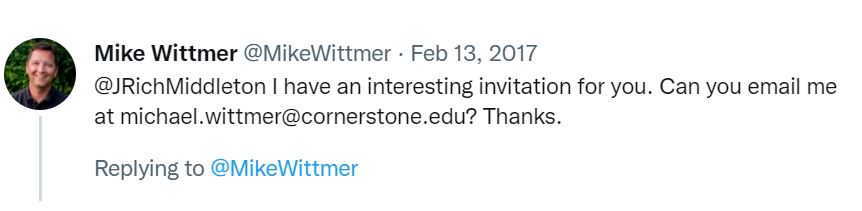
I first learned that something was in the works about the “Heaven” book when the editor, Mike Wittmer, sent me a message on Twitter in 2017.

The tweet was followed up by an email, in which Mike outlined the project, namely to have four position statements on the nature of the final destiny for the redeemed, with responses from each author.

A little over a year later I signed a contract with Zondervan and delivered my chapter and my responses to the other authors in summer 2020.

This is how the Zondervan website describes the book:

Discover and understand the different Christian views of what heaven will be like.

Christians from a variety of denominations and traditions are in middle of an important conversation about the final destiny of the saved. Scholars such as N. T. Wright and J. Richard Middleton have pushed back against the traditional view of heaven, and now some Christians are pushing back against them for fear that talk about the earthiness of our final hope distracts our attention from Jesus.

In the familiar Counterpoints format, Four Views on Heaven brings together a well-rounded discussion and highlights similarities and differences of the current views on heaven. Each author presents their strongest biblical case for their position, followed by responses and a rejoinder that model a respectful tone.

Positions and contributors include:

  • Traditional Heaven – our destiny is to leave earth and live forever in heaven where we will rest, worship, and serve God (John S. Feinberg)

  • Restored Earth – emphasizes that the saved will live forever with Jesus on this restored planet, enjoying ordinary human activities in our redeemed state. (J. Richard Middleton)

  • Heavenly Earth – a balanced view that seeks to highlight both the strengths and weaknesses of the heavenly and earthly views (Michael Allen).

  • Roman Catholic Beatific Vision – stresses the intellectual component of salvation, though it encompasses the whole of human experience of joy, happiness coming from seeing God finally face-to-face (Peter Kreeft).

There are two clarifications needed about both the title of the book and the above description.

Two Clarifications

First, the term “Heaven” in the book title should be understood as shorthand for the eschaton, which in my case is the new earth or renewed cosmos (the “new heavens and new earth”), with a focus on the redemption of creation.

Second, despite the description of the four views (which predates the writing of the book), all authors actually affirm that there will be a new heaven and new earth (the editor could not find a reputable theologian or biblical scholar who thought that salvation consisted in “going to heaven” forever). However, there is still a lot of disagreement on other issues along the way.

For example, the “Traditional Heaven” view is really on Dispensationalism, while the “Heavenly Earth” view claims that all we will do on the redeemed earth is worship God (an earthly “beatific vision”).

I have to say that while I disagreed with much of Peter Kreeft’s chapter on the “Roman Catholic” view, it is very wittily written (you will laugh out loud at some of the turns of phrase there). And Kreeft and I agree on some things that may be surprising.

Respect for Scripture and Each Other

The website description of the “Counterpoints” series stresses that each viewpoint seeks to respect Scripture:

The Counterpoints series presents a comparison and critique of scholarly views on topics important to Christians that are both fair-minded and respectful of the biblical text. Each volume is a one-stop reference that allows readers to evaluate the different positions on a specific issue and form their own, educated opinion.

One of the distinctive features of all the chapters in the Four Views on Heaven book is that every author is charitable to all the others, with no ad hominin attacks or denigration of someone for having a contrary opinion. The respect that accompanies the very real disagreements is salutary and I am delighted to be part of this conversation.

Focus on the Cosmic Temple Theme

Although I have previously written an entire book on eschatology (A New Heaven and a New Earth), my chapter in Four Views on Heaven isn’t simply a repeat or summary of what I’ve written before. Besides addressing some specific questions that the book’s editor put to each contributor, I greatly expanded the theme (already present in my eschatology book) of the world as God’s temple, with God’s desire for his presence to fill all of creation in the eschaton.

This focus was evident in my provisional title for the chapter: “The New Earth: Cosmic Redemption and the Coming of the Shekinah.” Shekinah is the post-biblical Jewish term for the divine Presence, derived from the Hebrew shakan, “to dwell,” with mishkan or “dwelling place” designating the tabernacle in the Old Testament. However, the editor (perhaps) wisely changed the title of my chapter to “A New Earth Perspective,” which is simpler.

You can purchase the book at a good discount from the Zondervan website, as well as other books in the “Counterpoints” series, which typically have four or five views of important topics. One that I have found particularly helpful is Five Views on the Exodus: Historicity, Chronology, and Theological Implications (2021).

I have been appointed a Fellow of Sinai and Synapses

I have been appointed a Fellow of Sinai and Synapses, a Jewish-based organization in New York City, founded to stimulate critical interaction between faith traditions and contemporary science. Sinai and Synapses is a sort of Jewish version of BioLogos, though BioLogos is an explicitly Christian organization, while Sinai and Synapses has an interfaith focus.

I met the founder and director of Sinai and Synapses, Rabbi Geoff Mitelman, at a BioLogos conference in Baltimore in 2019 (the picture below was taken at the National Aquarium, Baltimore).

The Fellowship is a two-year appointment (2021-2023), during which time I will attend meetings with other Fellows, possibly be interviewed for their “Down the Wormhole” podcast, and write blog posts and do public speaking on issues of science and faith.

This is the announcement about this year’s Fellows on the Sinai and Synapses Facebook page:

We are thrilled to announce the fifth cohort of Sinai and Synapses Fellows! We had some of the strongest applications ever in this round, and selected seventeen people from nine states, plus Washington, DC, the United Kingdom and Brazil. These brilliant, thoughtful and dedicated people will be learning together over the next two years, helping raise the discourse on religion and science in their communities and beyond. With the incredible work that our previous Fellows have already created, we can’t wait to see what happens with this group!

You can see the bios of the current group of Fellows here.

I am very much looking forward to interacting with the other Fellows (and alums of the Fellowship from previous years), We come from such different backgrounds and have such a range of diverse expertise and experiences that I am sure to be energized by the conversations.

I am also hoping that what I learn through participation in this Fellowship will be fruitful for a book I’ll be working on in a couple of years, entitled Life and Death in the Garden of Eden: A Theological Reading of Genesis 2-3 (contracted with Cascade Books).

Reconfiguring Abraham’s Test—What Is the Aqedah (Genesis 22) Really About?

In four previous blog posts, I summed up various aspects of the argument of my new book Abraham’s Silence: The Binding of Isaac, the Suffering of Job, and How to Talk Back to God.

My Blog Posts on the Argument of Abraham’s Silence

1.  Abraham’s Silence—Why Genesis 22 Has Been a Puzzle to Me

2. The Importance of Lament for Understanding Genesis 22

3. The Contrast between Job and Abraham—From Vigorous Protest to Unquestioning Silence

4. Abraham’s Shift from Protest (Genesis 18) to Silence (Genesis 22)—What’s Going on?

This post is the fifth in that series.

Here I want to address—head on—the question of what the test in Genesis 22 is all about.

Does Abraham Love God More than His Son?

It is traditional to think that Abraham is being tested to see if he loves God more than Isaac, his son.

However, a careful reading of Genesis reveals that while Abraham loves Ishmael (his first son, born of Hagar), it is doubtful that he cares at all about Isaac (the covenant heir that God promises will be born to Sarah).

Evidence for this is that he passes Sarah off as his sister after God announced the coming birth of Isaac (while Sarah is likely pregnant with him). The result is that the Philistine king of Gerar takes Sarah into his harem (Genesis 20), so that God has to rescue her.

Abraham Is Being Tested for His Discernment of God’s Character

A better interpretation of what is going on in Genesis 22 is that God is testing Abraham for his discernment of God’s character. Is this the sort of deity who demands child sacrifice on the part of his faithful followers? Or is this a God of mercy? After all, Abraham is a man from a pagan culture (Mesopotamia) with no prior knowledge of this God.

This question of merciful character was also the point of the episode in Genesis 18, where God revealed his plans to Abraham about Sodom. The point was so that Abraham could learn about YHWH’s “way” of righteousness and justice, in order to be able to pass this on to his household and descendants (Genesis 18:17–19).

And God revelation to Abraham about the cry of Sodom did lead to Abraham’s passionate intercession on behalf of the city, because Lot (his nephew) was living there.

But (as I discussed in the previous blog post) Abraham stops his request for God to save Sodom too early. And so he never fully plumbs the depths of God’s mercy.

So God gives him another chance in Genesis 22. But this time it won’t be his nephew Lot (who lives in Sodom) who is in danger; it will be Isaac, his own son. And it won’t be God who will do the act; Abraham himself will do it.

If anything would cause Abraham to speak out, this would be it.

God’s command for Abraham to sacrifice his own son ought to generate protest on Abraham’s part and intercession behalf of Isaac.

But he doesn’t speak out. Instead, he goes silently to obey.

God sends him on a three day journey to a distant place (Moriah) to perform the sacrifice, intentionally giving Abraham time to think about it and gather the courage to speak out. But Abraham never gets to that point.

God Might Also Be Testing Abraham’s Love for Isaac

It is possible that there is a second dimension to the test.

Perhaps God wants Abraham to positively develop a love for Isaac. After all,  when God describes Isaac as the one “whom you love” (Genesis 22:2), this isn’t necessarily a statement of fact. It could be an encouragement, as in, “you love him, don’t you?” Then show it, by your response. Testing can bring out what is only potential, if we rise to the occasion.

Three Chapters on the Aqedah

So far I have just given the barest outline of the position I develop through three chapters in Abraham’s Silence. There is a great deal in those chapters that I haven’t even touched on in the above sketch.

For example, I have one chapter specifically devoted to the question of whether it is right to question the traditional interpretation of the Aqedah and whether it is appropriate to question God (since my alternative reading of the Aqedah is that Abraham should have questioned God’s command to sacrifice his son). This is the burden of chapter 5: “Is It Permissible to Criticize Abraham or God?”

Then I have an entire chapter examining clues in the text of Genesis 22 that all is not right with Abraham or with Isaac in the story. And then I examine connections between the Aqedah and the book of Job, which suggest that Job leads to a critique of Abraham’s response to God in Genesis 22. This is chapter 6: “Reading Rhetorical Signals in the Aqedah and Job.” 

Chapter 7 is the climax of the argument, where I explicitly address the question: “Did Abraham Pass the Test?” Beyond looking at the earlier Abraham story as context for Genesis 22, I examine the effect of the test on Isaac (including evidence in Genesis of trauma he suffered).

In this chapter I also take a look at what most readers think is God’s affirmation of Abraham through the speeches of the angel from heaven (Genesis 22:11–18). By careful attention to what the angel says, I show that it is entirely possible that God is actually showing his displeasure with Abraham.

I’m aware that this claim will seem incredible to most readers of this blog post. But I won’t defend it here.

For that, you will need to read the book.