Reframing Abraham’s Call in Genesis 12—Beyond Supersessionism

For a long time I have understood the call of Abraham (Genesis 12:1–3) as fundamentally missional or instrumental, in the sense that the ultimate purpose for which God calls this ancestor of Israel is to mediate the blessings of salvation to the nations.

I taught the book of Genesis with this orientation for many years. And this understanding of Genesis 12:1–3 has played an integral role in my framing of the canonical narrative of Scripture in books I have written, such as Truth Is Stranger than It Used to Be: Biblical Faith in a Postmodern Age (1995) and A New Heaven and a New Earth: Reclaiming Biblical Eschatology (2014). It can be found also in a variety of essays written in the intervening years.

Three Challenges to My Interpretation of Abraham’s Call

However, my missional/vocational interpretation of Genesis 12:1–3, and thus my instrumental understanding of Israel’s election, was itself called into question—no less than three times.

Initially, I was challenged by two Christian scholars who had participated in Jewish-Christian dialogue—the Canadian Catholic theologian Gregory Baum (who I met through the Canadian Theological Society) and the American Old Testament scholar Werner Lemke (who was my colleague at Colgate Rochester Crozer Divinity School).

Both Baum (who had heard a paper I gave in 1995) and Lemke (who read my book Truth Is Stranger than It Used to Be in 1996) challenged me to repent of my implicit Christian supersessionism towards my Jewish brothers and sisters. This was something I had not been conscious of in my thinking.

The third challenge, which helped me positively reframe the call of Abraham, was an email conversation in 2007 with the British Old Testament scholar Walter Moberly, as we discussed a chapter he was writing on the call of Abraham for his book The Theology of the Book of Genesis (2009).

These three challenges led me to take seriously the problematic approach to Judaism that I had inherited from the church, which assumed that once the messiah had come, Judaism had become irrelevant and could be safely discarded.

Of course, I would never have put things in quite so stark a way. But I see how my interpretation of Genesis 12 could be harnessed to support that idea.

The question I now had to grapple with was how I could be faithful to my Christian understanding of redemptive history (I am a Christian, not a Jew—even though my mother was Jewish), while respecting God’s desire to bless, not just the nations through Abraham, but Abraham himself—and his descendants, the people of Israel.

On the Way to a New Reading of Abraham’s Call

This required me to engage in a much more careful reading of Genesis 12 than I had previously done.

The result was that when I was composing my chapter on the plot of the biblical story for A New Heaven and a New Earth, I wrote a lengthy excursus on the call of Abraham that attempted to take into account Moberly’s analysis of the issues, while still maintaining (in the end) a missional reading of Abraham’s call.

Once I had completed the excursus, however, I judged that it was too much of a sidetrack from the flow of the chapter and so I ended up simply summarizing the fruits of my analysis in two brief sections—one about the call of Abraham (pp. 61–62), the other about the place of the exodus from Egypt in the larger biblical story (p. 63). Although I did not abandon a missional reading of the role of Abraham/Israel in the story of salvation, I did affirm God’s purposes for the flourishing of Abraham/Israel—on the way to this larger purpose.

Ever since writing this excursus, I intended to work it up into a published essay on the subject, but never got around to the task. I was, however, recently encouraged to do this by New Testament scholar Andy Johnson, who drew on my unpublished analysis for his chapter on the call of Abraham in Holiness and the Missio Dei (2016).

I was further motivated to work on this material by my participation in an ecumenical Jewish minyan in New York City called the Hadar Institute, through which my respect has been greatly enlarged for Jews seeking to respond in faithfulness to God’s covenant.

My connection to Hadar (formerly called Mechon Hadar) came through one of its founding Rabbis, Shai Held. Having had email correspondence and an initial phone call with Rabbi Held (in 2015), and then reading many of his writings. I have twice participated in the week-long Executive Seminar sponsored by Hadar (in 2016 and 2017). I blogged about my first experience of the Executive Seminar here.

At my request, Walter Moberly, along with other Christian Old Testament scholars, joined me in writing endorsements for Held’s recently published two-volume commentary on the Pentateuch, entitled The Heart of Torah. I then organized and chaired a panel discussion of The Heart of Torah at the Society of Biblical Literature in November 2019. I blogged about the collection of essays that came from the SBL panel here.

Beyond a Supersessionist Reading of Abraham’s Call

Most recently my engagement with Genesis 12 and the question of supersessionism led to an essay called “The Blessing of Abraham and the Missio Dei: Reframing the Purpose of Israel’s Election in Genesis 12:1–3.” In this essay, I tried to be faithful to the text of Genesis 12:1–3 (paying attention to its details), while understanding the role of this text in the larger biblical canon—in a way that honors both the Christian and Jewish traditions. At the end of my analysis, I interacted specifically with Martin Buber’s understanding of Israel’s election and the blessing of the nations.

The essay has now been published as chapter 4 in Orthodoxy and Orthopraxis: Essays in Tribute to Paul Livermore, ed. by Douglas R. Cullum and J. Richard Middleton (Eugene, OR: Pickwick, 2020), 44–64.

This is a volume of twenty-five essays that I co-edited with Doug Cullum, the Vice President and Dean of Northeastern Seminary. It is a Festschrift in honor of our retired faculty colleague Dr. Paul Livermore, one of the charter faculty members of the Seminary—indeed, the person who first came up with the vision to start Northeastern Seminary.

Although I have been moving towards a new reading of Genesis 12 for a while now, the decisive impetus to work on the essay “The Blessing of Abraham and the Missio Dei” was my participation in this Festschrift. I am delighted to offer the current essay in tribute to Paul Livermore, who has always been interested in how the New Testament and the early Christian tradition (articulated by the Church Fathers) are related to the Jewish context in which they were birthed.

I have written a follow-up blog with more details about the fascinating essays in the book, along with an introduction to the incomparable Paul Livermore, whose life of teaching generated these essays from faculty colleagues, church leaders, and past students.

Future Conference on Science and Faith at Northeastern Seminary, Rochester, NY (October 25–26, 2019)

This is a heads up about a special conference on science and faith that will take place October 25–26, 2019 at Northeastern Seminary in Rochester, NY.

Every other year Northeastern Seminary co-sponsors a Fall theology conference with the Canadian-American Theological Association.

In 2019 the conference will have another co-sponsor—the Canadian Scientific and Christian Affiliation. Other co-sponsors will include the American Scientific Affiliation and BioLogos.

Keynote Speaker—William Brown

Our keynote speaker has already been booked—William P. Brown, professor of Old Testament at Columbia Theological Seminary.

Brown is an excellent biblical scholar and teacher, who has always had an interest in science. He is the author of many books on biblical interpretation that I have found helpful.

One of his best, which is directly relevant to the theme of the conference, is The Seven Pillars of Creation: The Bible, Science, and the Ecology of Wonder (Oxford University Press, 2010). In this book Brown examines seven different creation accounts in the Old Testament and imaginatively links them to his reflections on various aspects of the natural world that we have discovered through scientific exploration.

In my 2017 essay on the relationship of the Garden of Eden narrative to the evolution of humanity (“Reading Genesis 3 Attentive to Human Evolution: Beyond Concordism and Non-Overlapping Magisteria”), I cited Brown’s methodology in The Ten Pillars of Creation book as my model for how to think about the possible relationship of the Bible and evolution.

Brown and Middleton Essays for a Future Book

Brown and I are writing two chapters on the Old Testament for a volume entitled Christian Theology and the Modern Sciences, edited by John Slattery. I will be writing on Genesis 1–2, while Brown will write on the wisdom literature. We will each address how our assigned portion of Scripture relates to matters of ecology and science.

Interestingly, I was originally asked to contribute a chapter on the New Testament, based on a paper I gave in 2017 on the relevance of New Testament eschatology for ecology at the Society of Biblical Literature. When I explained that New Testament was not my primary expertise, I was offered a chapter on the Old Testament instead.

A tentative Table of Contents for the entire volume is as follows:

1. Introduction

Part 1: A History of Christian Theology and Science

2. Hebrew Bible (Middleton)
3. Hebrew Bible (Brown)
4. New Testament
5. New Testament
6. Augustine of Hippo
7. Cappadocian Fathers
8. Maximus and John of Damascus
9. Hildegard of Bingen
10. Francis of Assisi
11. Thomas Aquinas
12. Hesychast Controversy and Gregory Palamas
13. Post-Reformation Catholic Figure
14. Luther/Melanchthon
15. Calvin
16. Newman
17. Wesley
17. 20th and 21st Century Catholic Voices on Nature and Science
18. 20th and 21st Century Protestant Voices on Nature and Science
19. 20th and 21st Century Orthodox Voices on Nature and Science

Part 2: Reconsidering Theology and Science Narratives

20. HB and Race/Gender
21. NT and Race/Gender
22. Theological & Scientific Origins of Misogyny
23. Theological & Scientific Origins of Racism
24. Linnaeus and Human Stratification
25. Exemplar Chapter on Theology, Science, Race, Gender in 19th/20th/21st
26. Exemplar Chapter on Theology, Science, Race, Gender in 19th/20th/21st
27. Exemplar Chapter on Theology, Science, Race, Gender in 19th/20th/21st

Part 3: Broadening the Possibilities for Theology and Science

28. Physical Sciences
29. Biological Sciences
30. Medical Sciences
31. Social Sciences
32. Psychological Sciences
33. Environmental Sciences

Christian Theology and the Modern Sciences will be published in the “Companions” series by Bloomsbury / T&T Clark.

An Interview with Brown and Middleton

Back in May 2015 Brown and I were interviewed together in a live streaming event on Google Hangout by Matt Lynch of the Westminster Theological Center in the UK.

The focus of the interview was on themes arising from our most recent books, Brown’s Wisdom’s Wonder: Character, Creation, and Crisis in the Bible’s Wisdom Literature (Eerdmans, 2014) and my A New Heaven and a New Earth: Reclaiming Biblical Eschatology (Baker Academic, 2014), along with and my earlier book The Liberating Image: The Imago Dei in Genesis 1 (Brazos, 2005).

You can watch a recording of the interview here.

Don’t Forget the Science and Faith Conference

Remember to make a note to reserve October 25–26, 2019.

There will be a Call for Papers sent out from Northeastern Seminary and from each of the co-sponsoring organizations.

So stay tuned for more information about the conference as the time draws near.


Trusting the Bible and Accepting Evolution—Call me Crazy!

I just returned from Cornell University, where I gave a joint-presentation entitled “Origins, Self, and Soul” with Praveen Sethupathy, a Christian geneticist on the faculty of Cornell.

Our presentation, which addressed biblical and evolutionary perspectives on human origins and identity, was co-sponsored by Chesterton House, a Christian study center near the Cornell campus, and the Cornell Graduate Christian Fellowship.

The implicit question we addressed was whether it is possible to be a faithful Christian and accept an evolutionary account of human origins.

Whereas Praveen brought a scientist’s perspective, my portion of the presentation focused on what the Bible tells us about human commonality with animals and about what it means to be created in God’s image, which is usually taken as something unique to humans.

I wasn’t able to cover very much in the twenty minutes allotted to me.

However, those twenty minutes were part of longer presentation that I have given on the topic of the Bible and evolution, which covered a larger scope.

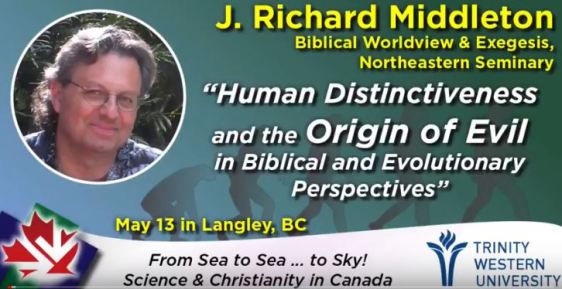
The last time I gave the full presentation was in May 2018, when I participated in a conference sponsored by the Canadian Scientific and Christian Affiliation (CSCA), held at Trinity Western University, in Langley, BC.

I was one of six plenary presenters. The presenters all came from different disciplines and addressed aspects of the intersection of faith and the sciences.

Can We Believe the Bible and Accept Evolution?

As the biblical scholar of the lot, my talk focused on biblical themes. Given the nature of the conference (and my interest in the faith-science interface on matters of origins), I attempted to relate the biblical themes of human distinctiveness and the origin of evil to what the sciences are telling us about our evolutionary origins.

I began by highlighting a number of tensions that Christians have perceived between the Bible and an evolutionary account of human origins. Then I suggested that these tensions are not necessary, but have to do with the way in which we read the Bible.

So I engaged in some serious Bible study.

My talk was videotaped and astutely edited together with my PowerPoint slides. The entire talk (with slides) can be viewed here.

Part 1: Human Distinctiveness

In part 1 of the talk, I addressed how the Bible understands the commonality of humans with other animals (in a variety of creation texts from Genesis, Job, and the Psalms), which suggests that we shouldn’t have an aversion to the idea of common descent. Then I explored the Bible’s teaching about humanity as the image of God (found in Genesis 1:26–28 and related texts). I speculated how the human calling to image God might be related to what science is telling us about human origins.

Part 2: The Origin of Evil

In part 2 of the talk, I focused on the portrayal of the origin of evil in Genesis 2–3, probing the way in which this portrayal is true to human experience and represents a profound phenomenology of temptation and sin. Then I picked up on my earlier speculation about the image of God and evolutionary origins, and added a suggestion for how human evil could have entered the evolutionary process.

I thus did what many Christians claim it is impossible. I attempted to affirm both an evolutionary account of human origins and the biblical teaching on human distinctiveness and a historical fall.

Call me crazy. But I respect God’s revelation in Scripture and God’s revelation in creation, which can be studied by science. I can’t deny either.

In fact, I believe that God is revealed—and glorified—in the evolutionary complexity of the biological world.

Insightful Devotional: “Called to Indwell the Earth”

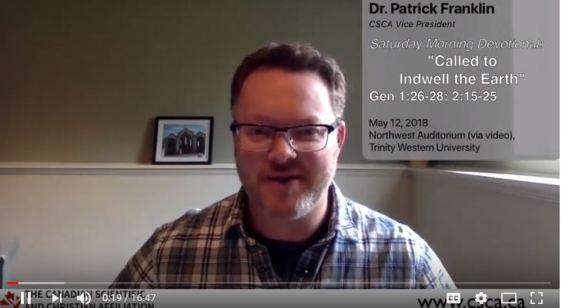
At the conference we had a wonderful devotional one morning given by Patrick Franklin, current vice-president of the Canadian Scientific and Christian Affiliation, and newly appointed associate professor of theology at Tyndale Seminary, in Toronto.

You can watch Patrick Franklin’s talk here.

Recordings of Other Talks at the Conference

You can see the entire conference schedule of keynote speakers and breakout sessions here.

All the keynote talks and some of the breakout sessions were recorded. You can find links to them here.