Future Conference on Science and Faith at Northeastern Seminary, Rochester, NY (October 25–26, 2019)

This is a heads up about a special conference on science and faith that will take place October 25–26, 2019 at Northeastern Seminary in Rochester, NY.

Every other year Northeastern Seminary co-sponsors a Fall theology conference with the Canadian-American Theological Association.

In 2019 the conference will have another co-sponsor—the Canadian Scientific and Christian Affiliation. Other co-sponsors will include the American Scientific Affiliation and BioLogos.

Keynote Speaker—William Brown

Our keynote speaker has already been booked—William P. Brown, professor of Old Testament at Columbia Theological Seminary.

Brown is an excellent biblical scholar and teacher, who has always had an interest in science. He is the author of many books on biblical interpretation that I have found helpful.

One of his best, which is directly relevant to the theme of the conference, is The Seven Pillars of Creation: The Bible, Science, and the Ecology of Wonder (Oxford University Press, 2010). In this book Brown examines seven different creation accounts in the Old Testament and imaginatively links them to his reflections on various aspects of the natural world that we have discovered through scientific exploration.

In my 2017 essay on the relationship of the Garden of Eden narrative to the evolution of humanity (“Reading Genesis 3 Attentive to Human Evolution: Beyond Concordism and Non-Overlapping Magisteria”), I cited Brown’s methodology in The Ten Pillars of Creation book as my model for how to think about the possible relationship of the Bible and evolution.

Brown and Middleton Essays for a Future Book

Brown and I are writing two chapters on the Old Testament for a volume entitled Christian Theology and the Modern Sciences, edited by John Slattery. I will be writing on Genesis 1–2, while Brown will write on the wisdom literature. We will each address how our assigned portion of Scripture relates to matters of ecology and science.

Interestingly, I was originally asked to contribute a chapter on the New Testament, based on a paper I gave in 2017 on the relevance of New Testament eschatology for ecology at the Society of Biblical Literature. When I explained that New Testament was not my primary expertise, I was offered a chapter on the Old Testament instead.

A tentative Table of Contents for the entire volume is as follows:

1. Introduction

Part 1: A History of Christian Theology and Science

2. Hebrew Bible (Middleton)
3. Hebrew Bible (Brown)
4. New Testament
5. New Testament
6. Augustine of Hippo
7. Cappadocian Fathers
8. Maximus and John of Damascus
9. Hildegard of Bingen
10. Francis of Assisi
11. Thomas Aquinas
12. Hesychast Controversy and Gregory Palamas
13. Post-Reformation Catholic Figure
14. Luther/Melanchthon
15. Calvin
16. Newman
17. Wesley
17. 20th and 21st Century Catholic Voices on Nature and Science
18. 20th and 21st Century Protestant Voices on Nature and Science
19. 20th and 21st Century Orthodox Voices on Nature and Science

Part 2: Reconsidering Theology and Science Narratives

20. HB and Race/Gender
21. NT and Race/Gender
22. Theological & Scientific Origins of Misogyny
23. Theological & Scientific Origins of Racism
24. Linnaeus and Human Stratification
25. Exemplar Chapter on Theology, Science, Race, Gender in 19th/20th/21st
26. Exemplar Chapter on Theology, Science, Race, Gender in 19th/20th/21st
27. Exemplar Chapter on Theology, Science, Race, Gender in 19th/20th/21st

Part 3: Broadening the Possibilities for Theology and Science

28. Physical Sciences
29. Biological Sciences
30. Medical Sciences
31. Social Sciences
32. Psychological Sciences
33. Environmental Sciences

Christian Theology and the Modern Sciences will be published in the “Companions” series by Bloomsbury / T&T Clark.

An Interview with Brown and Middleton

Back in May 2015 Brown and I were interviewed together in a live streaming event on Google Hangout by Matt Lynch of the Westminster Theological Center in the UK.

The focus of the interview was on themes arising from our most recent books, Brown’s Wisdom’s Wonder: Character, Creation, and Crisis in the Bible’s Wisdom Literature (Eerdmans, 2014) and my A New Heaven and a New Earth: Reclaiming Biblical Eschatology (Baker Academic, 2014), along with and my earlier book The Liberating Image: The Imago Dei in Genesis 1 (Brazos, 2005).

You can watch a recording of the interview here.

Don’t Forget the Science and Faith Conference

Remember to make a note to reserve October 25–26, 2019.

There will be a Call for Papers sent out from Northeastern Seminary and from each of the co-sponsoring organizations.

So stay tuned for more information about the conference as the time draws near.
 

Death and the Curse in the Garden of Eden—and Beyond

A new online article that I wrote on the topic of death in the Garden of Eden has now been posted to the website of the Carl F. H. Henry Center for Theological Understanding.

Here is a summary of the article:

It has been a common (though not universal) assumption in the history of Christian thought that humans were created immortal, and only lost their immortality with the entrance of death as the consequence for sin. This is, however, a misreading of the biblical data, which suggests that humans were created mortal with the possibility of attaining eternal life—a possibility that was lost through sin and is now realized in Jesus Christ.

Were Humans Mortal before the Fall?

The article is published in an online journal of the Henry Center called Sapientia, in the Areopagite forum (the Aereopagus was the meeting place in Athens where Paul preached in Acts 17).

My piece is the first in a series of blog posts that were invited to respond to the question Were humans mortal before the fall? Each blog post will give a different author’s perspective on this issue.

The Creation Project

I’ve been involved for three years now with the Creation Project of the Henry Center, which has explored the themes of Reading Genesis (2016), the Doctrine of Creation (2017), and Theological Anthropology (2018).

Each summer (in June) the Creation Project has run a conference (called Dabar, Hebrew for “word”) on the topic for the year, held on the site of Trinity Evangelical Divinity School, near Chicago.

At the first two Dabar conferences I gave paper responses, first to a paper on Genesis 1–11 (2016) and then to a paper on God as an Agent (2017).

Death, Immortality, and the Curse

This year (2018) I was invited to write a paper for the conference, which will have two respondents (one by a theologian, the other by a biblical scholar). I’ve been asked to give a brief response to my respondents.

My paper is entitled: “Death, Immortality, and the Curse: Interpreting Genesis 2–3 in the Context of the Biblical Worldview.”

It’s an expansion of the shorter Sapientia article, attempting to connect the discussion of death and mortality (from that article) with the broader “ecological” picture of how humans affect the non-human world for good or ill, which is first articulated by the “curse” on the ground because of human sin (Genesis 3:17).

The shorter article, entitled “Humans Created Mortal, with the Possibility of Eternal Life,” is available online.

My Ambiguous Relationship with Carl Henry

For those interested, you can check out the blog post I wrote in anticipation of attending the first Dabar conference (2016), where I recounted my initial (unpleasant) encounter with Carl Henry over twenty years before.

Luckily, my experience with the Henry Center has been much more positive than that early encounter. In my evaluation of the 2016 conference, I wrote:

“I found the atmosphere of the Dabar conference to be collegial and open. While the presenters, respondents, and other participants did not agree on everything, there was a welcoming hospitality between everyone, regardless of viewpoint.”

I later recounted my experience of the second Dabar conference (2017), where I was a respondent to philosopher Billy Abraham.

I’m very much looking forward to this year’s conference.

What Makes Us Human: Reflections on Genesis and Genetics in West Chester, PA

I’ve been doing quite a bit of speaking on behalf of BioLogos, a Christian organization dedicated to helping Christians and others see the hand of God in the evolutionary process.

Francis Collins

BioLogos was founded by Francis Collins, the evangelical Christian physician and geneticist, who—as head of the Human Genome Project—developed the first comprehensive analysis of the human genetic code.

Collin’s book, The Language of God: A Scientist Presents Evidence for Belief (2006), is both a good non-technical introduction to evolution and genomic science and a testimony to his view of the harmony of science and faith.

It was the honest questions that Collins received from the public about the relationship of Christian faith and evolution that led him to found BioLogos in 2007.

Praveen Sethupathy

I’ve now done three joint talks with Praveen Sethupathy, a Christian professor of genetics at Cornell University, who did a post-doc with Francis Collins at the National Human Genome Research Institute.

Both Praveen and I are members of BioLogos Voices, a group of speakers sponsored by BioLogos, who are offering our services to Christian and secular audiences interested in thinking about the relationship of science and faith in non-polarizing ways.

Our Lecture at West Chester University

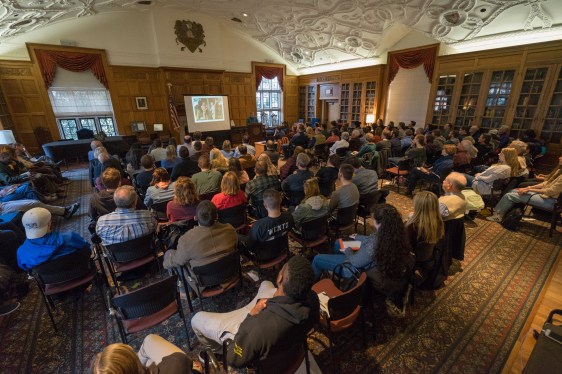
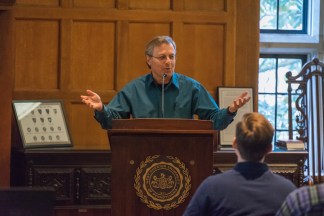
Praveen and I recently did a joint lecture in West Chester, PA on April 8, 2018. We were invited by Raymond Johnson, the pastor of The Journey Church in West Chester, to give a joint presentation in their Sunday Night Theology series, held at West Chester University.

The title of our talk, to a packed room, was “What Makes Us Human? Lessons from Genetics and Genesis.”

Praveen kicked off the evening by narrating some of his own faith journey and how he understands the intersection of his scientific profession and his Christian faith. He then discussed the various possibilities that scientists have proposed as characteristics that might distinguish humans from other animals, including anatomical, behavioral, cellular, and genetic distinctives. But none of them hold up to sustained scrutiny.

Not Biology, but the Image God

Instead, he suggested that the Bible understands human distinctiveness not in terms of any particular features of Homo sapiens, but in our calling or vocation to image God by how we live (a point on which there is nearly unanimity among contemporary biblical scholars). He introduced the topic by quoting from my own book, The Liberating Image: The Imago Dei in Genesis 1 (p. 27):

“The imago Dei designates the royal office or calling of human beings as God’s representatives and agents in the world, granted authorized power to share in God’s rule or administration of the earth’s resources and creatures.”

After discussing this “functional” human calling to image God and reveal God’s character, Praveen went on to talk about God’s delight in his creation, especially as portrayed in Psalm 104; thus our own ability to delight in God’s world may be an aspect of the image of God, a way in which humans uniquely reflect their Creator.

Along the way, Praveen addressed the paradox that ordered and purposeful outcomes often result from what we might think of as random processes. This is because randomness (such as we find in evolution) is often not purely random, but is impacted by all sorts of chemical and biological constraints that are built into nature. Thus even the supposed randomness of evolution is not inherently contrary to the notion of design in creation.

What Does the Bible Say about Human Distinctiveness?

Praveen then handed things over to me. My task was to develop the biblical materials on what it means to be human.

First, I took the audience through a tour of various Scriptures (in Genesis, the Psalms, and Job) that assumed a commonality or kinship between humans and other animals. I suggested that this commonality can prime us theologically to be open to the idea of common descent.

But the Bible also portrays humans as different from other creatures, in our calling to image God.

It is true that the Bible only rarely refers to humans as created in God’s image (there are only five or six passages that explicitly say this). Does that mean that the idea of the imago Dei is not particularly important in the biblical worldview?

To address this question, I used the following analogy:

Whereas the coherent vision of being human found in the Bible is like a powerful underground river that fertilizes much biblical theology, the explicit statements about our creation in God’s image are those places where the water bubbles to the surface, and the flow becomes visible.

I then fleshed out some of the content of the imago Dei, by examining a variety of biblical texts that articulate aspects of our calling to represent God and manifest his presence by how we live in the world.

This imaging function is clarified by how the ancients thought of images (idols) in temples dedicated to their various gods. Whereas the image/idol was understood as mediating the presence of the deity being worshiped, Scripture affirms that only humans are God’s authorized images in the cosmic temple of creation.

Humans can thus do what idols can’t. They are able to represent God on earth and to mediate God’s presence through their obedient response to God’s will in the full range of earthly life.

The Image of God and Evolution?

I concluded by speculating about how our unique calling to image God (the core of human distinctiveness) might be compatible with human evolution.

To that end, I sketched a possible scenario, wondering whether God may have entered into relationship with a group of Homo sapiens, sometime after the species had emerged and stabilized. This new relationship would have radically transformed human consciousness and thus initiated the imago Dei as the distinctive human response to God’s presence.

Of course, the truth of the Bible, and our calling to image of God, does not depend on this (or any other) imaginative scenario.

Questions, Questions, and More Questions

We then had a substantial time of discussion as people in the audience asked their probing questions and we tried to answer them as best we could.

Some of the questions had to do with scientific issues, but many had to do with the Bible and how we interpreted biblical creation accounts in relation to evolutionary science. We certainly did not get through all the questions the audience had in the time frame allotted, neither did we answer all the questions to everyone’s satisfaction.

Nevertheless, we tried to articulate our trust in the God of the Bible, who is revealed in Jesus Christ, while embodying an openness to science and the humility to acknowledge that we didn’t have all the answers.

Audio Recording of the Presentation

For those interested in the audio recording of the presentation, it is available here, either for online listening or for download.

The audio begins with an introduction by Raymond Johnson.

Praveen’s talk begins at about the 7:56 minute mark. And my talk starts at around 38:10 minutes.

The Q&A time is not part of the posted recording.