Created in God’s Image: The Royal Calling of Humanity (The Kingdom of God, part 3)

This is part 3 of a series of posts on the kingdom of God. Part 1 can be found here. Part 2 can be found here.

The kingdom of God in the teaching of Jesus is a distinctly Jewish idea, rooted in Israel’s Scriptures. To understand the significance of this kingdom we will need to explore some of the biblical backstory—especially the theme of “rule,” a royal metaphor for the exercise of power.

Imago Dei: The Royal Calling of Humanity

The opening chapter of the Bible recounts the creation of humanity (male and female) with the vocation or calling of being God’s “image” on earth (Gen 1:26–28). Genesis 1 here draws on (and interacts with) the royal ideology from the cultures of the ancient Near East (such as Mesopotamia and Egypt), which viewed kings (and sometimes priests) as the “image” of their gods. These human leaders were thought to have a function similar to that of the “image” (or cult statue) of the god, which was located in the temple. Just as the cult statue was thought to mediate the presence and power of the god from heaven to earth, kings (and some priests) claimed to be the gods’ unique earthly delegates, exercising power over the people on the gods’ behalf (a royal function), by which the gods’ presence was made manifest in their society (a priestly function).

Genesis 1 draws on this ancient, highly elitist notion of the “image of God,” but radically democratizes or universalizes it, applying it to all people, male and female (irrespective of their social status). This biblical vision of all people sharing the “royal” status of the “image of God” (imago Dei in Latin), with equal dignity in the sight of the Creator, helps explain a well-recognized historical fact: when the people of Israel came into existence as a nation (after their exodus from Egypt), they existed for centuries without a monarchy—something entirely unique in the ancient Near East. The idea of all humanity created to be God’s image functioned as a radical critique of—and form of resistance to—the royal ideology of the ancient societies among which Israel lived.

In Genesis 1:26–28, the image of God is manifested in the ordinary human exercise of power or agency in earthly life, involving “rule” (or “dominion” in some translations) over the animal kingdom (equivalent to animal husbandry) and “subduing” the earth or land (equivalent to agriculture). In Genesis 2, the human vocation is portrayed (without using the term “image”) as working and protecting a garden of fruit trees that God planted (Gen 2:15). Since God planted the garden, God is portrayed as the first gardener and humans implicitly image God as they continue tending God’s garden. Psalm 8 echoes the theme of animal husbandry from Genesis 1, when it describes humans as created a little less than God (similar to being God’s image in Genesis 1) and granted rule over various forms of animal life—on land, air, and water (Ps 8:5–8).

The image of God (imago Dei) is both a gift (humans are granted the status of being VIPs in God’s world) and a calling or vocation (we are commissioned as God’s ambassadors in the world). Every person is both gifted with royal dignity and also authorized to represent God’s rule in the ordinary practices of earthly life. Whereas Genesis 1 and 2 focus on caring for animals and farming the land, Genesis 4 extends this by mentioning that humans invented and developed cities, nomadic livestock herding, musical instruments, and metal tools (Gen 4:17, 20–21). This suggests that God is imaged by all forms of legitimate cultural innovation, as people develop the potentialities of earthly life.

But Genesis 3 portrays humans rebelling against their Creator (transgressing the limits God instituted) so that the gift of human agency or “rule” becomes distorted and twisted, with corrupting effects on the social order.

Life, Death, and Violence in Human History

In the Garden of Eden narrative, humans are warned that “death” is the consequence of disobedience to God (Gen 2:15–16). This death was not the introduction of mortality, as if humans had previously been immortal and only now would have an ending to their life; the idea of original immortality is an idea imported by later interpreters into the text. Rather, humans are created from “dust” (Gen 2:7), a term used throughout the Bible as a metaphor for mortality (see especially Ps 103:13–14). The “death” warned about in Genesis 2 best understood as the constriction and diminishing of life, where “life” refers to the fullness of earthly flourishing.

Immediately upon disobedience, the original harmony in the garden begins to be distorted, as the primal couple cower in fear before God and in shame of nakedness before each other (Gen 3:7–8, 10), while ordinary human relationships, like marriage, childbirth, and farming, became disharmonious (Gen 3:16–20). Ultimately, humans are exiled from the garden, losing access to the fullness of life (symbolized by the Tree of Life in the center of the Garden) and the intimate presence of God. These consequences are various ways of describing the “death” that results from sin.

Yet humans retain the dignity of being God’s image and the call to represent God is not rescinded (see Gen 9:6). But violence (the misuse of the power or agency associated with the image of God) is introduced into human history, evident in Cain’s murder of his brother out of jealousy (Gen 4:8) and Lamech’s revenge killing of a young man who injured him, while boasting about it to his two wives (Gen 4:23). Distorted human “rule” then spirals out of control, until violence fills the earth and life becomes corrupted (Gen 6:5, 11–12), which generates the flood to cleanse the earth of this corruption.

But the respite is only temporary and human violence culminates in the story of Babel (the normal Hebrew word for Babylon), an empire that tries to dominate others and impose its will (and even language) on conquered peoples (Gen 11:1–9). The tower of Babel is likely a ziggurat, a series of giant steps for the gods to descend from heaven to their favored city, thus providing religious legitimation for the empire. With the rise of every “Babylon” in history, every imperial legitimation of violence in the name of law and order (including Rome in the time of Jesus), God’s purposes for life and flourishing are impeded. In the “Babel” of Genesis 11, God’s purposes for blessing seem to have come to a dead end.

How will God respond to this imperial violence? That is the topic of part 4 of this series (The Story of Israel from Abraham to the Exile).


An Amazing First Novel: “Though I Walk” by Dale Harris

A past student of mine, Canadian Dale Harris, has published his first, absolutely stunning, novel, called Though I Walk (Word Alive Press, 2021).

I was privileged to have Dale as a DMin student at Northeastern Seminary a few years ago. He wrote a wonderful paper for my course, which has subsequently been published in the Canadian-American Theological Review (2019).

Dale won the 2020 Braun Book Award for Fiction for his novel and received a publishing contract with Word Alive Press.

I was delighted to be asked to write an endorsement for the novel. This is what I said:

An exquisite tale of love, longing, and loss, set against the coastlines of Nova Scotia and the Aegean. Harris deftly intermingles Greek myth with the concreteness of love and the horrors of war. A stunning first novel.

Book Summary

The truths of the past are often the hardest to face.

When Grace Stewart’s fiancé Stephen leaves Halifax in 1937 to pursue his dream of becoming an archaeologist in Greece, neither of them expect that war will soon engulf the world, keeping them apart for nearly ten years. As Stephen gets caught up in the resistance movement on the island of Crete, Grace immerses herself in the war effort at home, held up by her faith and praying for his safe return.

Though her prayers are eventually answered and she and Stephen are finally reunited, he is never able to speak of the things he saw in Greece. After his sudden death in 1967, however, Grace discovers among his effects the journal he kept during that dark time… a journal which allows her to, at long last, piece together the unimaginable story of the man she thought she knew.

Amazon Review

Here is what a review on Amazon said about the novel:

5.0 out of 5 stars Outstanding novel! Reviewed in Canada on April 13, 2021

I rarely read novels. But this one drew me in immediately and kept me coming back for more, in spite of my extremely short attention span.

It is a great story of love, loss, loyalty and longing. The characters feel very much like real people.

The author “shows” you the story. He doesn’t just tell you what happens. You feel as if you are there with the characters. The author’s attention to detail is magnificent! Halifax in the 30s and 40s and Greece during WWII come to life vividly in their parts of the story. The war scenes strike me as realistic, but they are not overdone in a sensationalized way.

Faith or spirituality of various sorts shows up at different points in the tale, but there is nothing preachy!
The book is so full of sensitivity to loss and grief, to unfulfilled longing and hope that many good things end up “sticking” to you while you journey with the winsome characters.

We have already given a copy to friends.

Get one and enjoy it.

The book is available in paperback or ebook format on Amazon.

Dale Harris Biography

Dale Harris is an author, songwriter, blogger, and pastor, though not necessarily in that order. He taught high school English in St. Paul, Alberta before being called into fulltime ministry, and has served as a Free Methodist pastor in the city of Oshawa, Ontario since 2009. He holds a Bachelor of Education from the University of Alberta (Edmonton, AB), a Master of Divinity from Briercrest Seminary (Caronport, SK), and a Doctor of Ministry from Northeastern Seminary (Rochester, NY).

Dale writes regularly about life, faith, and spirituality on his blog terra incognita, and he produces Three Minute Theology, a YouTube channel dedicated to communicating the deep truths of Christian theology through short, creative whiteboard videos. He is a prolific songwriter and publishes his music on Spotify and iTunes under the artist name D. Michael Harris. Through his writing Dale loves to explore the mysterious ways God is present to us in all aspects and every season of our lives.

Here is an article about the writing of the book on the Free Methodist Church website.

Terry Fretheim and the Renewal of Creation Theology

One of my favorite Old Testament scholars, Terence Fretheim, died yesterday (November 16, 2020).

Terry was both a wonderful person and a brilliant biblical scholar. He excelled both in detailed exegesis of the Old Testament and in his reflections on the theological and ethical meaning of of this ancient text.

The first book of his that I read was The Suffering of God: An Old Testament Perspective (1984), which was a short but profound study of how God is affected by us. Although the book focuses on the Old Testament, it helpfully lays the foundation for understanding the coherence of both Testaments, since the same God who allowed himself to be affected by humanity at the flood (God’s heart was grieved by human evil) and by Israel’s unfaithfulness (see the prophet Jeremiah), ultimately became incarnate and went to the cross for our sake.

I found some similarity between Fretheim’s interest in reading the Old testament theologically and the work of Walter Brueggemann. In Nijay Gupta’s recent interview with me, I cited Brueggemann as the first Old Testament scholar whose work deeply impacted me, especially on the relevance of the Old Testament for its claims on our lives today.

I read Terry Fretheim a bit later and he impacted me in a similar way. But what was distinctive about Fretheim was that he grounded his understanding of the Old Testament in a creation theology, a topic I was coming to see as crucial.

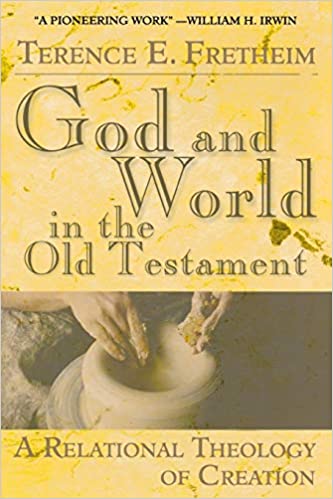
After The Suffering of God, I read numerous journal articles by Fretheim, many of which were spin-offs from his wonderful commentary on Exodus (1991) and were incorporated into his magnum opus, God and World in the Old Testament: A Relational Theology of Creation (2005).

The latter book is so good that I view it as one of the best works of biblical theology I have ever read. On almost every page, as Fretheim works through Genesis, Exodus, the Psalms, and the wisdom literature, there are reams of exegetical insights that could serve as a sourcebook for years of sermons on the Old Testament. And it is all exegetically rigorous and theologically thoughtful.

Fretheim was a Lutheran and the Lutheran tradition has been notoriously weak historically on the doctrine of creation (with a few exceptions, like Gustav Wingren). So I have often thought that Fretheim was addressing this lack in his own tradition by mining the Scriptures for their teaching about creation and the God-creation relationship.

An example of the difference between Brueggemann and Fretheim can be seen in their respective commentaries on Jeremiah. Brueggemann’s Jeremiah commentary (which is immensely helpful) focuses on the radical (almost Barthian-like) challenge the prophet brought to Israel back then and that he brings to us today. Fretheim’s commentary, however, focuses on God’s complex relationship to Israel and to the created order, showing much more of divine compassion in the midst of judgment. Indeed, Fretheim often takes Brueggemann to task (gently) in the commentary about his glossing over aspects of the text.

My own early interaction with Brueggemann took the form of a critique of his creation theology, first given at the Society of Biblical Literature (SBL) in 1992 and then published a couple of years later as “Is Creation Theology Inherently Conservative? A Dialogue with Walter Brueggemann.”

Brueggemann graciously accepted my critique, both in his unplanned response to my paper (the person presenting after me was absent and the chair asked him if he had anything to say), then, after I published the paper, in a more formal print response.

Interestingly, although my first interaction with Fretheim was at the SBL (in 1995), it wasn’t a critique, but rather encouragement. I had just given a paper on a rhetorical reading Genesis 1, in a session on the ethical reading of Scripture, which was followed by a respondent who was somewhat negative towards my paper.

Just as the floor was opened for questions, Fretheim came up to me, introduced himself, and told me he had to leave for an appointment. But he wanted me to know that I was onto something important in my reading of the text and that I should not be fazed by the response I got. He handed me his business card and told me to be in touch.

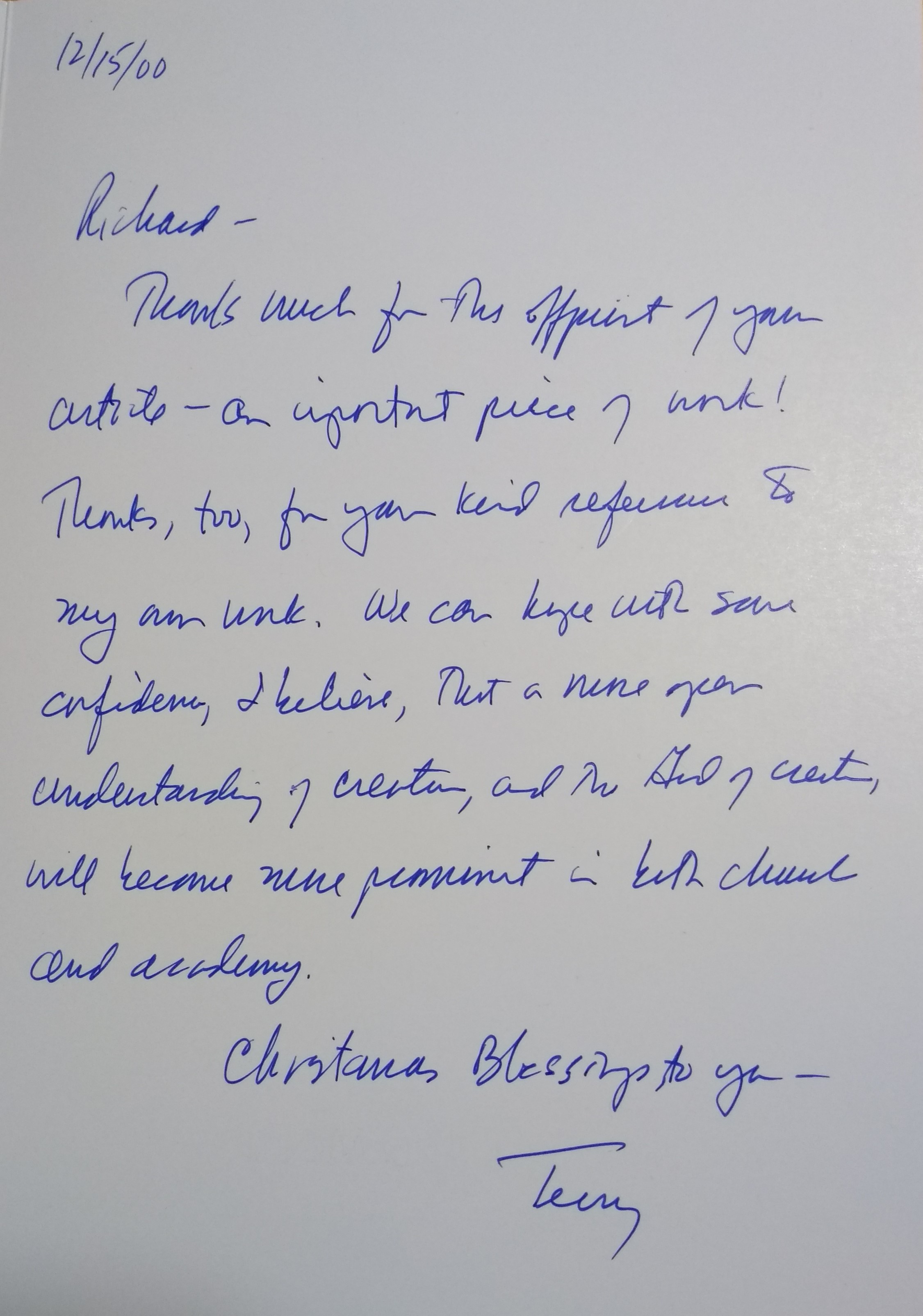
So, when I published the paper in 2000, called “Creation Founded in Love,” I sent him a copy. I received a wonderful Christmas card from him, dated December 15, 2000, with this encouragement:

“Thanks for the offprint of your article—an important piece of work! Thanks, too, for your kind reference to my own work. We can hope with some confidence, I believe, that a more open understanding of creation, and the God of creation, will become more prominent in both church and academy.”

For his astute biblical scholarship and for his winsome personality, I will miss Terry Fretheim.

RIP until the resurrection!