I’ve always prized Psalm 51 as an amazing articulation of the meaning of repentance; and it is a favorite and valued psalm for many Christians.
Although the superscription links it to David’s confrontation by the prophet Nathan in 2 Samuel 12 over his adultery with Bathsheba, I had the sense that the traditional reading of this psalm as David’s prayer of confession did not fit the actual story in 2 Samuel. This came from teaching both the psalm and the Samuel narrative over many years (in different courses).
I therefore decided to read Psalm 51 carefully in light of the narrative of David’s sin and confession to see what I could come up with.
Since psalms superscriptions are not original to the psalms, but inserted by later editors (I give evidence for this in the essay), I propose that we take the superscription to Psalm 51 as a (divinely inspired) lectionary suggestion for reading the psalm together with the 2 Samuel narrative.
The result of doing this, I argue, is that the psalm ends up functioning as a critique of David’s superficial “repentance” in 2 Samuel 12.
My essay, therefore, challenges the naive, idealistic reading of the figure of David often found in the evangelical church (but then anyone who reads 1-2 Samuel with their eyes open would be disabused of this ideal picture anyway).
The essay is, most fundamentally, my attempt to take the authority of Scripture seriously (regarding both Psalm 51 and 2 Samuel 12 as divinely inspired), with eyes wide open to the complexity of this divinely inspired Scripture, asking what the implications might be for Christians reading these texts.
The Jamaica theology conference that I’ve been helping to plan is coming up in just over a month (I had posted a final Call for papers a while back).
KEYNOTE SPEAKER – DR. STEED DAVIDSON
The keynote speaker is Dr. Steed Davidson, Associate Professor of Hebrew Bible / Old Testament at McCormick Theological Seminary in Chicago.
Dr. Davidson, who is originally from Tobago, will kick off the conference with a programmatic lecture on Friday evening (September 8) entitled “The Hazards and Opportunities of Sola Scriptura for Caribbean Biblical Interpretation.” Then on Saturday (September 9) there will be papers on a variety of topics related to the conference theme: “Biblical Interpretation for Caribbean Renewal.”
PAPER TOPICS FOR SATURDAY
We have papers lined up from a variety of theological disciplines and perspectives, especially focused on the Bible and Caribbean renewal. Here are some of the paper titles:
The Parable of the Good Samaritan: A Political Reading from a Caribbean Perspective
The Inclusive Vision of Isaiah 56 and Contested Ethical Practices in Scripture and the Church: Toward a Canonical Hermeneutic of Discernment
Food for Thought: The Work of the Spirit and the Dynamics of Disgust in Acts 10
Word, Sound, and Power: The Religious Imagination of Rastafari Hermeneutics
Chiastic Contours, Caribbean Hermeneutic, and the Book of Acts
Black Identity in Light of Slavery, God’s Sovereignty, and Scripture
Pastoral Priorities for Biblical Interpretation in the Caribbean
Contextual Interpretation and the Canonical Narrative: Toward a Holistic Understanding of the Bible
The Anatomy of a Church Healing
The Biblical Interpretation of Demonic Possession and Voodoo-Like Possession as the Identity of Evil In Haiti
The theology conference is sponsored by the Jamaica Theological Seminary and will be held on their campus, at 14-20 West Ave., Kingston 8, Jamaica, W.I..
This interdisciplinary theology conference celebrates the 50th anniversary of the Jamaica Association of Evangelicals and the 500th anniversary of the Protestant Reformation.
I recently participated in two separate events of science-faith dialogue. Both were sponsored by evangelical organizations with Trinity in the name. And both had a significant BioLogos presence.
EVENT #1: The Dabar Conference on “Affirming the Doctrine of Creation in an Age of Science” (June 14–17, 2017)
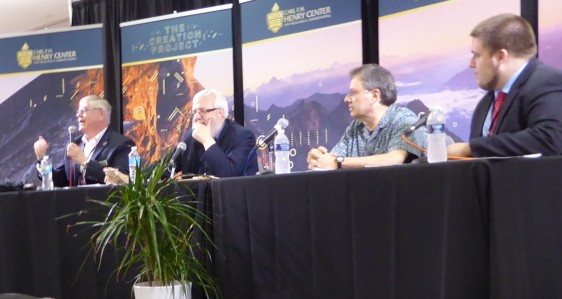
Two weeks ago I participated in the Dabar conference of the Henry Center at Trinity Evangelical Divinity School, near Chicago (Dabar is Hebrew for “word”).
This was the second Dabar conference that I attended. These conferences are part of a three-year research project on creation that I’ve been involved in. The Creation Project aims to help the evangelical church develop a robust creation theology that can interact fruitfully with contemporary scientific understandings of the world.
Last year (2016) the topic was interpreting Genesis; this year (2017) the focus has been on the doctrine of creation; and next year (2018) it will be on what it means to be human.
The Dabar conference is held each June as the highlight of the year’s theme, and is attended by about 80–100 theologians, biblical scholars, philosophers, scientists, and pastors.
The keynote papers weren’t read at this year’s conference, but were circulated to the participants in advance and we were expected to have read them all and to come with our questions.
The author of each keynote paper gave a five minute summary of their paper, which was followed by two short response papers, then by the author’s reply. After that it was open to the audience for Q&A. To see the list of speakers and topics, click here.
Each afternoon, we met in small groups to discuss the ideas raised in the papers and to see what the range of our opinion was on matters of creation theology and the science of origins.
There was a lot of very engaging discussion.
This year two of the main speakers (Deb Haarsma and Jeff Schloss) and two the respondents (Jim Stump and myself) were associated with BioLogos. Deb Haarsma is president of BioLogos, and Jim Stump is senior editor at BioLogos. Jeff Schloss and I are part of BioLogos Voices (the BioLogos speakers bureau).
There were lots of other BioLogos folks at the conference, who often raised excellent questions in the discussions.
This is the second year that I presented a response to one of the keynote papers.
My response this year was to philosopher William (Billy) Abraham‘s paper on “God as an Agent.” I was able to draw on my background in philosophy and my expertise in Old Testament to address the topic of how the Bible speaks of God.
EVENT #2: An Evening Conversation on “Genes, Self, and Soul” (June 26, 2017)
Just a few days ago I was one of two speakers at an evening event in Washington, DC on science and faith, sponsored by the Trinity Forum.
The Trinity Forum was founded by Os Guinness (who had been an associate of Francis Schaeffer), along with others interested in fostering significant dialogue between Christianity and major intellectual issues of our time.
By a strange coincidence, I actually quoted Os Guinness (from his first book, The Dust of Death) in my response paper at the Dabar conference.
According to the Trinity Forum website, this series “features renowned scientists, philosophers, and theologians in conversation on the ways that scientific discovery and spiritual knowledge are complementary and together contribute to a greater sense of wonder and worship.”
Both speakers on June 26 (geneticist Praveen Sethupathy and myself) were members of BioLogos Voices.
Then it was my turn, as a biblical scholar, to explore how the Bible might contribute to an understanding of our biological nature, which we share with other animals, and to our distinctive human calling or vocation to image God .
Given the topic for the evening (“Genes, Self, and Soul”), both Praveen and I made the same distinction between 1) our biological composition (which includes our genetic makeup) and 2) our human calling as the image of God (which distinguishes us from other creatures). This distinction between biology and the image of God was an attempt to address the words “genes” and “self” in the title of the event.
But what about “soul”?
While “soul” is often a synonym for “self” in modern discussions, I suggested that what the Bible means by “soul” (Hebrew nephesh; Greek psyche) has to do with what we have in common with other animals, rather than anything distinctive to human beings. Here I drew on the use of “soul” in the early chapters of Genesis and how the apostle Paul uses the term.
I told the audience that if they expected the Bible to mean by what we mean by “soul” they should “get used to disappointment.”
As is often the case, here the Bible challenges our received wisdom.
The entire Evening Conversation can be viewed by clicking on this link. The video includes a brief introduction by Deb Haarsma (the president of BioLogos) and then by Cherie Harder (the president of The Trinity Forum), followed by the presentations by Praveen and myself, and the discussion afterwards.
Event #3: Possible Joint-Lecture at Brown University by Sethupathy and Middleton (Fall 2017)
Praveen and I may be speaking together again in the Fall on the topic of evolution and Christian faith at Brown University in Providence, Rhode Island. Our joint- talk, sponsored by a campus ministry organization called Christian Union, would explore evolution from the points of view of a scientist and a theologian; it would be geared to interested students and faculty, both Christian and secular.
Although the details still have to be worked out (including the date), I am looking forward to this possibility since I have a lot of respect both for Praveen and for the Christian Union; I got to know this campus ministry organization when I gave a talk five years ago for them at Columbia University (in NYC) on what it means to be made in the image of God.




 CREATION to ESCHATON