The Liberating Image—The Practical Significance of Being Made in God’s Image

Back in November 2019, when I was attending the Society of Biblical Literature annual meeting in San Diego, I met up with Jim Stump, vice-president of BioLogos. I’ve known Jim for about five years and he asked if he could interview me for the Language of God podcast series that BioLogos sponsors.
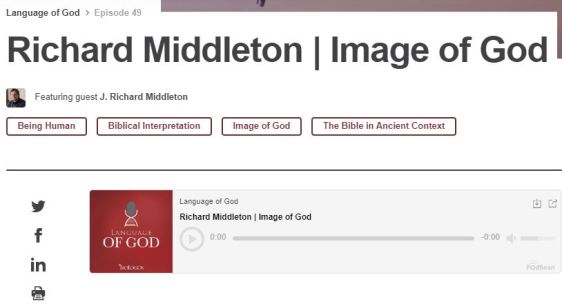
The focus of the interview was a topic dear to my heart—what it means to be made in the image of God (imago Dei).

The podcast page introduces the interview this way:

“We were made in the image of God, but what does that really mean? Whom does that apply to? What does that call us to? The Bible is very central to understanding the answers to these questions, as is cultural context. In this episode, biblical worldview professor, Richard Middleton joins Jim Stump in an attempt to answer some of the questions about human identity through both of those lenses.”

This is some of what Jim Stump said on Facebook about the interview.

“Here we talk about the Bible and science (like what each has to say about Adam and Eve), but mostly focus on his specialty: the image of God. I’m biased and prone to believe what I want to be the case, but I think this is a really interesting conversation.”

You can listen to the full interview here on the BioLogos podcast website.

Although Jim does eventually ask me to speculate on how the imago Dei might relate to the development of Homo sapiens, the interview focuses on what the Bible says about the image in its ancient Near Eastern context and its relevance for living in God’s world. I essentially summarize the main thrust of my book The Liberating Image: The Imago Dei in Genesis 1 (Brazos, 2005).

Prior to the book, I had written a programmatic article on the subject, with almost the same title: “The Liberating Image? Interpreting the Imago Dei in Context,” published in Christian Scholar’s Review 24 (1994): 8–25.

Jim Stump is from the Missionary Church, the same denomination that I was a member of as a teen and young adult in Jamaica. I did my undergraduate degree in theology at the Jamaica Theological Seminary, which was founded in 1960 by the Missionary Church Association of Jamaica. It turns out that Jim had spoken at a 2007 commencement ceremony at my seminary.

Although the image of God is the focus of the BioLogos interview, I also talk a bit about what Jamaica is like (in response to Jim’s questions).

If you are interested in further reflections on the applicability of the imago Dei to matters of ethics and justice, you can read the blog post I was invited to write for the Imago Dei Fund. It is called “The Ethical Challenge of the Image of God in the 21st Century – Human Rights and Beyond.

And if you want to explore a bit more about how the imago Dei (and the Fall) might (I emphasize that word) relate to what we know of the origins of Homo sapiens, I discuss these topics in a presentation I gave for the Canadian and Christian Scientific Affiliation, called “Human Distinctiveness and the Origin of Evil in Biblical and Evolutionary Perspectives.”

God’s Wisdom and the Wonder of Creation—Theology & Science Conference with Bill Brown in Rochester, NY

Some months ago I gave a heads up about a special conference on Scripture, theology, and the sciences that will take place October 25–26, 2019 at Northeastern Seminary, in Rochester, NY.

The conference is co-sponsored by Northeastern Seminary and the Canadian-American Theological Association (CATA).

Northeastern Seminary previously hosted CATA Fall conferences in 2013 and 2017. The Seminary is honored to again host this year’s conference.

Keynote Speaker—William Brown

The keynote speaker is William P. Brown, professor of Old Testament at Columbia Theological Seminary.

Brown will give a public lecture on Friday evening, October 25, on the topic of human evolution and the garden of Eden, entitled: “From Ardi to Adam: The Garden and Human Origins.”

He will present a lecture specifically for conference attendees on Saturday, October 26, on YHWH’s speeches from the whirlwind, entitled “Job, Astrobiology, and the Science of Awe.”

Call for Papers Now Open

Papers proposals are now being solicited for presentation in one of the concurrent paper tracks to be held throughout the day on Saturday, October 26.

We welcome papers from the theological/biblical or the scientific side, especially those that explore intersections of a biblical vision with issues in science.

You may access (and download) the Call for Papers here.

For those who need to plan ahead, the conference opens at 7:00 pm Friday and runs from 8:00 am till 5:00 pm on Saturday.

This promises to be a rich time of interdisciplinary learning and fellowship between Christians (and others) interested in the science-faith dialogue.

Conference registration will be available on the Northeastern Seminary website as the summer progresses.

Other Co-sponsors for This Year’s Conference

Since this year’s conference will address the intersection of Scripture, theology, and the sciences, it is appropriate that the conference will be co-sponsored by three Christian organizations involved in the science-faith dialogue—the Canadian Scientific and Christian Affiliation,  the American Scientific Affiliation, and BioLogos.

What Happens between Death and Resurrection? A Symposium on the Intermediate State

This post was updated April 2019.

On January 17, 2019 I participated in a Symposium on the “intermediate state.” This Symposium explored the question of how best to think about what happens to a Christian between death and resurrection.

Symposium on the Intermediate State: J. P. Moreland and J. Richard Middleton

The Symposium was sponsored by the Carl F. H. Henry Center for Theological Understanding at Trinity Evangelical Divinity School, in Deerfield, IL.

My dialogue partner was philosopher J. P. Moreland, a famous supporter of “substance dualism” (the view that a person is composed of an immaterial soul and a body). He argued for the traditional view that our souls go to be with God (in heaven), awaiting the resurrection.

As a biblical scholar, I presented my position that the Bible doesn’t teach substance dualism, but rather a holistic view of the person, and that Scripture doesn’t clearly explain what happens between death and resurrection. I am therefore agnostic about the intermediate state.

My presentation focused on biblical exposition of these themes, with attention to 2 Corinthians 5:6–8 (absent from the body, present with the Lord) and Luke 23:39–43 (the thief on the cross). These two biblical texts are often taken as teaching an intermediate state. My exegesis of these texts attempted to show that they both address the final resurrection, not an intermediate state.

In the end, I don’t believe that we need to have an explanation of what happens between death and resurrection. It is sufficient to trust that God, who is faithful, will bring those who are in Christ to the resurrection.

The raw video feed of the Symposium is found here.

  • Tom McCall (head of the Henry Center) opens the event at around the 16 minute mark.
  • Steve Matthewson (a local pastor) introduces the topic and the speakers at about the 17 ½ minute mark.
  • J. P. Moreland begins to speak just before the 21 minute mark.
  • My presentation begins at the 43 ½ minute mark. I had slides with some visuals and lots of biblical texts. However, you will see that the projection system wasn’t working properly.
  • The Q&A begins at the 1 hour and 11 ½ minute mark.

Our Focus Should be on the New Creation

My main point was that the intermediate state shouldn’t be the focus of our faith at all. Rather, biblical hope is for embodied resurrection life in the new heavens and new earth.

This is a point I made in my book on eschatology, A new Heaven and a New Earth: Reclaiming Biblical Eschatology (Baker Academic, 2014). In one of the chapters I included an excursus on the intermediate state (it was not central to the book’s argument), and I intended it merely as an exploration of the biblical evidence, not as an argument for a particular viewpoint.

Yet it is interesting that some reviews of my book brought up this excursus, often claiming to disagree with my position, even though my point was simply that there isn’t enough clear biblical evidence for me to affirm an intermediate state. Sometimes I wish  hadn’t put that excursus in at all, since it seemed to sidetrack some readers. But other readers have told me it was important for them.

The Henry Center’s Exploration of Theological Anthropology

I was invited to participate in this Symposium on the intermediate state not primarily because of my work on eschatology, but due to my prior involvement in the Henry Center’s three-year Creation Project.

Each summer the Center has had a conference (the Dabar Conference) on some aspect of the theme of Creation, and I have been involved every year.

In the first two years I was a paper respondent, in 2016 to Old Testament scholar C. John (“Jack”) Collins and in 2017 to philosopher-theologian William (“Billy”) Abraham, two very wonderful scholars, both of whom I was delighted to get to know.

This year I wrote a keynote paper for the Dabar Conference (June 2018), entitled “Death, Immortality, and the Curse: Interpreting Genesis 2–3 in the Context of the Biblical Worldview,” with two respondents (one a biblical scholar, the other a theologian).

The theme of the Creation Project (and thus of the Dabar Conference) this year (2018-19) is Reclaiming Theological Anthropology in an Age of Science.  But the Project extends beyond the Dabar conferences, and involves numerous other events.

It was because of my analysis of human mortality expressed in the Dabar paper (and a shorter version called “Humans Created Mortal, with the Possibility of Eternal Life,” which was published on the Henry Center website) that I was invited to present my views at the upcoming Symposium.

This is the description of the Symposium (along with presenter bios) on the Henry Center website:

The resurrection of the body is one of the central doctrinal claims of the Christian faith. It is also the source of Christian hope when faced with the death of a loved one.

But what happens between now and then? When a child asks their parent where a departed loved one is “now,” how should Christians respond?

Do the souls of those who have died in faith go to be with the Lord now, awaiting to be reunited with their resurrected bodies?

Or are traditional Christian beliefs in an immaterial soul that is separable from the body misplaced—an unscriptural incursion of Platonic metaphysics that has misshaped our expectations of the afterlife?

The discussion will be followed by a pastoral response and extended audience Q&A on the theological and pastoral implications of the different views.

J. P. Moreland (PhD University of Southern California) is a Distinguished Professor of Philosophy at Talbot School of Theology, Biola University. He is the author or editor of over a dozen books, including The Soul: How We Know It’s Real and Why It MattersThe Blackwell Companion to Substance Dualism, and Philosophical Foundations for a Christian Worldview.

J. Richard Middleton (PhD Vrije Universiteit in Amsterdam) is Professor of Biblical Worldview and Exegesis at Northeastern Seminary. He is the author of A New Heaven and a New Earth: Reclaiming Biblical Eschatology, and The Liberating Image: The Imago Dei in Genesis 1.

Date Thursday, January 17, 2019
Time 11am — 12:30pm CST
Location Main Campus

Hinkson Hall

This event was made possible through the support of a grant from Templeton Religion Trust