A New Venture with Global Scholars Canada

I have had a wonderful and fulfilling full-time teaching career, which began some thirty years ago at Colgate Rochester Crozer Divinity School and continued through my move to Roberts Wesleyan University and Northeastern Seminary.

I formally retired from the Seminary in 2024 and have since focused on writing (though as Emeritus Professor I will still teach from time to time).

I am currently working on two books (both are partially complete). One is on the ethics of power in 1 Samuel 1–15 (contracted with Eerdmans). The other is on the liberating worldview of the Scriptures (for Baker Academic); this is a complete rewrite of The Transforming Vision, the book I coauthored with Brian Walsh when we were both graduate students.

Discernment Process

When I retired, I had a clear sense that writing was going to be my major focus (I have three other book contracts beyond the two mentioned above). But I have also been in a period of discernment for new ventures that God might be calling me to.

Here is a somewhat humorous poem I wrote the year before I retired, while on a retreat at the Gell Center in the Finger Lakes (a beautiful rural area south of Rochester, NY where I live). I broke up some of my sentences to mimic my breathing as I climbed uphill.

Uphill All the Way

J. Richard Middleton

Panting and huffing, he lugged
his sixty-eight-year-old frame
over rotting logs, snagging
his foot on a broken limb, stumbled, yet doggedly
kept ascending the steep climb. No
horizon in sight. Just trees, trees as far as vision. Yet
far easier to make out than his future
after retirement. After
twenty-seven years of pouring
his heart out
to indifferent students,
grading mediocre papers (and the odd
brilliant piece), correcting
bad grammar. It was time. Something
new beckoned. If only
he could see what it was.

October 2023
Gell Center, Finger Lakes

Contrary to the poem (which is only partly autobiographical), I’ve had excellent students throughout the years, who have gone on to do wonderful things for God’s kingdom. I’ve had the joy and privilege of keeping in touch with many of them.

Post-Retirement Opportunities

Since retirement, I have kept getting invitations to speak on topics close to my heart for various organizations, and I certainly could just take up such opportunities as they arise. But I have been wondering if there is a more strategic way to use my gifts and academic experience.

Being originally from the Caribbean, I have been especially interested in theological education for the global church. I’ve kept in touch with Jamaica Theological Seminary (where I earned my BTh) and the Caribbean Graduate School of Theology (where I taught while on sabbatical some years back). Both schools have recently contacted me about being involved in a variety of ways, including teaching, faculty development, and integrating a Christian worldview into the curriculum.

I am also a Canadian, having lived fifteen years in Ontario, where I worked as a campus minister and completed two graduate degrees, prior to my teaching career in the USA.

My period of discernment led me to join Global Scholars Canada (GSC), an organization that links Canadian scholars in a variety of fields with opportunities for teaching and mentoring in the Majority World.
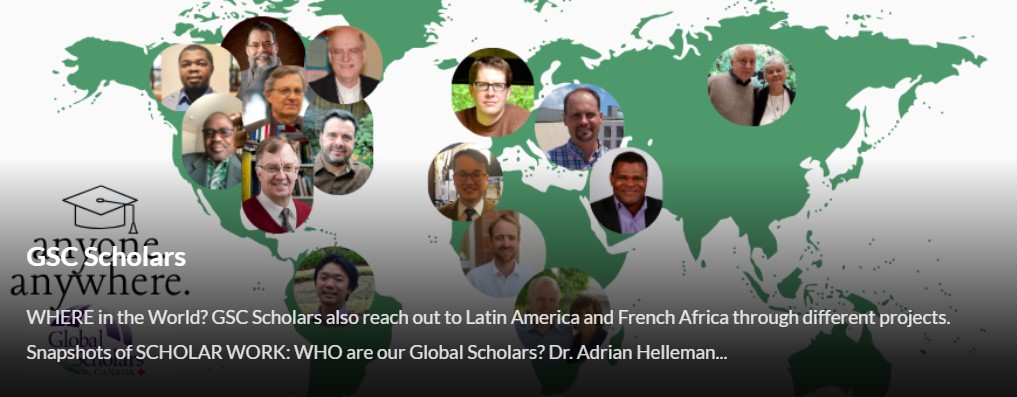
Peter Schuurman, the director of Global Scholars Canada (GSC), wrote a short piece introducing me to the GSC community.

My Vision and Mission

I am hoping to leverage my Canadian and Jamaican experience and my expertise in biblical studies and the Christian worldview to help other scholars, whether in Canada or other countries, bring their faith to bear on their academic vocation in a way that witnesses to God’s kingdom purposes for the redemption of all of life.

I see my mission as raising the level of biblical literacy among Christian academics, but also among pastors and laypeople, by immersing them in serious, yet inspiring and practical, study of Scripture.

My fuller vision and mission statement can be found on my Global Scholars Canada webpage.

I am coming on board Global Scholars Canada as a part-time global scholar. Full-time scholars typically get placed in teaching positions overseas, negotiated between GSC and the hiring institution, with GSC helping to raise funds to supplement what the hiring institution is unable to cover.

Given that I have been ministering “overseas” since I left Jamaica as a young adult, and that I am part-time, my situation is somewhat different. I will be involved in specific short-term assignments that Global Scholars Canada will set up, such as speaking at conferences or mentoring young academics.

Two Specific Assignments

Global Scholars Canada is a partner with the Society of Christian Scholars, an international community of Christian academics that developed from a consultation (some sixteen years ago) of eleven scholars from six countries. The Society has numerous individual and organizational partners and affiliates throughout the world.

One of the affiliates is the Caribbean Network of Christian Scholars.
My very first assignment as a global scholar was an invitation that came through a member of the Caribbean Network, who is the librarian for the Society of Christian Scholars. I will be doing an online presentation for the Society’s Library Reading Group meeting in June 2026. I’ve been asked to introduce the article I wrote for the book of Caribbean theology that I coedited with Garnett Roper some years ago (the article explores a creation theology for the Caribbean).

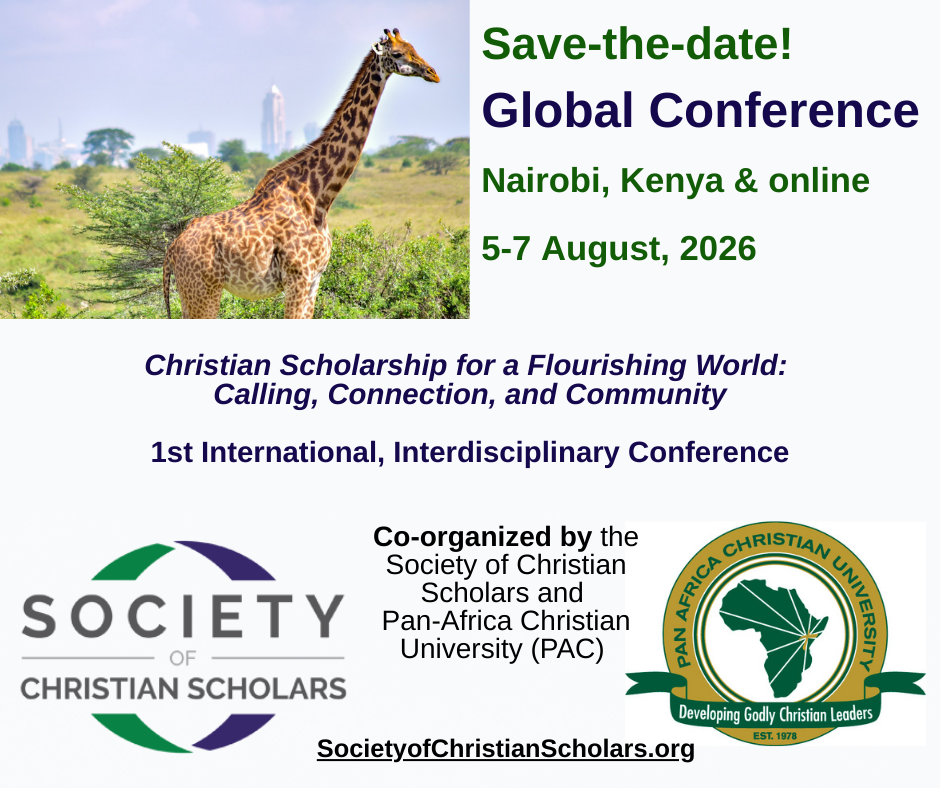
My next assignment will be to give a paper at the first international conference sponsored by the Society of Christian Scholars, which will be held at the Pan-African Christian University in Nairobi, Kenya, in early August 2026. My paper is entitled “The Vocation of the Christian Scholar: A Caribbean Biblical Studies Perspective.”

At the urging of Global Scholars Canada, I will be taking along a younger scholar, Chris Landon (who is currently working on his PhD at McMaster Divinity College), as a mentee. He may also be presenting a paper at the conference.

Although the conference is only a few days, it will be quite an undertaking, given the travel (and recovery) time and the cost of airfare and conference registration (which includes lodging and food).

Fundraising—Something I don’t Usually Do

Global Scholars Canada is committed to covering 90% of the cost of any mentees attending the conference (so they will cover this for Chris). They don’t cover quite as much for their scholars. But I am extremely grateful that their contribution will reimburse about half my expenses. I will need to raise the other half (which comes to about USD 1,100 = CAD 1,500).

Anyone interested in contributing towards these expenses (as charitable giving in the US or Canada), can check out the relevant links below. It will be much appreciated.

The Global Scholars Canada website has a list of different ways to give (online or by cheque) in support of their scholars. The first four ways are for Canadian donations (you just designate the scholar you are supporting).

The fifth way takes you to the website of the Society of Christian Scholars, where you can make a USD donation online or by a mailed check (with the scholar designated).

Newsletter

I will soon be starting a quarterly newsletter, reporting on some of my activities for Global Scholars Canada; if you are interested in receiving this, you can sign up on my GSC webpage (scroll down to the end for the sign-up form).

You’re invited to join me in this new adventure!


Beyond Eurocentrism—A Future for Canadian Biblical Studies

On May 31, 2021 I had the privilege of giving my presidential address to the Canadian Society of Biblical Studies (CSBS). This is something every outgoing president does at the end of their term.

A Delayed Presidential Address

I was in the unusual situation of being president of CSBS for two consecutive years (2019–21), something unprecedented in the eighty-eight year history of the Society (which was formed in 1933). In every previous case, a person is elected to become vice-president for a year, then serves as president for the following year, then gives their presidential address.

However, the COVID-19 pandemic resulted in the cancelation of the 2020 annual meeting, at which we would have had the election of new officers (those whose terms were up) and at which I would have given my presidential address. Without a formal election of new officers, all the elected officers whose term was up continued pro tem until the next annual meeting.

The executive decided that despite the ongoing pandemic we couldn’t go another year without an annual meeting. But because of the pandemic, they decided that the 2021 annual meeting would be purely virtual.

Since I hadn’t been able to give my presidential address in 2020, I gave it (virtually) in 2021.

A Different Presidential Address

However, it was on a different topic from what I had originally planned.

In 2020 I had planned to focus my presidential address on the Aqedah (Genesis 22), in anticipation of the book I was writing, entitled Abraham’s Silence: The Binding of Isaac, the Suffering of Job, and How to Talk Back to God (Grand Rapids: Baker Academic, 2021).

However, new issues arose in the CSBS, along with some external prods, which resulted in me giving a presentation on the past and future of biblical studies in Canada.

In “Beyond Eurocentrism: A Future for Canadian Biblical Studies,” I traced the history of biblical studies in Canada and challenged biblical scholars in Canada to explicitly bring their social and religious context to bear on their academic work, while allowing the Bible to speak to their context.

Here is the abstract of my paper:

The history of Canadian biblical studies, like biblical studies south of the border, has been defined by the attempt to protect academic study of the Bible from religious and ecclesiastical control. Although legitimate in its time, this has resulted in the fictitious ideal of an academic discipline uncontaminated by the contemporary contexts of the interpreter. Not only is such an ideal unattainable (since everyone brings their contexts, explicitly or implicitly, to their academic work), it is ethically problematic, since it has legitimated the Eurocentric orientation of the field as normative, resulting in the marginalization of alternative voices and perspectives.

Thankfully, biblical scholars have begun to take cognizance of how we read the Bible in terms of existential questions arising from our social and ecclesial locations. Besides many publications on the subject of contextual biblical studies over the past thirty years (perhaps beginning with Stony the Road We Trod), the Society of Biblical Literature sponsored two seminars in 2020 called “#Black Scholars Matter.”

Canadian biblical scholars, however, have been slower than our American counterparts to recognize the importance of the interpreter’s context for our field. The question this essay raises is whether we can envision a future for Canadian biblical studies beyond Eurocentrism.

Although I was addressing the Canadian context, I drew significantly on my Jamaican background (including Jamaican traditions of resistance to power) in order to make a particular proposal for the practice of biblical studies in Canada.

You can watch the video of my presidential address here.

The text of the address is being published in the Canadian-American Theological Review. I will post a link here when it is available.

Trusting the Bible and Accepting Evolution—Call me Crazy!

I just returned from Cornell University, where I gave a joint-presentation entitled “Origins, Self, and Soul” with Praveen Sethupathy, a Christian geneticist on the faculty of Cornell.

Our presentation, which addressed biblical and evolutionary perspectives on human origins and identity, was co-sponsored by Chesterton House, a Christian study center near the Cornell campus, and the Cornell Graduate Christian Fellowship.

The implicit question we addressed was whether it is possible to be a faithful Christian and accept an evolutionary account of human origins.

Whereas Praveen brought a scientist’s perspective, my portion of the presentation focused on what the Bible tells us about human commonality with animals and about what it means to be created in God’s image, which is usually taken as something unique to humans.

I wasn’t able to cover very much in the twenty minutes allotted to me.

However, those twenty minutes were part of longer presentation that I have given on the topic of the Bible and evolution, which covered a larger scope.

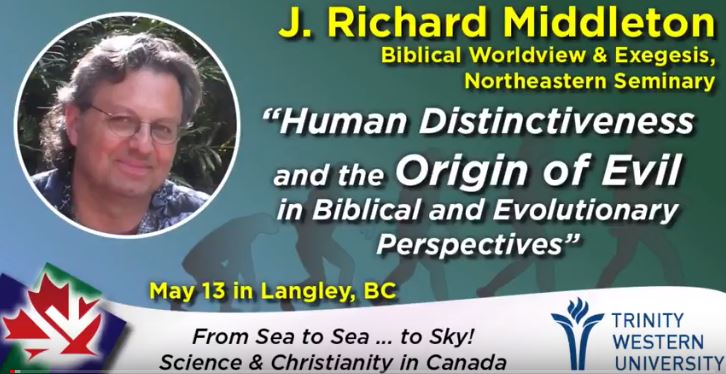
The last time I gave the full presentation was in May 2018, when I participated in a conference sponsored by the Canadian Scientific and Christian Affiliation (CSCA), held at Trinity Western University, in Langley, BC.

I was one of six plenary presenters. The presenters all came from different disciplines and addressed aspects of the intersection of faith and the sciences.

Can We Believe the Bible and Accept Evolution?

As the biblical scholar of the lot, my talk focused on biblical themes. Given the nature of the conference (and my interest in the faith-science interface on matters of origins), I attempted to relate the biblical themes of human distinctiveness and the origin of evil to what the sciences are telling us about our evolutionary origins.

I began by highlighting a number of tensions that Christians have perceived between the Bible and an evolutionary account of human origins. Then I suggested that these tensions are not necessary, but have to do with the way in which we read the Bible.

So I engaged in some serious Bible study.

My talk was videotaped and astutely edited together with my PowerPoint slides. The entire talk (with slides) can be viewed here.

Part 1: Human Distinctiveness

In part 1 of the talk, I addressed how the Bible understands the commonality of humans with other animals (in a variety of creation texts from Genesis, Job, and the Psalms), which suggests that we shouldn’t have an aversion to the idea of common descent. Then I explored the Bible’s teaching about humanity as the image of God (found in Genesis 1:26–28 and related texts). I speculated how the human calling to image God might be related to what science is telling us about human origins.

Part 2: The Origin of Evil

In part 2 of the talk, I focused on the portrayal of the origin of evil in Genesis 2–3, probing the way in which this portrayal is true to human experience and represents a profound phenomenology of temptation and sin. Then I picked up on my earlier speculation about the image of God and evolutionary origins, and added a suggestion for how human evil could have entered the evolutionary process.

I thus did what many Christians claim it is impossible. I attempted to affirm both an evolutionary account of human origins and the biblical teaching on human distinctiveness and a historical fall.

Call me crazy. But I respect God’s revelation in Scripture and God’s revelation in creation, which can be studied by science. I can’t deny either.

In fact, I believe that God is revealed—and glorified—in the evolutionary complexity of the biological world.

Insightful Devotional: “Called to Indwell the Earth”

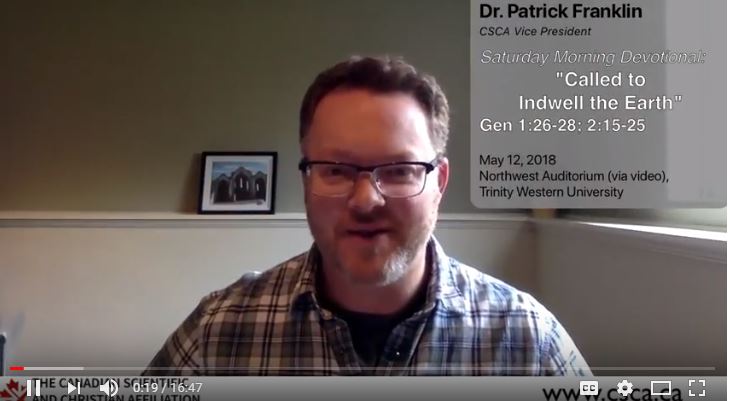
At the conference we had a wonderful devotional one morning given by Patrick Franklin, current vice-president of the Canadian Scientific and Christian Affiliation, and newly appointed associate professor of theology at Tyndale Seminary, in Toronto.

You can watch Patrick Franklin’s talk here.

Recordings of Other Talks at the Conference

You can see the entire conference schedule of keynote speakers and breakout sessions here.

All the keynote talks and some of the breakout sessions were recorded. You can find links to them here.