Meeting up with a Variety of Biblical Scholars in Cheltenham

This is the eighth installment about my speaking in the UK.

After my second talk in Oxford (given at Wycliffe Hall), I got on a bus to Cheltenham, in order to speak on the same topic (biblical eschatology) at the University of Gloucestershire that evening.

My host at the University was well-known Old Testament scholar J. Gordon McConville.

I first met Gordon when I was invited to be the respondent to his keynote address at the Institute for Biblical Research annual meeting in 2013, on the topic of the Bible’s understanding of what it means to be human.

That keynote address ultimately led to his wonderful book called Being Human in God’s World: An Old Testament Theology of Humanity (Baker Academic, 2016). I wrote a short endorsement for the dust jacket, and I have now been asked to write a full-fledged book review for the journal Themelios.

There were some other biblical scholars at my lecture (some of whom I had known before), and we all went out for dinner afterwards (led by Gordon McConville).

Matt Lynch is an Old Testament scholar, who is both Dean of Studies and teaching faculty at the Westminster Theological Centre, with head offices in Cheltenham and learning centres throughout the UK, Channel Islands, and Northern Europe.

Two years ago (May 2015) Matt conducted an online interview (via Google Hangout) with both me and OT scholar William Brown on the topic of “Creation, Violence, and the God of the Old Testament” (the interview can be viewed here).

The morning after my eschatology lecture, I met Matt in a local coffee shop (called the Boston Tea Party, appropriate since Matt is American) where he interviewed me as part of a series of interviews with biblical scholars called On Script.” The interview is available as a podcast either to listen to online or to download.

Matt is the author of Monotheism and Institutions in the Book of Chronicles: Temple, Priesthood, and Kingship in Post-Exilic Perspective (2014). He is currently working on a new book on violence in the Hebrew Bible, which I’m dying to read (one of my MA students who wants to write a thesis on Genesis 4, which is the starting point of the book, is also looking forward to it).

Crispin Fletcher-Louis is an independent scholar, who works on Second Temple (Dead Sea Scrolls) and New Testament materials, with a focus on the imago Dei theme. Among his books are All the Glory of Adam (2001) and Jesus Monotheism, vol. 1: Christological Origins (2016). He is especially interested in how Adam, the High Priest, and Jesus (among others) are portrayed in Jewish and Christian literature as participating in God’s divinity (you can listen to an interview with Crispin about Jesus Monotheism here). While I don’t formulate these ideas in quite the same way, I have found his work helpful, and I cited him in my entry on “Image of God” in vol. 2 of The Oxford Encyclopedia of the Bible and Theology (2015). it was good to meet Crispin in person.

Andrew Lincoln is a senior New Testament scholar who has just retired from teaching at the University of Gloucestershire. I met Andrew back when he was teaching at Wycliffe College, at the University of Toronto (he is a friend of Brian Walsh and Sylvia Keesmaat).

Andrew was probably the most outspoken critic of my eschatology lecture (and he didn’t hesitate to raise questions); I had read his book on Paradise Now and Not Yet (2004) when I was working on my eschatology book, so I expected his questions. He is a prolific author, and has a fascinating recent book on the virgin birth, which I don’t quite agree with. Nevertheless, disagreement doesn’t negate collegiality, and we had a friendly discussion over supper. In fact, my students will know that I have assigned his commentary on the Gospel of John in one of  my biblical exegesis courses over the past few years.

My speaking tour in the UK ended at Trinity College, Bristol, the topic of my final post.

Visiting Tom Wright—A Good Start in Scotland

I drove from Rochester to Toronto on Wednesday and took the overnight flight to Glasgow to begin my two weeks of talks in the UK. I arrived at the Glasgow airport on Thursday morning (9:00 am), with almost no sleep, and was picked up by Tom Wright.

From Glasgow we drove to the Wrights’ home (named the “Hilton Cottage”) just outside of the small town of St. Andrews. It was a bright sunny day and the scenery on the drive was glorious.

Great Conversations with Tom and Maggie

The conversation on the drive was pretty good too!

In fact, one of the highlights of the trip so far (besides my interaction with students and faculty at the University of St. Andrews) was getting to know Tom and Maggie.

Although Tom and I have had lots of sporadic contact over the years (we first met in the mid nineteen-eighties), and we each have found the other’s writings helpful for our own scholarship, this was the first time I was able to have extended conversations with Tom, both about theology and biblical interpretation and about our lives and families.

It was also a delight getting to know Maggie, who is a brilliant amateur photographer—and who, in an amazing coincidence, uses the exact same make and model of camera that I do (a Panasonic Lumix).

Talks at the Logos Institute for Analytic and Exegetical Theology

I gave two talks at the University of St. Andrews (one on biblical eschatology, the other on the theology of lament psalms). Both were well attended by faculty and students, many of whom were in the doctoral program of the Logos Institute. This is an innovative institute with an interdisciplinary doctoral program that tries to integrate analytic theology/philosophy with in-depth biblical studies.

The problem (as many in academia know) is that theologians and biblical scholars often speak what seem to be totally different languages (or discourses), with very little overlap. They often talk past each other.

Biblical scholars often focus on the minutiae of textual and linguistic (or historical) issues to the detriment of thinking about the big theological and ethical claims of Scripture. Theologians, likewise, often engage in the analysis of ideas that are at a far remove from biblical exegesis.

This was a problem I highlighted in the introductory chapter of my book The Liberating Image in relation to the interpretation of the imago Dei. Here is an excerpt from the introduction:

Pretty much all my publications over the years have tried to address this problem by modeling an approach to Scripture that is both exegetically detailed and concerned for theological coherence.

The Logos Institute for Analytic and Exegetical Theology was founded to tackle this problem head on. It is a bold enterprise that seeks to help theological students, especially those trained in the analytic tradition of philosophy, to indwell the particularity of biblical texts and learn to ground their theological analysis in serious, in-depth biblical exegesis.

Although it hadn’t been planned this way, I was perfectly suited to addressing this audience. My training in philosophy at the graduate level (with an MA thesis on the nature of religious language), followed by my subsequent move to Old Testament studies, allowed me to interact with many of the Logos students, taking their concerns seriously.

Although my talks were on what I would describe as biblical theology, I managed in my second talk (having taken the pulse of the audience) to weave in some philosophical analysis (concerning the problem of evil) in relationship to the topic I was speaking on (the lament psalms).

The question time (along with the reception afterward) was very valuable, as I was able to engage students philosophically where they were, while showing the fruitfulness of grounding theology in the careful study of Scripture.

Of Eggs and Chicken Pie

To top it off, I was fed very well by Maggie and Tom, both in local eateries and by their own cooking.

Maggie baked an amazing chicken and leek pie for our supper on Thursday (she nicknamed it her “resurrection pie,” since she hadn’t made it in so long, and also because we had been discussing the meaning of the resurrection); the pie was so amazing that I asked for the recipe.

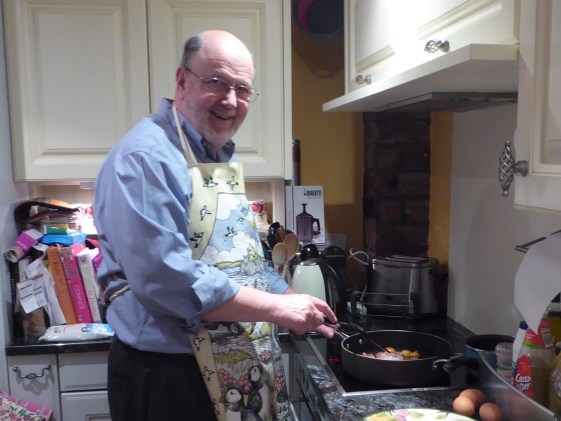
And Tom cooked us bacon and eggs for a late night snack on Friday—he quipped that not many people could produce a photograph like the one below.

All in all, I am grateful to God for the experience so far (including the fact that I managed to get three solid nights’ sleep after the overnight trans-Atlantic flight).

And I am looking forward to heading to the University of Aberdeen with Grant Macaskill tomorrow morning for my lecture there. While there, Grant and I will begin informal talks about a possible doctoral program in theology co-sponsored by Aberdeen and two Jamaican graduate schools that I am affiliated with.

You can read about my trip to Aberdeen here.