Alfredo Valentin is a Nuyorican (a member of the Puerto Rican diaspora in New York city), whose specialty is “urban apologetics.”
This is a genre of apologetics that addresses questions especially relevant to the black and brown Christian demographic who are being targeted for proselytizing by religious groups like the Nation of Islam , the Israelite Church of God in Jesus Christ, or Israel United in Christ. Such groups often play on issues of identity and race, suggesting that orthodox Christianity is a religion of whiteness.
Alfredo tries to educate his listeners in an intelligent way about the claims of genuine Christian orthodoxy, often by interviewing scholars and practitioners in the faith who has particular insight to share about Scripture or theology.
Since one of the primary issues in urban apologetics is identity (Who are we? and What is our purpose in life?), the topic of the image of God is directly relevant.
Having written a book on the image of God (The Liberating Image), as well as various articles and blog posts on the subject, I’m looking forward to the conversation.
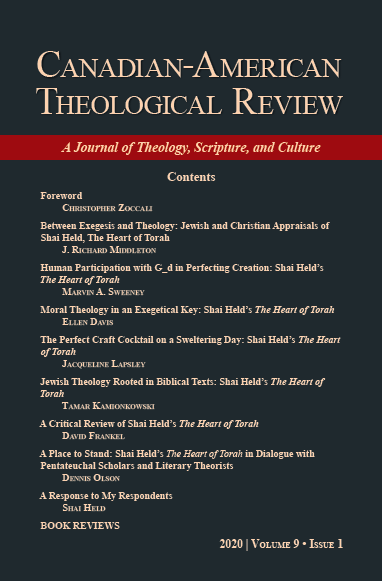
The latest issue of the Canadian-American Theological Review (the journal of the Canadian-American Theological Association) has just been published. This is a theme issue, which collects the papers presented in a panel discussion at the Society of Biblical Literature last year (November 2019) on Shai Held’s two-volume work, The Heart of Torah, (Jewish Publication Society, 2017). These papers were given by Jewish and and Christian biblical scholars.
Although it hadn’t been planned that way, the presentations (hence the published essays) all focused, in one way or another, on the question of the relationship of biblical exegesis to theology. Or, to put it in Jewish terms, the relationship between peshat (literary-contextual readings of the Bible) and midrash (readings that go beyond the intent of text, in order to explore contemporary significance).
While all the articles are agreed that these are both legitimate approaches to the Bible, there is some disagreement about how these should be related, and Held’s response addresses this issue head on.
This has a parallel with recent discussion among Christian biblical interpreters about the value of the “Theological Interpretation of Scripture” and whether this is at odds with historical-critical study of the Bible. For an excellent discussion of why these two shouldn’t be severed, see Joel Green’s essay, “Rethinking ‘History’ for Theological Interpretation,” published in the Journal of Theological Interpretation (2011).
An Introduction to Shai Held
Rabbi Shai Held is Dean and Chair of Jewish Thought at the Hadar Institute, an ecumenical egalitarian study center in New York City that he helped found in 2006, along with Rabbis Elie Kaunfer and Ethan Tucker.
My initial introduction to Shai Held was in January 2015 when he contacted me to discuss the imago Dei in Genesis 1, in preparation for a public lecture he was going to give on human dignity and police violence against African Americans. He had read my book The Liberating Image and wanted to clarify some aspects of the interpretation. We first communicated by email, then had a telephone conversation on the topic.
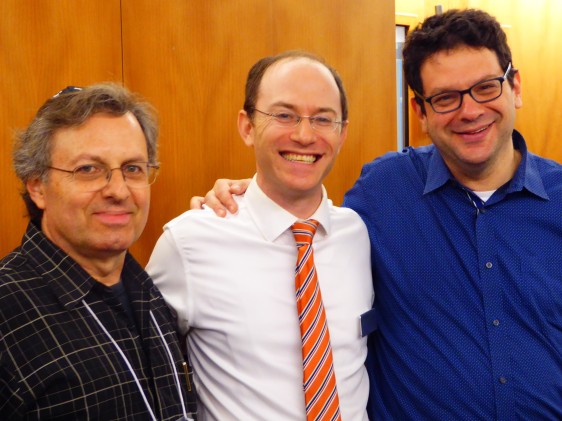
Middleton with Rabbis Elie Kaunfer and Shai Held at Hadar, July 2016
Shai Held (son of Ugaritic scholar Moshe Held) has written an in-depth study of the theology of Abraham Heschel (Abraham Joshua Heschel: The Call of Transcendence) that explores the complexity of his thought. This is his published dissertation, written under the supervision of Jon D. Levenson at Harvard.
Along with approximately 7,000 others, I subscribed to receiving these essays every week by email; and I have been profoundly moved by Held’s insights. So when I found out that the essays would be published in a two-volume collection, I contacted a number of Christian biblical scholars to join me in writing endorsements for the publication.
The essay has been published in a volume of twenty-five essays that I co-edited with Doug Cullum, the Vice President and Dean of Northeastern Seminary. This volume is a Festschrift in honor of our retired colleague Paul Livermore, one of the founding faculty members of the Seminary—indeed, the person who first came up with the vision to start the Seminary.
Paul Livermore retired in 2013, after thirty-three years of faithful service to both Roberts Wesleyan College and Northeastern Seminary. This short video commemorates his life and ministry at both institutions.
The video is interspersed with Livermore’s comments. Three things he says stand out to me.
One is his comment that in a given class lecture, only one-tenth of what a professor knows is visible (often it is students’ questions that uncover some of the hidden nine-tenths). This was very true for Paul, who had an amazing wealth of knowledge about a wide range of subjects.
Another is that hell for a professor would be a huge stack of bad student papers to grade (how honest can you get!). But that heaven would consist in reading some really excellent papers.
The third thing I note about Paul is that there is a recording of his reciting the Shema (Deuteronomy 6:4–9), which plays over the opening video scenes; this shows how deeply grounded he has always been in the Old Testament.
The title of the Festschrift is Orthodoxy and Orthopraxis, which suggests something of the range of intellectual and practical interests that have characterized Paul Livermore throughout his career. These interests have spanned theological scholarship (in different academic disciplines) and a commitment to the life of the church.
Although he started out teaching Biblical Studies at Roberts Wesleyan College, Livermore eventually became an expert in Patristic theology. As someone in the Wesleyan theological tradition, he was drawn to the Church Fathers (especially the Eastern Fathers, as John Wesley himself had been) and he crafted an influential interdisciplinary course at Northeastern Seminary that addressed the development of doctrine, spirituality, and the church in the centuries after the New Testament.
Originally called “The Formative Era,” the course is now called “Being Christian,” and focuses on the attempt of the early church to clarify what it meant to be Christian in the first few centuries of the Common Era.
Since Livermore retired, the course has been taught by Dr. Rebecca Letterman and (in its current configuration) by Dr. Josef Sykora. The Seminary offers this course as part of six foundational courses, called The Great Conversation.
Contributors and Essays in the Festschrift
Paul Livermore’s impact on a range of faculty colleagues, church leaders, and students is confirmed by the wide variety of essays in the volume, which span Old and New Testament studies, theology, history, pastoral ministry, the Apocrypha, and the ancient Near East.
The essays are grouped into three sections:
Part 1: Grappling with Scripture in Ancient and Contemporary Contexts (eleven essays).
Part 2: Insights from the History of the Church (nine essays).
Part 3: Exploration and Reflections—Theological and Otherwise (five essays).
There are essays by current and former faculty at Northeastern Seminary and Roberts Wesleyan College, including:
Jeffrey Altman (Professor of Psychology, Emeritus, Roberts Wesleyan College)
David Basinger (Professor of Philosophy at Roberts Wesleyan College and Northeastern Seminary, and Chief Academic Officer, Roberts Wesleyan College)
Douglas Cullum (Professor of Historical and Pastoral Theology, Vice-President and Dean, Northeastern Seminary)
Timothy Dwyer (Professor of Bible and Ministry, Chair of the Ministry Department, Warner University)
Elizabeth Gerhardt (Professor of Theology and Social Ethics, Northeastern Seminary)
Rebecca Letterman (Professor of Spiritual Formation, Northeastern Seminary)
Wayne McCown (Provost Emeritus of Roberts Wesleyan College and Founding Dean Emeritus of Northeastern Seminary)
J. Richard Middleton (Professor of Biblical Worldview and Exegesis, Northeastern Seminary)
There are essays by past students of Paul Livermore, including:
David Belles (Academic Dean, International Fellowship of Christian Assemblies Bible College, Richmond Heights, OH)
T. L. Birge (Assistant Professor of Biblical Studies, Azusa Pacific University)
Margaret Flowers (Professor Emerita of Biology, Wells College, Aurora, NY)
Joel H. Hunt (author, Athens, GA)
Mark McMonagle (Vicar, St Brendan Orthodox Mission, Honeoye Falls, NY)
John Miller (Professor and Program Chair, Elim Bible Institute and College, Lima, NY)
Linda Schwab (Professor Emerita of Chemistry, Wells College, Aurora, NY)
Louis Stulman (Professor of Religious Studies, University of Findlay)
Thomas Worth (Pastor, Community Covenant Church, Manlius, NY)
There are also essays by colleagues of Paul Livermore from various academic and church contexts, including:
Donald Bastian (Bishop Emeritus of the Free Methodist Church)
Joseph Coleson (Professor of Old Testament, Emeritus, Nazarene Theological Seminary)
Eugene Lemcio (Professor Emeritus of New Testament, School of Theology, Seattle Pacific University)
James McNutt (Professor of History and Chair of the Department of History, Thomas More University)
Frank Anthony Spina (Professor Emeritus of Old Testament, Seattle Pacific Seminary and School of Theology, Seattle Pacific University)
James Sweeney (J. Russell Bucher Professor of New Testament, Director of the Master of Divinity Program, Winebrenner Theological Seminary)
Karen Winslow (Professor of Biblical Studies, Chair of Biblical and Theological Studies, Director of Master of Arts in Theological Studies, Azusa Pacific Seminary)
In the video commemorating Paul Livermore’s retirement, he mentions teaching Hebrew in his first semester at Roberts Wesleyan College and the extremely bright students he had in the class. Two of his brightest students (who went on to do doctoral work in Old Testament and ancient Near Eastern Studies), were Louis Stulman and Joel Hunt. I don’t know if they were in that particular Hebrew class, but Stulman’s essay on the Hebrew Bible as trauma and resistance literature and Hunt’s essay on the meaning of an ancient Mesopotamian prayer are included in the Festschrift.
Livermore’s deep connection to the Old Testament and the Jewish tradition is evident in a 1987 article he wrote for the Wesleyan Theological Journal, where he challenged various Christian stereotypes about “legalism” and Jewish understandings of the Law/Torah. The article title is taken from a comment Rabbi Akiva makes about the Torah as the “precious instrument” (klî ḥemdah, also translated “precious vessel” or “desirable instrument) in Pirkei Avot 3:14 (Pirkei Avot or “Chapters of the Fathers” is a collection of ancient Rabbinical teaching on various ethical subjects).
Various of Livermore’s colleagues from other academic contexts have also contributed essays in Old Testament, the Apocrypha, and Judaism.
These include Joseph Coleson, who probes beneath the idea of “covenant” to a more foundational relationship between God and his people in the Bible; Eugene Lemcio, who engages in an eschatological reading of “Bel and the Dragon” (in the Apocrypha); James McNutt, who exposes the anti-Judaism in the writings of biblical scholar Adolf Schlatter; Frank Anthony Spina, who addresses the irony of reading Joshua as a Christian text; and Karen Winslow, who explores the understanding of the Akedah (Genesis 22) among Second Temple Jews.
And then there are all the essays on New Testament, church history, spirituality, ethics, and beyond!
These essays pay tribute to the multidisciplinary impact of Paul Livermore, founding faculty member and Professor Emeritus of Northeastern Seminary at Roberts Wesleyan College.
Orthodoxy and Orthopraxis is a book well worth owning, with essays to be mulled over and savored.
Endorsements and Reviews
Brian T. Hartley, Vice President for Academic Affairs and Professor of Theology at Greenville University:
“Paul Livermore’s deep influence over three generations of students can be clearly discerned through these twenty-five essays that span key refrains in Scripture, theology, and church history. Dr. Livermore’s character, passion, and vision for bridging the divide between church and academy all receive clear witness through probing pieces that explore central themes which lay at the heart of his own scholarship and teaching.”
David W. Kendall, Bishop Emeritus, Free Methodist Church-USA:
“I have known and worked with Dr. Paul Livermore for nearly forty years. I regard him as both friend and mentor, scholar and learner, accomplished and humble, and a lover of God and people. I am pleased to commend this volume as a fitting tribute to the breadth and depth of Paul’s character and influence for so many of us—his students, colleagues, and friends.”
Deana L. Porterfield, President, Roberts Wesleyan College and Northeastern Seminary:
“This collection weaves together multiple voices to create a beautiful tribute to the deep impact of the life and teaching of Dr. Paul Livermore. It is an accessible but rich compilation focused on his commitment to the cause of Christ through scholarship, teaching, and service to the church. Each author magnifies an aspect of Dr. Livermore’s insights, through their own lens of scholarship, to honor a life and mind dedicated wholly to God.”



 CREATION to ESCHATON