This is the seventh installment about my speaking tour in the UK.
In between my two visits to Oxford I spent the day in Cambridge.

I gave a lunchtime lecture at the Faraday Institute for Science and Religion at Cambridge University (housed in St. Edmund’s College), as part of their bi-weekly series of Research Seminars on various topics relating to science and Christian faith.

Most of my other lectures in the UK were presented to divinity students and faculty at various universities and in a few cases to wider audiences that included non-academics.
Those lectures were all related to my teaching and research on the Bible, deriving either from my published writings (A New Heaven and a New Earth) or from material I am currently working on for publication (the lament psalms, Genesis 22, and Job).
My lecture at the Faraday Institute was a bit different; my assigned topic of how the early chapters of Genesis might relate to an evolutionary account of human origins (“Human Distinctiveness and the Origin of Evil in Biblical and Evolutionary Perspective”) was quite new to me; I’ve only begun thinking about this issue in the last few years.
The audience for the lecture was also different, being composed of scientists, theologians, and students, including people of different religious faiths, and even some skeptics.
This was the largest group I spoke to on my entire UK trip. Whereas some of the academic audiences I addressed were as small as 15 or 20, the Faraday organizers told me they counted 99 people in the audience, the largest turnout they had in recent memory for one of their seminars.
You can read a brief summary of part 1 of the talk (on human distinctiveness in the Bible) or listen to (and watch) the full talk (on human distinctiveness and the origin of evil) on Faraday’s Science and Belief website.
In the Faraday lecture I was representing BioLogos, an organization in the US that tries to help Christians see the harmony between science and faith, especially focusing on how we might understand evolution as the way that God has worked in the created order.
I became a BioLogos theology fellow in 2016, tasked with writing a number of blog posts on issues relating to biblical interpretation and evolution. I was also asked to become a member of BioLogos Voices, which is their Speaker’s Bureau (I am one of the speakers listed under Bible and Theology).
My approach in the Faraday lecture (which has also been my approach in my BioLogos blogs) was to use my expertise as an Old Testament scholar to help the audience notice what the relevant Scriptures were saying about the topic at hand, and then speculate (tentatively) on how this might connect with what we know about human evolution.
I had very diverse questions from people of different faith stances; I can only hope that my exposition of Scripture helped those in the audience (Christian or otherwise) realize the rich resources of the Bible, when it is taken seriously and read carefully.
Some Interesting People That I Met
Keith Fox is Associate Director of The Faraday Institute and Professor of Biochemistry at the University of Southampton. He was my initial contact with Faraday and the person who decided on the topic of my lecture (from the options that I suggested).
Jennifer Wiseman works for the National Aeronautics and Space Administration (NASA) as the Senior Project Scientist for the Hubble Space Telescope (having previously headed the Goddard’s Laboratory for Exoplanets and Stellar Astrophysics); I had previously met her at a BioLogos conference in the US. She was at the University of Cambridge to work on a short-term research project in astrophysics and was the next speaker for the Faraday Research Seminars, two weeks after my lecture.
Hilary Marlow, Lecturer in the Faculty of Divinity at University of Cambridge, is an Old Testament scholar well-known for her work on ecology in the prophetic literature. She is one of the editors of the forthcoming Oxford Handbook of Bible and Ecology, for which I wrote an essay on “The Image of God in Ecological Perspective.” I met Hilary last November when she gave the keynote address on ecology and justice at the 2016 meeting of the Ecological Ethics and Biblical Studies research group of the Institute for Biblical Research (I will be giving the keynote address on ecology and hope at the 2017 meeting).

Fox, Middleton, Weisman, and Marlow
Ruth Bancewicz, a biologist, is a Senior Research Associate at The Faraday Institute, who also writes for BioLogos. After my lecture Ruth interviewed me for the Science and Belief blog, which she is in charge of. The interview (both print and audio) can be accessed on the Science and Belief website. Ruth told me that the interview had been requested by the editor of The War Cry, a Christian newspaper in the UK published by the Salvation Army (since 1879). Unlike many Christian organizations in North America, it looks like the Salvation Army in the UK isn’t afraid of evolution!
Daniel Weiss is Polonsky-Coexist Lecturer in Jewish Studies, in the Faculty of Divinity at the University of Cambridge. After my Faraday lecture, Daniel took me aside and chatted enthusiastically about his work on biblical interpretation and the Jewish intellectual tradition. I was pleasantly surprised when he affirmed that my analysis of humanity as the image of God (in The Liberating Image) was helpful for his own work.
The Work of Michael Faraday
And now a word about Michael Faraday, the nineteenth-century English Christian (1791-1867) for whom The Faraday Institute is named. Although he had almost no formal schooling, Michael Faraday became fascinated with science in his teenage years and became an important experimental scientist as a young man. He was the first to demonstrate the relationship of electricity to magnetism, and he developed the first electric motor. Later on he demonstrated the connection of electromagnetism to light. In 1825 Faraday instituted a series of Christmas lectures on science for the public that continue to this day.
In the plane on the way home, I happened to watch a special episode of Cosmos (the science TV series) on Michael Faraday; it was quite inspiring.
After my time in Cambridge and Oxford I traveled to Cheltenham to speak at the University of Glouchestershire, which is the topic of my next post.


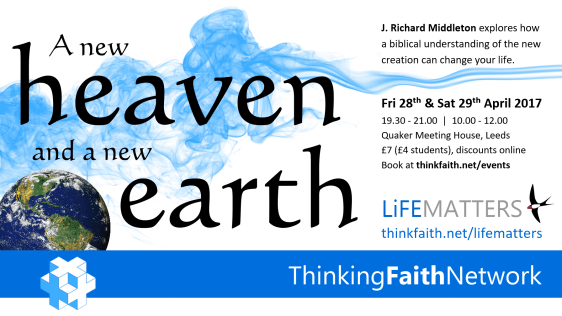 My talks for the Thinking Faith Network on this visit were on eschatology (tracing the motif of the image of God from creation to consummation), and the lament psalms (as a resource for addressing suffering).