Visiting Tom Wright—A Good Start in Scotland

I drove from Rochester to Toronto on Wednesday and took the overnight flight to Glasgow to begin my two weeks of talks in the UK. I arrived at the Glasgow airport on Thursday morning (9:00 am), with almost no sleep, and was picked up by Tom Wright.

From Glasgow we drove to the Wrights’ home (named the “Hilton Cottage”) just outside of the small town of St. Andrews. It was a bright sunny day and the scenery on the drive was glorious.

Great Conversations with Tom and Maggie

The conversation on the drive was pretty good too!

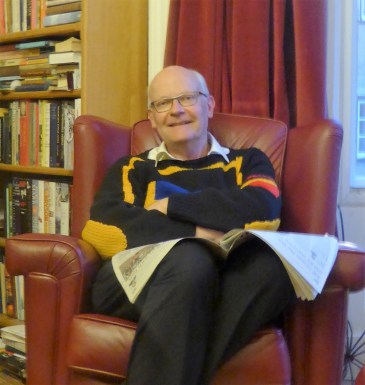
In fact, one of the highlights of the trip so far (besides my interaction with students and faculty at the University of St. Andrews) was getting to know Tom and Maggie.

Although Tom and I have had lots of sporadic contact over the years (we first met in the mid nineteen-eighties), and we each have found the other’s writings helpful for our own scholarship, this was the first time I was able to have extended conversations with Tom, both about theology and biblical interpretation and about our lives and families.

It was also a delight getting to know Maggie, who is a brilliant amateur photographer—and who, in an amazing coincidence, uses the exact same make and model of camera that I do (a Panasonic Lumix).

Talks at the Logos Institute for Analytic and Exegetical Theology

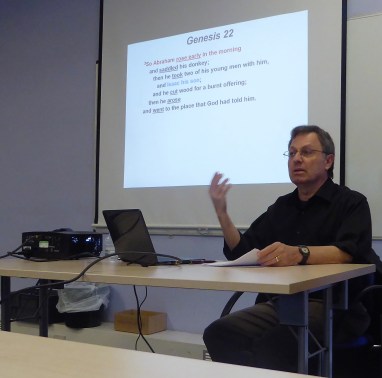
I gave two talks at the University of St. Andrews (one on biblical eschatology, the other on the theology of lament psalms). Both were well attended by faculty and students, many of whom were in the doctoral program of the Logos Institute. This is an innovative institute with an interdisciplinary doctoral program that tries to integrate analytic theology/philosophy with in-depth biblical studies.

The problem (as many in academia know) is that theologians and biblical scholars often speak what seem to be totally different languages (or discourses), with very little overlap. They often talk past each other.

Biblical scholars often focus on the minutiae of textual and linguistic (or historical) issues to the detriment of thinking about the big theological and ethical claims of Scripture. Theologians, likewise, often engage in the analysis of ideas that are at a far remove from biblical exegesis.

This was a problem I highlighted in the introductory chapter of my book The Liberating Image in relation to the interpretation of the imago Dei. Here is an excerpt from the introduction:

Pretty much all my publications over the years have tried to address this problem by modeling an approach to Scripture that is both exegetically detailed and concerned for theological coherence.

The Logos Institute for Analytic and Exegetical Theology was founded to tackle this problem head on. It is a bold enterprise that seeks to help theological students, especially those trained in the analytic tradition of philosophy, to indwell the particularity of biblical texts and learn to ground their theological analysis in serious, in-depth biblical exegesis.

Although it hadn’t been planned this way, I was perfectly suited to addressing this audience. My training in philosophy at the graduate level (with an MA thesis on the nature of religious language), followed by my subsequent move to Old Testament studies, allowed me to interact with many of the Logos students, taking their concerns seriously.

Although my talks were on what I would describe as biblical theology, I managed in my second talk (having taken the pulse of the audience) to weave in some philosophical analysis (concerning the problem of evil) in relationship to the topic I was speaking on (the lament psalms).

The question time (along with the reception afterward) was very valuable, as I was able to engage students philosophically where they were, while showing the fruitfulness of grounding theology in the careful study of Scripture.

Of Eggs and Chicken Pie

To top it off, I was fed very well by Maggie and Tom, both in local eateries and by their own cooking.

Maggie baked an amazing chicken and leek pie for our supper on Thursday (she nicknamed it her “resurrection pie,” since she hadn’t made it in so long, and also because we had been discussing the meaning of the resurrection); the pie was so amazing that I asked for the recipe.

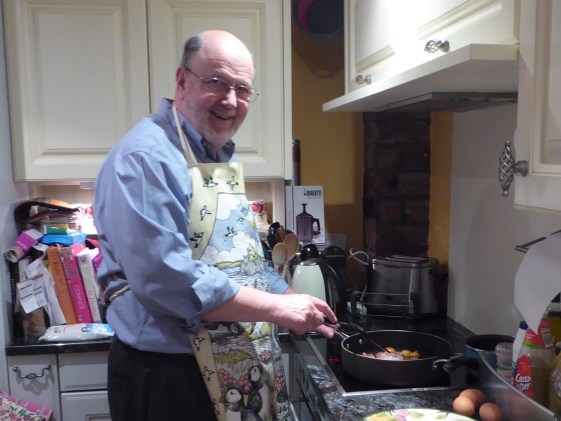
And Tom cooked us bacon and eggs for a late night snack on Friday—he quipped that not many people could produce a photograph like the one below.

All in all, I am grateful to God for the experience so far (including the fact that I managed to get three solid nights’ sleep after the overnight trans-Atlantic flight).

And I am looking forward to heading to the University of Aberdeen with Grant Macaskill tomorrow morning for my lecture there. While there, Grant and I will begin informal talks about a possible doctoral program in theology co-sponsored by Aberdeen and two Jamaican graduate schools that I am affiliated with.

You can read about my trip to Aberdeen here.

A Speaking Tour in the United Kingdom

I am getting ready to head to the UK to give a series of lectures, mostly on eschatology (but with a few other topics included as well). The first stop is in Scotland, with most of my time spent moving southward through England.

I was initially invited by folks who run the Thinking Faith Network (in Leeds) to speak on the topic of my eschatology book, A New Heaven and a New Earth. Given that I would be coming all the way across the Atlantic, they worked out a series of other speaking events for me in the UK.

It is a bit of a grueling schedule, so I would appreciate prayers from anyone who feels so led, both for my sustained energy and that my talks would be helpful to those in attendance.


If you are going to be in the areas where I’m speaking, you are invited to attend any of the public lectures.

So far the following locations and events have been confirmed.

St. Andrews

Two public lectures sponsored by the Logos Institute for Analytic and Exegetical Theology and the School of Divinity (St. Mary’s College), at the University of St. Andrews.

  • April 20 – “A New Heaven and a New Earth: For God So Loved the World.” Thursday afternoon lecture (4:00 pm), Lecture Room 1, St. Mary’s College, University of St. Andrews.
  • April 21 – “Voices from the Ragged Edge: The Gritty Spirituality of the Psalms for a Broken World.” Friday afternoon lecture (4:00 pm), Lecture Room 1, St. Mary’s College, University of St. Andrews.

Aberdeen

Durham

  • April 25 – “Unbinding the Aqedah from the Straightjacket of Tradition: An Inner-Biblical Interpretation of Abraham’s Test in Genesis 22.” Old Testament research seminar for postgraduate students in the Department of Theology and Religion, Tuesday afternoon (4:00-5:30 pm), Seminar Room C, Abbey House, Palace Green, Durham University.

Mirfield

Leeds

Two public lectures in the Life Matters series, Thinking Faith Network, Leeds. Click here for a flier about both talks.

  • April 28 – “Why Are We Here? Our Sacred Calling in God’s World.” Friday evening lecture (7:30-9:00 pm),  Quaker Meeting House, 188 Woodhouse Lane, Leeds.
  • April 29 – “Voices from the Ragged Edge: The Gritty Spirituality of the Psalms for a Broken World.” Saturday morning lecture (10:00 am-12:00 noon), Quaker Meeting House, 188 Woodhouse Lane, Leeds.

Oxford

Cambridge

Oxford

Cheltenham

  • May 3 – “A New Heaven and a New Earth: For God So Loved the World.” Wednesday evening public lecture (6:00-7:30 pm), University of Gloucestershire, Room TC001, Francis Close Hall Campus, Swindon Rd., Cheltenham. You can download a flier here.

Bristol

Evangelical Theology—Challenges and Opportunities

Many theologians, pastors, and lay people who have used the term “Evangelical” to describe themselves recently have become quite wary of the designation.

This is largely due to the way the media has hijacked the term to describe a certain segment of the American population who are typically identified with a narrow range of political and ideological views.

But “Evangelical” was not always a term with such a narrow meaning.

On October 20-21, 2017 (Friday evening, all-day Saturday) Northeastern Seminary will host a theology conference to explore the full-orbed meaning of “Evangelical.” This conference will be co-sponsored with the Canadian-American Theological Association.

Our keynote speaker will be Dr. Richard Mouw, Professor of Faith and Public Life at Fuller Theological Seminary (where he previously served as President for twenty years).

Dr. Mouw is the author of numerous books, including Uncommon Decency: Christian Civility in an Uncivil World (rev. ed. IVP, 2010), Called to the Life of the Mind: Some Advice for Evangelical Scholars (Eerdmans, 2014), and his autobiography, Adventures in Evangelical Civility: A Lifelong Quest for Common Ground (Brazos, 2016).

Dr. Mouw’s will give two lectures on the theme of the conference: Evangelical Theology: New Challenges, New Opportunities.

These lectures will explore the continuing value of the term “Evangelical” in the twenty-first century, while tracing the history of its meaning and usage over the past hundred years.

  1. A public lecture on Friday evening, October 20: New Challenges for Evangelical Theology
  2. The keynote lecture for the conference on Saturday, October 21: New Opportunities for Evangelical Theology

Besides Dr. Mouw’s lectures, we are expecting to have a wide range of papers related to the conference theme.

Our first such conference in 2013, on New Creation, had 65 papers presented; and our more recent conference in 2016, on Participation in God’s Mission, had 45 papers.

Interested scholars, pastors, and students are invited to propose papers for the conference. You may download the call for papers here. The deadline for proposals is June 1, 2017.

Once the conference program is decided, further information will be made available on the dedicated Northeastern Seminary website for the conference. The site will include online registration as we get closer to the conference.

Graduate students, post-docs, and pre-tenured faculty are invited to submit finished papers by September 15 for the Jack and Phyllis Middleton Memorial Award for Excellence in Bible and Theology.

In a follow-up post, I will describe something of the history and mission of the conference co-sponsor, the Canadian-American Theological Association, which began in 1990 (under the name the Canadian Evangelical Theological Association) specifically as an alternative to the narrowness of the way “Evangelical” was being used in the USA.