Embracing Evolution: How Understanding Science Can Strengthen Your Christian Life

I just received from InterVarsity Press a copy of Embracing Evolution: How Understanding Science Can Strengthen Your Christian Life (IVP Academic, 2020), by Matthew Nelson Hill.

Matt Hill is a graduate of Roberts Wesleyan College (double major in psychology and in philosophy and religion). He went on to do an MDiv at Asbury Theological Seminary and a PhD in philosophy at Durham University. Matt is ordained in the Free Methodist Church and currently serves as associate professor of philosophy in the theology department of Spring Arbor University.

I have known Matt’s father, Nelson Hill, who was a faculty member and administrator at Roberts, before he retired, and I came to know Matt on his many visits to Rochester over the years.
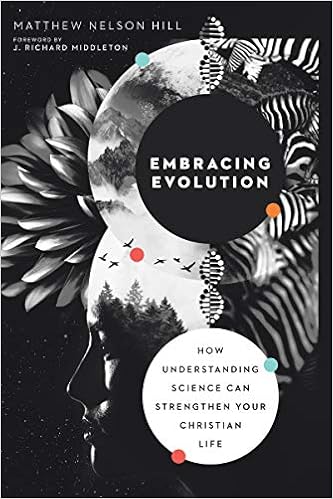
Embracing Evolution is a beautifully articulate and helpful book that builds on the more technical book Matt wrote for IVP called Evolution and Holiness.

The IVP website says that the official release date for Embracing Evolution is June 16, 2020. I received an advance copy because I wrote the Foreword to the book (I had read Matt’s earlier book and benefited greatly from it).

In the Foreword (which is reproduced below), I recount some of my own journey towards reconciling the Bible and evolutionary science. This version of the Foreword has some extra footnote references (not all of which appear in the published format).


Foreword to Embracing Evolution

Many Christians today are on a journey of understanding, trying to make sense of evolution in light of their faith. This is particularly difficult to do in our polarized cultural climate in North America, where religion and science are often portrayed as opposed to each other.

For that reason I am delighted to be able to write this Foreword to Matt Hill’s Embracing Evolution. Whereas many books on Christian faith and evolution either view the two as antithetical to each other or struggle to make significant connections between them, Embracing Evolution shows that understanding human evolution can be positively helpful for Christians seeking to be faithful to Jesus Christ.

My Journey of Understanding the Bible and Science on Origins

Unlike those Christians who started out as young earth creationists and became convinced of the validity of biological evolution later in life, I have no memory of ever dismissing evolution as fundamentally incompatible with biblical faith. Having become a Christian at a young age, I not only accepted, in my teenage years, that the earth was very old (based on what seemed to be reasonable scientific research), but as a young adult I read widely about the evolution of Homo sapiens and our various hominin relatives.

Thankfully, my home church in Kingston, Jamaica (Grace Missionary Church) never insisted on young earth creationism. And when I began my undergraduate studies at Jamaica Theological Seminary, I took two courses in my first semester that made such a view of creation untenable.

The first was a course on the Pentateuch, where one of the textbooks assigned was Bernard Ramm’s The Christian View of Science and Scripture.[1] Here I found an evangelical theologian outlining multiple views of how the Bible related to a variety of scientific issues. Although Ramm articulated his own opinion on the issues he discussed, he noted that there was no single obvious “biblical” answer for questions such as the age of the earth, the great flood, or even evolution. In each case, this was a matter, not of biblical authority but of scientific evidence.

I also took a course in my first undergraduate semester on hermeneutics or biblical interpretation, where the textbook was A. Berkely Mickelson’s Interpreting the Bible.[2] While this was a bit of a dense read for an eighteen-year-old, I never forgot Mickelson’s point that since there was no human observer at creation and since the eschaton is still future, biblical language describing the beginning and end must be largely figurative; these descriptions inevitably transcended human experience.[3] Therefore, just as it would be inappropriate to read eschatological imagery in the book of Revelation as a journalistic account of what a movie camera might record (which seemed obvious to me), I came to realize that it would likewise be a misreading of Genesis to treat the six days of creation as a scientific account of origins.

These two courses at the start of my theological studies combined to convince me that there was no conflict, in principle, between science and the Bible on the question of origins. More than that, these courses (along the rest of my seminary education) encouraged me to be open to the scientific exploration of God’s world.

During my undergraduate studies I was also developing an interest in a holistic theology that affirmed the goodness of creation (in the beginning) and God’s intent to redeem the cosmos (in the end).[4] By the time I graduated with my bachelor of theology degree, I was on a track to take seriously what the sciences were telling us about how this world, including biological life, came to be.

Cognitive Dissonance about Evolution

Then as a graduate student in philosophy, while working as a campus minister for InterVarsity Christian Fellowship at the University of Guelph, in Canada, I found myself avidly reading books on hominin evolution—including Lucy, the account of the discovery of Australopithecus afarensis (nicknamed Lucy) by Donald Johanson and Maitland Edy.[5]

Although I had no real doubts about the scientific evidence for evolution, including the evolution of Homo sapiens, I was somewhat troubled that evolution didn’t seem compatible with the biblical notion of the fall, the origin of evil recounted in Genesis 2–3. I had always been taught that this text portrays Adam and Eve (an original couple) forfeiting a primal paradisiacal state through a single act of disobedience, which led to the introduction of death for both humans and the natural world. I couldn’t get my head around how this might fit with what scientists claimed about human evolution, including the obvious fact that animal and plant death preceded the origin of humanity on earth. So I did what many Christians do when confronted with cognitive dissonance—I put it out of my mind and concentrated on other things.

In my case, these other things were my graduate studies, first a master’s degree in philosophy and then course work in Old Testament, followed by a doctoral dissertation on humans as imago Dei in Genesis 1 (published as The Liberating Image: The Imago Dei in Genesis 1).[6]

In the years leading up to my dissertation, I taught often on the imago Dei, in both church and academic settings, and I’ve now written some dozen articles and blog posts on the subject.[7] I have also regularly taught on the garden story of Genesis 2–3, both in churches and in a variety of undergraduate and graduate courses.

My teaching on the first three chapters of Genesis was developed without any explicit reference to evolution. Rather, my focus was on how these texts should be read for their theological discernment of God, the world, and the human calling. Instead of referencing the modern scientific context, I was focused on how the theology of ancient Israel, gleaned from the Bible itself, along with the “cognitive environment” of the ancient Near East, contributed to the meaning of these texts for the life of the church.[8]

Evolution and the Fall

But everything changed in 2013, when I was invited by James K. A. Smith to join an interdisciplinary team of scholars (united by a commitment to the classic orthodox creeds of the church) who would connect their scholarly expertise to the subject of human evolution and the fall. The invitation to participate in this project set me on a path to address the very questions that my cognitive dissonance had previously led me to avoid.

As I began working on how the narrative of Genesis 2–3 might relate to the evolutionary history of Homo sapiens, I discovered that paying attention to evolution did not detract from reading the text but actually helped me notice nuances that I had previously overlooked. For example, I had simply assumed that the first humans lived in a paradisaical state of perfection before the entrance of sin. Yet immediately after the creation of the humanity in Genesis 2, we have the account of human disobedience in Genesis 3. Might that lack of narration of a paradisaical state be significant for relating the text to evolutionary history?

In the essay I wrote on Genesis 2–3, published in a volume called Evolution and the Fall, I attempted to hold together an evolutionary account of humanity with a real historical origin of evil (which I believe is a non-negotiable Christian doctrine), yet without claiming that the Bible and science are saying the same thing.[9]

In doing so, I was rejecting the classic idea that we can easily correlate or harmonize the Bible and science. Yet, I also found Stephen Jay Gould’s famous idea of nonoverlapping magisteria (NOMA) inadequate.[10] This view is usually taken to mean that the Bible and science describe different realms of reality—and so cannot, in principle, contradict one another. However, I have now come to formulate the relationship between the Bible and science as two different lenses or perspectives through which we may view the same world.

Of course, the connections between the lenses of the garden story and human evolution aren’t seamless. As Matt Hill himself admits, it isn’t always easy to correlate what the Bible tells us theologically about suffering and death with the history of animal predation and extinctions long before humans came along. And how exactly does a biblical perspective on human sin relate to the development of moral consciousness among Homo sapiens—or even among earlier hominins?[11]

Evolution and the Christian Life

But Embracing Evolution does not focus on the Bible and science generally. Instead, the book addresses how knowledge of evolution can aid us in the quest for holiness and moral transformation in the Christian life.

Matt helpfully builds on his earlier (more technical) book, Evolution and Holiness: Sociobiology, Altruism and the Quest for Wesleyan Perfection, but with a wider purview.[12] Drawing on what we know about our common genetic inheritance as human beings, and even the specific proclivities we may have because of our particular ancestry, Matt gives practical advice on how this knowledge can help us make better moral decisions as we seek to be faithful to the God of the Scriptures.

Having done more and more speaking of late for church groups and conferences on how a biblical approach to questions of human identity and the origin of evil might be related to what the sciences are telling us about human evolution, I’ve found a hunger among Christians (and interested others) to come to a deeper understanding of biblical faith in a way that opens us up to learning from God’s other book, the empirical world that the sciences address.

I am delighted to recommend Matt Hill’s Embracing Evolution as a wonderful addition to the literature on this subject.


[1] Bernard L. Ramm, The Christian View of Science and Scripture (Grand Rapids: Eerdmans, 1954).

[2] A. Berkely Mickelson, Interpreting the Bible (Grand Rapids: Eerdmans, 1963).

[3] Mickelson, Interpreting the Bible, chap. 14: “Descriptive Language of Creation and Climax” (306–322).

[4] This led to a book that I co-authored with Brian J. Walsh, The Transforming Vision: Shaping a Christian World View (Downers Grove, IL: IVP Academic, 1984); I later wrote a book specifically on eschatology, A New Heaven and a New Earth: Reclaiming Biblical Eschatology (Grand Rapids: Baker Academic, 2014).

[5] Donald Johanson and Maitland Edey, Lucy: The Beginnings of Humankind (New York: Simon and Schuster, 1981).

[6] J. Richard Middleton, The Liberating Image: The Imago Dei in Genesis 1 (Grand Rapids: Brazos, 2005).

[7] A few of the articles are: “The Liberating Image? Interpreting the Imago Dei in Context,” Christian Scholar’s Review 24 (1994): 8–25; “The Role of Human Beings in the Cosmic Temple: The Intersection of Worldviews in Psalms 8 and 104.Canadian Theological Review 2.1 (2013): 44–58; “Image of God,” in The Oxford Encyclopedia of the Bible and Theology, vol. 2, ed. by Samuel E. Ballentine et al. (Oxford: Oxford University Press, 2015), 516–523; “The Genesis Creation Accounts,” chap. 1 in T & T Clark Handbook of Christian Theology and the Modern Sciences, ed. by John P. Slattery (London: Bloomsbury T&T Clark, 2020), 15–31; and “The Image of God in Ecological Perspective,” in The Oxford Handbook of Bible and Ecology, ed. by Hilary Marlow and Mark Harris (Oxford: Oxford University Press, 2020).

[8] For more on the term “cognitive environment,” see John H. Walton, Ancient Near Eastern Thought and the Old Testament: Introducing the Conceptual World of the Hebrew Bible, 2nd ed. (Grand Rapids: Baker Academic, 2018). Walton has popularized this idea through his many books in the Lost World series.

[9] Middleton, “Reading Genesis 3 Attentive to Human Evolution: Beyond Concordism and Non-Overlapping Magisteria,” chap. 4 in Evolution and the Fall, ed. by William T. Cavanaugh and James K. A. Smith (Grand Rapids: Eerdmans, 2017), 67–97. Along with this, I wrote a more broadly-based article on the garden story, entitled “From Primal Harmony to a Broken World: Distinguishing God’s Intent for Life from the Encroachment of Death in Genesis 2–3,” chap. 7 in Earnest: Interdisciplinary Work Inspired by the Life and Teachings of B. T. Roberts, ed. by Andrew C. Koehl and David Basinger (Eugene, OR: Pickwick, 2017), 145–173.

[10] Stephen Jay Gould, “Non-Overlapping Magisteria,” Natural History 106 (March 1997): 16–22.

[11] A few years ago (2017) I was interviewed at the Faraday Institute (Cambridge University, UK) on the topic of the image of God and evolution (after having given a public lecture on the subject). More recently, I was interviewed by Jim Stump of BioLogos for a podcast on the topic of humanity made in the image of God, which touches on the question of evolution (you can read my blog post about it here).

[12] Matthew Nelson Hill, Evolution and Holiness: Sociobiology, Altruism and the Quest for Wesleyan Perfection, Strategic Initiatives in Evangelical Theology (Downers Grove, IL: IVP Academic, 2016).

5 Common Misconceptions about Heaven and the Afterlife

A couple months back I was asked to write a guest blog for the Gospel Relevance website on the topic of five common misconceptions about heaven and the afterlife.

This is part of a series on “5 common misconceptions” on a variety of topics by guest authors.

The five misconceptions I addressed are as follows (these are five things that the Bible does not teach):

1. That Christians will live in heaven forever.

2. That the earth will be destroyed in the judgment when Jesus returns.

3. That the new heavens and new earth will be a replacement cosmos.

4. That the new heavens and new earth will consist of a never-ending worship service.

5. That the way we live now doesn’t affect the afterlife (and vice versa).

You can now read the blog post online here.

Or you can download a PDF of the post to read later.

Update: By March 2019 the post I wrote for the Gospel Relevance website had been shared over 1,000 times.

Fair Payment for Speakers—A Re-Post from John G. Stackhouse, Jr.

I initially posted this blog by John G. Stackhouse, Jr. (with his blessing) nearly four years ago.

I think it is time to re-post it, not just for myself, but for the many Christian speakers I know who simply are not reimbursed fairly for their work.

When John Stackhouse wrote this blog he was on the faculty of Regent College, Vancouver, BC. Since 2015 he has been Samuel J. Mikolaski Professor of Religious Studies & Dean of Faculty Development, at Crandall University, in Moncton, NB.

Stackhouse’s comments are true to my own experience.

Although I sometimes do speaking engagements without an honorarium (or with a less than adequate honorarium), one of my rules is that if the organization really cannot afford to pay me, they should state this up front. And they do need, at a minimum, to cover all my out-of-pocket costs.

Anything less is disrespectful.

Accepting a speaking engagement without an honorarium (or with a less than adequate honorarium) should be the exception, not the rule. And it needs to be a decision made without any pressure from the inviting organization.


By their Honoraria Ye Shall Know Them

The way some Christian churches and other organizations pay their speakers, it makes me embarrassed to be a member of the same faith.

A friend of mine is a gifted staff worker with a well-known Christian organization on a university campus. He is married, with three young children, and works hard and long at his job. Frequently he is asked to speak at churches’ youth retreats or special events sponsored by other groups. Rarely is he paid well for what is in fact overtime work—for audiences other than the one that pays his regular salary.

One weekend, he left his family to speak at a retreat for more than 100 young people, each of whom paid to go away to a well-furnished camp for three days. My friend gave four talks and participated in a question-and-answer session—a typical, and demanding, schedule. But his work didn’t end there, of course. Retreat speakers are “on call” all weekend: for impromptu counseling, offering advice over mealtimes, and modeling what they preach on the volleyball court or around the campfire. Make no mistake: There is very little relaxing in that role, however restful the retreat might be for everyone else.

So at the end of this tiring weekend, at the close of the Sunday luncheon, the leader of the group thanked him profusely at the front of the dining hall (he had gone over very well). Then he tossed the speaker a T-shirt emblazoned with the group’s logo while everyone clapped. It took my friend several minutes to realize that this shirt was his total payment for the weekend’s work. He got in his car, without even a check for gasoline, and headed back to his waiting family.

An isolated and extreme example? Not at all. Every professional Christian speaker has stories like these.

A widely-respected author was asked to headline a fundraising banquet for a women’s organization. She prepared a talk on the subject requested, left her husband and children at home, drove herself in the family car across the city to the site of the meal, chatted with her tablemates, and then delivered her speech. Again, it was apparent from the applause and the warm remarks that greeted her when she took her seat that she had done her job well.

The evening ended, and the speaker was saying her goodbyes. The convenor then appeared in a gush of appreciation. “Your talk was just excellent,” she said. “Exactly what we wanted. Thank you so much for coming!” Then, by way of payment, she grandly swept her arm over the room and said, “Just help yourself to one of the table centerpieces.”

We Christians have two problems in this regard. One might be remedied by an article such as this one. The other can be fixed only by the Holy Spirit.

The Problem of Ignorance

The former problem is that most people who invite speakers are not themselves professional speakers and so honestly don’t know how much is involved in doing this work well. So let’s price it out straightforwardly, and consider whether we pay people properly in the light of this analysis.

A speaker first has to receive the invitation, work with the inviter to clarify and agree upon terms (usually this takes correspondence back and forth), and confirm the date. Then the speaker has to prepare the talk. Sometimes a speaker can pull a prepared text out of a file, but usually at least some fresh preparation is necessary to fit the talk to this particular group and its context. (And let’s remember that the speaker at some time did indeed have to prepare this talk from scratch, so the inviting group does have a share in the responsibility for that preparation since they will be benefiting from it.) The speaker concludes her preparation by printing out her notes, and perhaps also prepares a photocopied outline, or overhead slides, or PowerPoint presentation for the benefit of the group.

Next, the speaker must make her travel arrangements and then actually travel. Most of this time is not productive: Airports and airplanes are not designed to aid serious work (unless the inviting group springs for first-class seats and airport lounges—an uncommon practice), and driving one’s car is almost entirely useless time.

The speaker arrives, and then has to wait for her particular slot. She finally gives her presentation, waits for everything to conclude, and returns home. If she is out of town, normally she will have to spend at least one night in a hotel room, probably sleeping badly in a strange bed and, again, spending time in transit that is largely unproductive.

Count up all of those hours. Not just the forty minutes she actually spoke at the banquet, or the four hours she was actually in front of the microphone during a weekend conference, but the many, many hours spent in the service of the inviting group from start to finish. Divide those hours into the honorarium, assuming her costs are covered (as they sometimes aren’t–for shame!), and you have the true wage the group paid her.

One speaker I know was asked to speak at a weekend conference requiring of her three plenary talks plus a couple of panel sessions. She would have to travel by plane for several hours and leave her family behind. The honorarium she was offered? Expenses plus $300. Her husband heard of it and replied with a rueful smile, “I’ll pay you three hundred bucks to stay home with us.”

Here’s yet another way to look at it. A speaker was asked to give the four major speeches at the annual meeting of a national Christian organization. He was also asked to come two days earlier than the staff meeting in order to address the national board twice. In return, he was offered travel expenses and accommodation for himself and his wife at the group’s posh conference center—of which they were extremely proud.

So the speaker asked for an honorarium of $2000: for the five days he would be away plus all of the time he would spend in preparation for this large responsibility. The group’s president immediately withdrew the invitation, saying he was charging too much.

Now, let’s think about this. Transportation to this remote facility entailed the speaker and his wife driving their car part of the way, then taking a ferry, and then perhaps a float plane. The group clearly had no trouble covering considerable traveling expenses. The group also was covering similar expenses for two dozen board members and well over a hundred staff. The conference center was advertised in its glossy brochures as deluxe, and it looked that way in the photos.

So what would be the total budget for a weekend like this? Figure on, conservatively, 150 people with travelling expenses of an average of $600 each (allowing for airfare across the country for most) plus accommodation expenses of at least $200 each for the long weekend. This comes out to a total budget of at least $120,000. Let’s assume that the group would offer the speaker some sort of honorarium—surely at least $500. This means that on a total budget of $120,500, this group disinvited its speaker because of a difference of $1500—slightly more than one percent of its conference budget. Is this good stewardship by a Christian nonprofit corporation? Or is it something else?

One wonders about the “something else” when one looks closer to home and examines the typical honoraria given to preachers who fill pulpits when pastors are on vacation. Most churches now pay $100 or so, although I know of many, including both mainline and smaller evangelical congregations, who still pay less.

Let us ask ourselves, before God, how we can justify paying a guest preacher a mere hundred bucks. He has to accept the invitation and get clear on his various duties from the person who invites him. He has to prepare the sermon—again, even if he is going to preach one he has preached before, he still has to decide upon which one to preach and then prepare to preach it well on this occasion. He has to travel to our church and take his place with the other worship leaders. He has to preach the sermon, and greet people afterwards. Then he has to drive home.

Time it out, and it’s likely ten hours or more that he has invested in our church. We offer him a hundred dollars, and that works out to ten bucks an hour—a little more than minimum wage. He has to pay all of the taxes on that, so now he’s taking home between fifty and sixty dollars. Is that what we think our preachers are worth?

Let’s look at this from another angle. The average congregation isn’t large, so let’s suppose that about 200 people are to hear that sermon. By offering the preacher even $150 (which is more than most churches pay), we’re saying that his sermon is worth less than a dollar for each person who hears it.

Those who would invite speakers to their events should do this simple bit of division: Take the proposed honorarium and divide it by the number of talks, then divide it again by the number of people in the audience. The result is the price per talk per person. So ask yourself: Is the talk you want your speaker to give worth less than an ice cream cone? Much less than a Starbucks coffee?

The Problem of Undervaluing “Spiritual” Work

Let’s look at it still another way. Many Christian speakers have expertise that is in demand from secular agencies as well. Invariably those agencies pay better, and sometimes a lot better. A Christian psychologist I know has told me that he is paid at least a thousand dollars per full day of consulting with government agencies. He counts himself blessed if he is offered even half that much by a Christian group. Flip it around, and we observe that even we cheap Christians routinely pay high wages to our physicians, lawyers, plumbers, airline pilots, and other skilled people whose work we want done for us in an excellent fashion. Why don’t we pay Christian speakers accordingly?

Some of us even self-righteously think that we shouldn’t pay such people at all because they’re doing “Christian” work or “spiritual” work and therefore shouldn’t charge for it. (I was once asked to speak to a national convention of Christian lawyers whose president inquired as to what was my fee–”if any.” In reply, I was sorely tempted to ask him to draw up my will, arrange for the sale of my house, and defend me on my next parking ticket, and then ask him what his fee would be–”if any.”)

The notion, however, that spiritual, or theological, or other “Christian” expertise should not be paid for is utterly foreign to the Bible. From the Old Testament requirements that generous provision be made for the priests to Paul’s commands in the New Testament that pastoral workers are worthy of their wages and should be paid such (I Corinthians 9), the Bible believes that people in such occupations are worthy of both esteem and financial support. Indeed, we show our esteem precisely in the financial support we give them. We think our physical health matters, so we pay good money for good physicians. How much does our spiritual health matter? Well, let’s see what we typically pay for it. We are, in fact, putting our money where our mouth is.

One speaker put it this way: “I’m not in this line of work for the money, but for the ministry. All I want is not to be insulted by the people I’m serving by them paying me less than they pay their kids’ piano teachers or their own hair stylists. They can say all the nice things they want when I’m finished. But when they hand me a paltry check, what are they really saying? What do they expect me to conclude about how much they value my work?”

Thus we encounter the latter problem, the one that only the Holy Spirit of God can address. It might be that we pay Christian speakers badly because we were unaware of all that is involved in preparing and delivering an excellent speech. Okay. But now that we know better, we should pay better. The latter problem of simply undervaluing such Christian service, however, is a problem in our hearts, not our heads. And the Bible is plain: We undervalue our spiritual teachers at the peril of undervaluing the divine truth they bring us. God frowns on such parsimony.

Indeed, God has threatened one day to mete out to each of us our appropriate wages for such behavior. And those wages will make even a T-shirt or a table centerpiece look pretty good.

This article was published in the Canadian journal ChristianWeek and is posted at: http://www.johnstackhouse.com/fair-payment-for-speakers/. An earlier version appears in the book Church: An Insider’s Look at How We Do It (reprint edition available from Regent College Publishing). This article may be forwarded or otherwise distributed as long as these credits are duly included. Copyright John G. Stackhouse, Jr., 2005.